

Gross profit margin with financial highlights




Try Before you Buy Download Free Sample Product
 Impress Your
 Audience
 100%
100% Editable
 Save Hours
 of Time


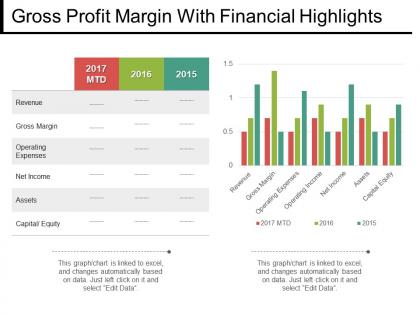
Monitor the financial health and productivity of the company by using the Gross Profit Margin With Financial Highlights presentation slide. You can discuss the process of generating revenue from the cost of products or services with the help of this financial ratio PowerPoint graphic. Use the gross margin PPT slideshow to calculate the profitability that shows the overall percentage of the monetary growth of your organization. Analyze the financial performance of the company with the aid of the profit margin PowerPoint layout. Take the assistance of net profit ratio PPT visual to determine the value of incremental sales that maximize the performance graph of the company. Employ the net margin presentation template to outline the different sources of data like balance sheet, income statement, and statement of cash flows. You can mention the points in this accounting ratio PPT theme that helps to convert non-cash assets to cash assets. You can raise the profitability of your organization by downloading our ready-to-use total comprehensive income PowerPoint slide.
People who downloaded this PowerPoint presentation also viewed the following :
Gross profit margin with financial highlights with all 5 slides:
Illustrate your expertise beyond all doubt with our Gross Profit Margin With Financial Highlights. They build greater credibility.


FAQs for Gross profit margin
So it's basically: (Revenue - Cost of Goods Sold) / Revenue × 100. Take your total sales, subtract what you actually paid to make/buy the products, divide by revenue and boom - multiply by 100 for the percentage. Say you sold $100k worth of stuff but it cost $60k to produce. That's $40k gross profit ÷ $100k = 40% margin. Just don't mix up COGS with other expenses like rent or whatever - only direct costs count. I usually check mine monthly since it helps catch when suppliers are screwing you over or if your pricing's off.
Okay so basically - gross profit margin just takes out your cost of goods sold (what it actually costs to make the thing). Net profit margin though? That's after you subtract literally everything else too - your rent, salaries, interest payments, taxes, all of it. Gross margin tells you if your actual product is profitable. Net margin shows whether your whole business makes money after paying for everything. You could honestly have amazing gross margins but still be losing money if your overhead costs are crazy high. I'd definitely track both because they tell totally different stories about how your business is doing.
Honestly, gross profit margin is like your business health check - shows how well you're turning sales into actual money before all the other expenses kick in. Track it over time and you'll catch pricing issues or cost problems before they kill you. Compare yours to what others in your industry are doing (though honestly, those benchmarks can be all over the place sometimes). If your margins suck, doesn't matter how amazing your marketing is - the whole thing falls apart. I'd look at what's changing month to month first, then figure out if your basic business model actually makes sense.
So there's basically two ways to go about this - bump up your prices or slash what it costs to make your stuff. Price increases are tricky though, you've gotta give people a real reason to pay more. Better quality, cool new features, whatever. Cost cutting is honestly way more doable. I'd start there if I were you. Hit up your suppliers and see if you can negotiate better deals. Maybe tweak how you're making things to be more efficient. Even tiny improvements in material costs add up fast. Oh, and definitely look for waste you can eliminate - that's usually low-hanging fruit.
Your margins are probably bouncing around because of cost changes - material prices going up, labor getting more expensive, that kind of thing. Pricing pressure doesn't help either; sometimes you've got to drop prices while your costs stay the same. Production efficiency makes a huge difference too. Running smoother operations = better margins, obviously. Seasonal stuff can really throw you off more than you'd think (learned that one the hard way). I'd check these numbers monthly so you can catch problems before they get worse. Way easier to fix issues early.
Dude, margins are all over the place depending on what you're doing. Grocery stores? Maybe 10% if they're lucky. Software companies though - they're basically printing money at 80%+ because copying code is free once it's built. Manufacturing usually lands around 20-30%, which honestly seems brutal to me. Service businesses do way better, like 50-70%, since there's no physical product to make. Restaurants and retail get screwed with thin margins from high costs. Don't compare yourself to random companies - compare within your industry. A 25% margin would suck for consulting but kill it for restaurants.
Look, pricing is honestly your biggest tool for boosting profit margins. Your costs stay the same, but bumping price up literally puts more money in your pocket per sale. Don't race to the bottom - I see too many people do that. Better to lose some volume than kill your margins completely. Figure out what customers will actually pay first. Calculate where you're at now, then try small increases with customers who aren't super price-sensitive. You might be surprised how much room you have. Just stay somewhat competitive and you'll be fine.
Check your competitors' 10-Ks or quarterly reports first - gross profit margins are usually right in the income statements. Industry databases like IBISWorld work too if you can get access (though they're pricey). Don't just grab anyone in your industry though. Stick to companies that actually run similar business models. Accounting differences between companies can mess with the comparisons anyway, so you want as close to apples-to-apples as possible. Pull 3-5 years of data to see the trends - that's where you'll spot if you're consistently behind or ahead of the pack.
So production efficiency is basically your secret weapon for better gross margins. You make the same stuff for less money, which means more profit per sale - pretty straightforward math there. Same selling price but lower production costs equals higher margin percentage. I'd start by figuring out where you're bleeding the most money first. Could be slow workers, tons of material waste, or machines breaking down constantly. Then just work through those problems one by one. It's way easier than messing with your pricing, honestly. Actually had a buddy do this with his shop and saw results pretty quick.
So gross profit margin shows how well a company converts sales into profit before overhead eats into it. I always look for steady or rising margins over 3-5 years - that screams good pricing power and cost management. Thin margins? Those companies get crushed when supply chains go crazy or competitors undercut them. Here's the thing though - you gotta compare apples to apples within industries. Software companies will demolish grocery stores on margins every time. Don't get hung up on one bad quarter either.
Here's the thing - gross profit margin doesn't actually show how profitable your whole business is. Just your core product before all the other expenses hit. People get obsessed with having the highest margin possible, but sometimes you're better off with lower margins if you're selling way more volume. Oh, and stop comparing yourself to random industries! Your restaurant's 15% margin isn't bad just because some tech company has 80%. That's apples to oranges. Track how your margins change over time instead. Compare against actual competitors in your space - that's what actually matters.
Seasonal swings will absolutely wreck your margin analysis if you're not smart about it. During peak season, margins look incredible because you can charge premium prices. Then slow periods hit and you're dumping inventory at discounts - suddenly everything looks terrible. Compare the same time periods year-over-year instead of quarter-to-quarter. I made this mistake before when Q4 looked fantastic, but we were just riding holiday pricing power. Rolling 12-month averages are your friend here - they smooth out all that seasonal noise so you can actually see what's happening underneath. Way better than getting fooled by timing.
So COGS and gross margin are pretty much opposites - one goes up, the other tanks. Basic math: (Revenue - COGS) ÷ Revenue. Say you're selling something for $100. COGS jumps from $40 to $60? Your margin just crashed from 60% to 40%. Ouch. You've got two moves here: bump up prices or slash those costs. I'd honestly start with the cost side first since customers hate price hikes. Look at your biggest COGS buckets and see what you can trim without making your product garbage. Sometimes there's surprisingly low-hanging fruit there.
Gross profit margins are actually pretty solid for predicting where your business is headed. When margins keep improving, you can bank on better profits even if sales growth is just okay. But declining margins? That's when you realize you'll need way more revenue to hit those same profit goals - learned that one the hard way during our last budget cycle. I'd look at your last few quarters and spot the pattern there. Use that as your starting point for next year's numbers. You can also play around with different pricing scenarios or figure out where to cut costs. The trend tells you more than any single quarter honestly.
So basically, set target margins for each product line first, then work backwards to figure out your minimum prices. Like if you're hitting 40% margin but need 50% for your goals, boom - you know exactly how much to bump prices up. Compare margins across all your products too because some might just be bringing in revenue without actually making you real money (learned that one the hard way). After you adjust prices, keep an eye on how margins change. The market will tell you pretty quick what it'll tolerate.
-
Wonderful templates design to use in business meetings.
-
Easily Understandable slides.