

Guide On Defining Roles Of Stablecoins And Central Bank Digital Currencies CBDC Complete Deck BCT CD




Try Before you Buy Download Free Sample Product
 Impress Your
 Audience
 100%
100% Editable
 Save Hours
 of Time


Get our readily accessible and professionally crafted Guide on Defining Roles of Stablecoins and Central Bank Digital Currencies CBDC PowerPoint presentation. This professionally crafted and informative deck elucidates the intricate functions of stablecoins and Central Bank Digital Currencies CBDCs in the context of the modern financial landscape. The Virtual digital assets PPT templates present a foundational understanding of stablecoins and CBDCs, establishing a solid groundwork for subsequent exploration. Furthermore, the PowerPoint presentation offers a comparative analysis of various virtual-based currencies and delves into three key trends shaping stablecoin projects. Lastly, the Digital currency PPT slides also provide insights into different types of stablecoins available for investors. Download our 100 percent editable and customizable PowerPoint, compatible with Google Slides, to streamline your presentation process.
People who downloaded this PowerPoint presentation also viewed the following :
Content of this Powerpoint Presentation
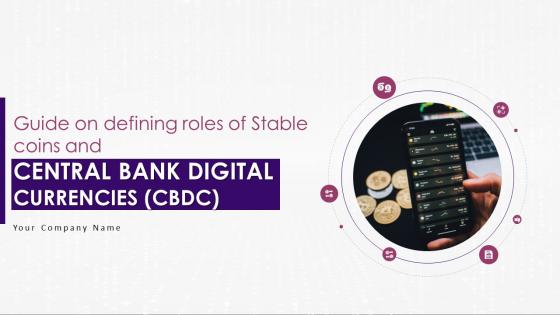
Slide 1: This slide introduces Guide on Defining Roles of Stable coins and CENTRAL BANK DIGITAL CURRENCIES (CBDC). State your company name and begin.
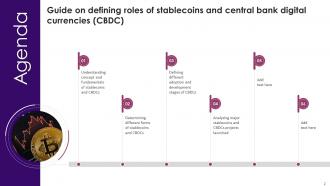
Slide 2: This is an Agenda slide. State your agendas here.
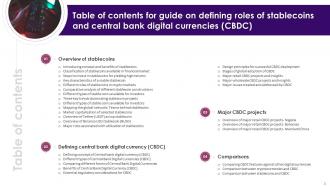
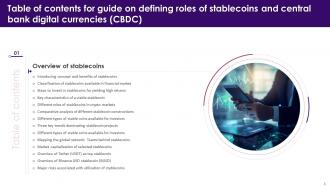
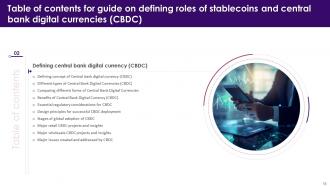
Slide 3: This slide shows Table of Content for the presentation.
Slide 4: This slide shows title for topics that are to be covered next in the template.
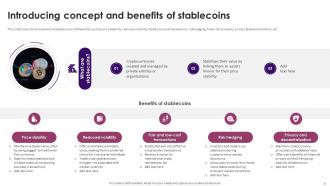
Slide 5: This slide covers brief summary of stablecoins with benefits such as price stability, reduced volatility, fast & low cost transactions, risk hedging etc.
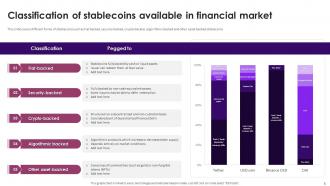
Slide 6: This slide presents different forms of stablecoins such as Fiat backed, security backed, crypto-backed, algorithmic backed and other asset backed stable coins.
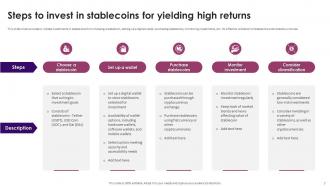
Slide 7: This slide covers process to initiate investments in stablecoins from choosing a stablecoin, setting up a digital wallet, purchasing stablecoins etc.
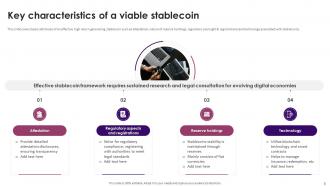
Slide 8: This slide displays basic attributes of an effective high return generating stablecoin such as attestation, nature of reserve holdings etc.
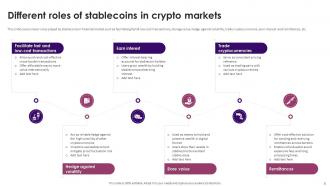
Slide 9: This slide covers major roles played by stablecoins in financial market such as facilitating fast & low cost transactions, storage value etc.
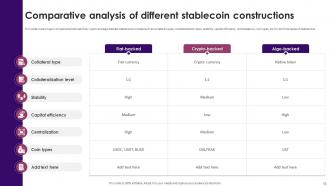
Slide 10: This slide displays major comparisons between fiat, crypto and algo backed stablecoins on basis such as collateral types, collateralization level etc.
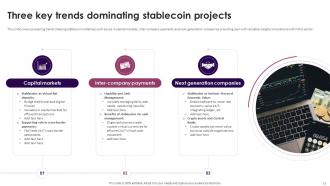
Slide 11: This slide covers prevailing trends shaping stablecoin initiatives such as use in capital markets, inter-company payments and next generation companies.
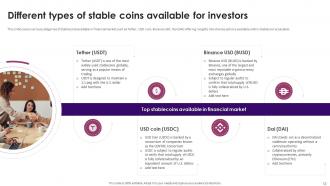
Slide 12: This slide presents various categories of stablecoins available in financial market such as Tether, USD coin, Binance USD etc.
Slide 13: This slide covers network of teams such as developers, blockchain experts, regulatory specialists contributing to development and maintenance of stablecoins worldwide.
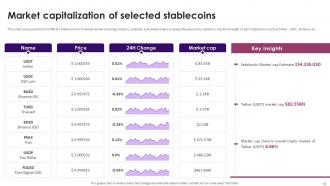
Slide 14: This slide displays positions of different stablecoins in financial market allowing investors, analysts etc.
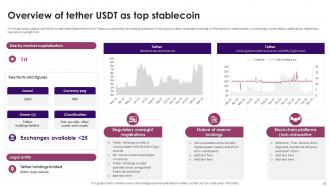
Slide 15: This slide covers insights into Tether United States Department of the Treasury.
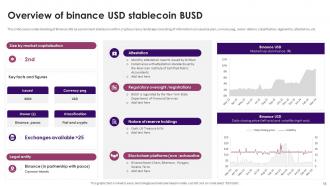
Slide 16: This slide presents understanding of Binance USD as a prominent stablecoin within cryptocurrency landscape consisting of information on issuance year etc.
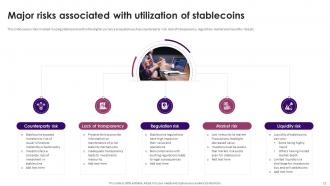
Slide 17: This slide covers risks involved in using stablecoins within the digital currency ecosystem such as counterparty risk, lack of transparency etc.
Slide 18: This slide shows title for topics that are to be covered next in the template.
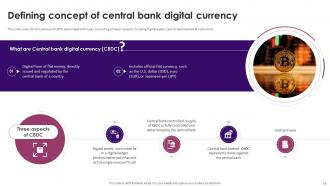
Slide 19: This slide covers brief summary of CBDC associated with types consisting of major aspects including digital assets, central bank backed & controlled.
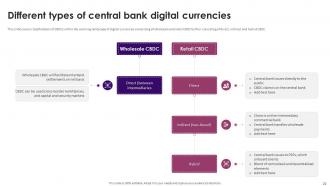
Slide 20: This slide displays classifications of CBDCs within the evolving landscape of digital currencies comprising of wholesale and retail CBDC further consisting of direct etc.
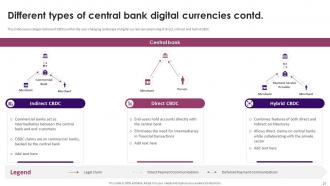
Slide 21: This slide covers categorizations of CBDCs within the ever-changing landscape of digital currencies comprising of direct, indirect and hybrid CBDC.
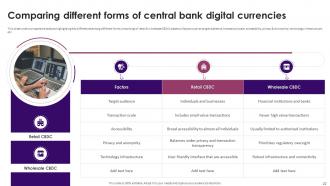
Slide 22: This slide displays comparative analysis highlighting key differences among different forms comprising of retail & wholesale CBDCs based on factors such as target audience etc.
Slide 23: This slide covers advantages associated with adoption and implementation of retail and wholesale CBDCs such as financial inclusions, reduced transaction costs etc.
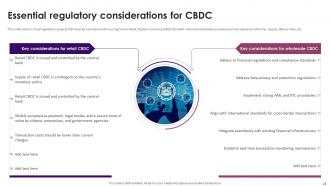
Slide 24: This slide presents critical regulatory aspects that must be considered while using Central Bank Digital Currencies (CBDC).
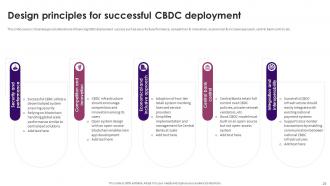
Slide 25: This slide covers critical design considerations influencing CBDC deployment success such as security & performance, competition & innovation etc.
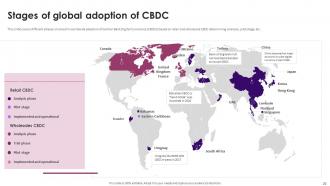
Slide 26: This slide displays different phases involved in worldwide adoption of Central Bank Digital Currencies (CBDCs).
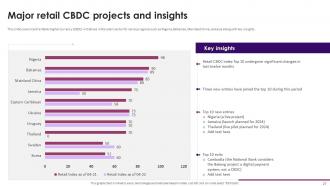
Slide 27: This slide covers Central Bank Digital Currency (CBDC) initiatives in the retail sector for various regions such as Nigeria, Bahamas, Mainland China etc.
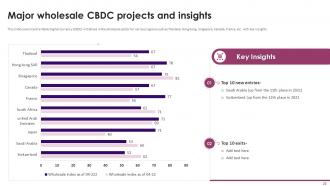
Slide 28: This slide also covers Central Bank Digital Currency (CBDC) initiatives in the wholesale sector for various regions such as Thailand, Hong Kong, Singapore, Canada etc.
Slide 29: This slide shows title for topics that are to be covered next in the template.
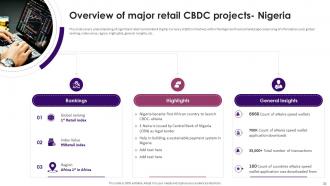
Slide 30: This slide covers understanding of significant retail Central Bank Digital Currency (CBDC) initiatives within the Nigerian financial landscape.
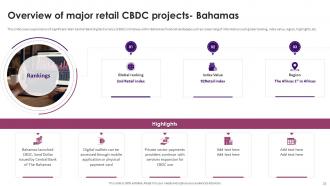
Slide 31: This slide displays exploration of significant retail Central Bank Digital Currency (CBDC) initiatives within Bahamian financial landscape.
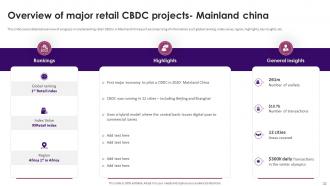
Slide 32: This slide covers detailed overview of progress in implementing retail CBDCs in Mainland China such as comprising of information such global ranking, index value etc.
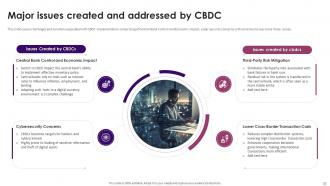
Slide 33: This slide covers challenges and solutions associated with CBDC implementation comprising of Central Bank Control and Economic Impact etc.
Slide 34: This slide shows title for topics that are to be covered next in the template.
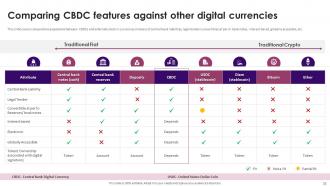
Slide 35: This slide covers comparative assessment between CBDCs and alternate electric currencies on basis of central bank liabilities and more.
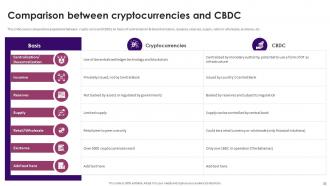
Slide 36: This slide displays a comparative assessment between crypto coins and CBDCs on basis of centralization & decentralization, issuance, reserves etc.
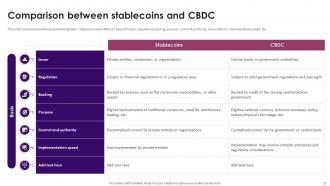
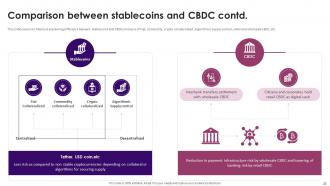
Slide 37: This slide covers comparative assessment between stablecoins and CBDCs on basis of issuer, regulations, backing, purpose, control & authority etc.
Slide 38: This slide presents architecture explaining difference between stablecoins and CBDCs on basis of Fiat, commodity, crypto collateralized etc.
Slide 39: This slide is titled as Additional Slides for moving forward.
Slide 40: This slide shows all the icons included in the presentation.
Slide 41: This slide provides 30 60 90 Days Plan with text boxes.
Slide 42: This is a Timeline slide. Show data related to time intervals here.
Slide 43: This slide shows Post It Notes for reminders and deadlines. Post your important notes here.
Slide 44: This slide contains Puzzle with related icons and text.
Slide 45: This slide depicts Venn diagram with text boxes.
Slide 46: This is an Idea Generation slide to state a new idea or highlight information, specifications etc.
Slide 47: This is a Thank You slide with address, contact numbers and email address.
Guide On Defining Roles Of Stablecoins And Central Bank Digital Currencies CBDC Complete Deck BCT CD with all 55 slides:
Use our Guide On Defining Roles Of Stablecoins And Central Bank Digital Currencies CBDC Complete Deck BCT CD to effectively help you save your valuable time. They are readymade to fit into any presentation structure.
















FAQs for Guide On Defining Roles Of Stablecoins And Central Bank Digital Currencies CBDC Complete
Stablecoins are privately-issued digital currencies pegged to stable assets like the US dollar, while CBDCs are government-issued digital versions of national currencies backed by central bank reserves. These approaches differ significantly in regulatory oversight, monetary policy control, and operational frameworks, with stablecoins enabling faster cross-border payments and CBDCs delivering enhanced financial system transparency and direct monetary policy implementation.
Stablecoins maintain their peg through collateralization with fiat reserves, algorithmic supply adjustments, over-collateralization with crypto assets, and automated market-making mechanisms that respond to price deviations. These stabilization methods enable consistent value preservation by automatically expanding or contracting supply, maintaining reserve ratios, and facilitating arbitrage opportunities, ultimately delivering reliable digital currency solutions for cross-border payments and institutional treasury management.
Stablecoins face regulatory uncertainty around reserve requirements, compliance standards, and classification issues, while CBDCs benefit from direct central bank oversight and clearer regulatory frameworks. Many financial institutions find that stablecoins present both innovation opportunities and compliance challenges, whereas CBDCs offer regulatory clarity but limited operational flexibility, ultimately creating different strategic considerations for digital payment adoption.
Stablecoins provide advantages in cross-border payments, remittances, and 24/7 transactions by eliminating intermediaries, reducing settlement times from days to minutes, and offering lower fees than traditional wire transfers. These digital assets enable financial institutions and businesses to streamline international commerce, enhance liquidity management, and deliver faster customer services, with many banks increasingly integrating stablecoin infrastructure.
CBDCs enable central banks to implement monetary policy more directly and efficiently by facilitating real-time transaction monitoring, programmable money features, and immediate policy transmission mechanisms. These digital currencies enhance financial inclusion by providing unbanked populations with direct access to central bank money through mobile devices, streamlining cross-border payments, and reducing transaction costs, ultimately delivering greater economic participation and monetary system transparency.
Stablecoins serve as crucial bridges between traditional finance and cryptocurrencies, providing price stability, liquidity infrastructure, and seamless trading pairs across digital asset markets. These digital currencies enable faster cross-border transactions, reduce volatility risks for institutional adoption, and facilitate decentralized finance applications, with many financial institutions finding that stablecoins deliver operational efficiency while maintaining regulatory compliance in increasingly digital payment landscapes.
CBDCs typically offer stronger consumer protections through government backing, regulatory oversight, deposit insurance, and legal recourse mechanisms. Stablecoins present varied protection levels depending on issuer reserves, auditing practices, and regulatory compliance, with many financial institutions finding that CBDCs deliver greater transparency and stability, while stablecoins enable faster innovation and broader accessibility across digital payment ecosystems.
CBDCs could significantly reshape stablecoin markets by offering government-backed digital currency alternatives with enhanced regulatory compliance, direct central bank oversight, and potentially lower transaction costs. While this presents competitive pressure for private stablecoins, many financial institutions find that CBDCs may coexist with stablecoins, ultimately delivering greater market legitimacy and expanded digital payment ecosystems.
Countries are approaching CBDC development through diverse strategies, with China leading through extensive digital yuan pilots, the EU exploring privacy-focused designs, and the US conducting thorough research phases. While some nations like the Bahamas have fully launched CBDCs and others pursue wholesale banking applications, most are balancing innovation with regulatory frameworks, ultimately seeking to enhance monetary policy effectiveness and financial inclusion while maintaining economic sovereignty.
Widespread stablecoin adoption presents both regulatory uncertainty and systemic financial risks, including potential bank disintermediation, reserve management challenges, and reduced monetary policy effectiveness. While offering payment efficiency and financial inclusion, stablecoins could create liquidity pressures on traditional banking systems and complicate central bank oversight, with many financial institutions finding that strategic regulatory frameworks remain essential for sustainable implementation.
Stablecoins ensure transparency through blockchain technology that records all transactions on public ledgers, while security comes from cryptographic protocols, multi-signature wallets, regular audits, and collateral backing verification. Financial institutions and payment providers leverage these features to deliver faster cross-border transactions, reduced settlement times, and enhanced regulatory compliance, ultimately enabling more efficient digital payment ecosystems.
Stablecoins enhance cross-border trade and remittances by eliminating traditional banking intermediaries, reducing transaction costs by up to 90%, and enabling near-instantaneous settlement across borders. These digital currencies streamline international payments for manufacturers, exporters, and migrant workers sending remittances, while minimizing currency volatility risks, ultimately delivering faster liquidity and significantly lower fees than conventional banking systems.
CBDCs present both enhanced transparency for regulatory oversight and significant privacy considerations for users, as central banks gain unprecedented visibility into individual transactions, spending patterns, and financial behaviors. While this enables better monetary policy implementation and financial crime prevention, many institutions are exploring programmable privacy features, tiered anonymity systems, and selective data encryption to balance regulatory compliance with user privacy rights, ultimately delivering more secure digital payment ecosystems.
Stablecoins serve as foundational infrastructure for DeFi by providing price-stable assets that enable lending, borrowing, yield farming, and automated market making without traditional banking intermediaries. Through programmable smart contracts, stablecoins facilitate seamless peer-to-peer transactions, liquidity provision, and decentralized exchanges, with many DeFi protocols finding that dollar-pegged stability ultimately delivers faster settlement and broader financial accessibility.
**INPUT**: What technological advancements are necessary for the successful implementation of CBDCs? **OUTPUT**: Successful CBDC implementation requires robust blockchain infrastructure, advanced cryptographic security protocols, scalable payment processing systems, comprehensive digital identity verification, and seamless interoperability frameworks. These technologies enable central banks to deliver faster cross-border transactions, enhanced financial inclusion, and reduced operational costs, with pilot programs in countries like China and Sweden demonstrating significant improvements in payment efficiency and monetary policy transmission. [Word count: 60 words]
-
The visual appeal of the templates is just unparalleled! I was so worried about the design of my presentation but SlideTeam made it all so easy.
-
The quality of the templates is as fine as it could get. It was a purchase well made!