

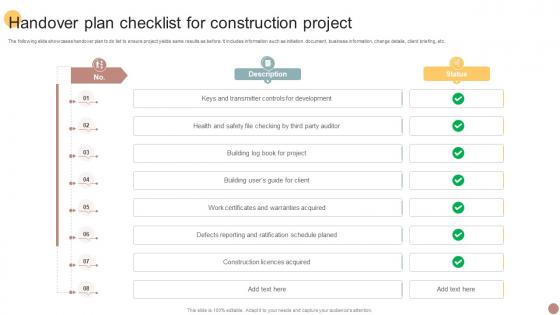
Handover Plan Checklist For Construction Project




Try Before you Buy Download Free Sample Product
 Impress Your
 Audience
 100%
100% Editable
 Save Hours
 of Time


The following slide showcases handover plan to do list to ensure project yields same results as before. It includes information such as initiation document, business information, change details, client briefing, etc.
People who downloaded this PowerPoint presentation also viewed the following :
Handover Plan Checklist For Construction Project with all 6 slides:
Use our Handover Plan Checklist For Construction Project to effectively help you save your valuable time. They are readymade to fit into any presentation structure.





FAQs for Handover Plan Checklist
Okay so you'll want to hit five main things: project status with all the deadlines, key contacts (and honestly, mention if anyone's particularly difficult to work with), your day-to-day responsibilities, where everything's saved plus passwords, and any fires that need putting out. More detail is always better - trust me on this one. The "why" behind processes matters just as much as the "what." Oh and definitely do a proper sit-down walkthrough session. Some stuff just doesn't translate well to writing, you know?
Honestly, you just need to get super specific about who gets what info and when. Map out everyone who needs updates first - that's the boring but crucial part. Then figure out your channels: email for the formal stuff, Slack for quick "hey what's this mean" questions, meetings when things get messy. The whole point is avoiding those awkward moments where someone's like "wait, I was supposed to handle that?" Set realistic deadlines too. People hate being blindsided. Once everyone knows their role and how to communicate, handovers actually work instead of turning into a disaster.
Oh man, documentation is SUCH a lifesaver when you're leaving a job. Trust me on this one - I once left without proper docs and got calls for months afterward. Super annoying for everyone involved. Start writing stuff down like two weeks before your last day, not the night before (guilty as charged lol). Focus on the practical stuff: step-by-step processes, login info, who handles what, upcoming deadlines. Your replacement will thank you for not making them decode your brain. Keep it simple though - nobody wants to read a dissertation about how the printer works. Just the essentials so they're not completely lost on day one.
Honestly, get everyone on the same platform first - Confluence or Notion work great for keeping all your project stuff searchable. Video walkthroughs are seriously underrated though, way better than trying to explain complex processes in writing. I'd also set up something like Asana to track what's done vs what's still hanging over your head. The key is having both teams collaborate during the handover instead of just dumping info and running. Oh, and make sure everyone has access to your central hub before you start - learned that one the hard way!
Obviously your boss and whoever's covering for you are must-haves. I'd also give your regular clients a heads up - nobody likes finding out their contact person bounced without warning. Then think about who else actually needs you around: IT for cutting off system access, HR for the paperwork stuff, anyone you're working on projects with. Finance too if you touch budgets at all. Honestly, the scheduling part is probably gonna be the biggest headache since getting everyone in the same room is like herding cats. Start that coordination early.
Walk through everything with your replacement and write down what could break. Missing passwords, confusing processes, key people being out - that stuff. Honestly, most handovers totally skip the "what if this goes sideways" talk, which is so dumb. Make a list of each problem you find, then figure out fixes like backup contacts or step-by-step guides. Test the important stuff together before you're gone. Don't just assume they'll figure it out - they won't, and you'll get calls later asking where things are.
Ugh, the worst thing you can do is be super vague and assume they'll just "get it" - spoiler alert, they won't. Don't info-dump everything at once either. Prioritize the critical stuff first. Oh and passwords! Can't tell you how many people forget to hand over system access (like, how are they supposed to do the job??). You want to explain the "why" behind big decisions, not just rattle off a task list. Skip the micro-managing every tiny detail though. That's exhausting for everyone. Actually sit down together instead of just emailing docs and crossing your fingers.
Quarterly reviews are the bare minimum, but honestly update them whenever someone new joins or leaves. Major process changes? Same deal. I learned this the hard way when I found handover docs mentioning Sarah who'd been gone for like 6 months lol. Performance review season is perfect timing since you're already thinking about team stuff. Just stick a calendar reminder every three months and actually follow through. Trust me, scrambling to write everything down while someone's already walking out the door is the worst. Your stressed future self will be so grateful you kept this current.
So I usually check a few things - how fast they hit their productivity milestones and whether they're actually finishing the handover checklist stuff. Those random "wait how do I..." messages in the first month? Total red flag. Time to independence is huge too - like, can they handle their tasks without bugging you every day. I'll throw in some quick knowledge checks or just ask how confident they feel about different processes. Oh and definitely get feedback from clients or whoever they're working with now. Honestly, the best sign is when weeks go by and they haven't needed to circle back to you for basic stuff.
Oh man, cultural stuff can totally derail international handovers if you're not ready for it. Time zones are the easy part - it's the communication styles that'll get you. Some places are crazy direct, others dance around problems for ages. Documentation expectations are all over the map too. What looks thorough to you might seem sloppy to them. Meeting styles, how decisions get made, even asking questions works differently everywhere. I got burned on a Japan project once because I misread all the polite silence! Always build in extra time for back-and-forth clarification. Visual stuff helps when language gets tricky, and don't assume quiet means everyone's on board.
Honestly, shadowing works best - have them watch the current process in action first. Then flip it with hands-on practice sessions where they actually do the tasks. Documentation walkthroughs are super helpful too, going through everything step by step together. Oh, and try reverse training where they explain the process back to you. Sounds weird but it catches knowledge gaps fast. Cross-training your existing people helps during the transition period too. Start this whole thing like 2-3 weeks early though - people need time to actually absorb it all, not just check boxes.
Oh man, handovers with confidential stuff are tricky. Only share what they actually need to know for the job - nothing extra. Get those NDAs signed first, obviously. I learned this the hard way when a coworker overshared and it came back to bite them later. Honestly, people get way too casual about this stuff. Don't use regular email for sensitive documents - stick to secure channels or just do it face-to-face. Encrypted platforms work too. And yeah, write down what you shared and when. Sounds boring but you'll thank yourself if questions come up down the road.
Honestly, you can't over-communicate when you're remote. Don't just send docs - hop on video calls and actually walk through stuff with screen sharing. That's where the magic happens. I'd record the tricky processes too (Loom works great) so they can go back and rewatch when they inevitably forget something. Screenshots are your friend - what makes perfect sense to you might be total gibberish to them. Oh, and block out time that first week for random questions. They'll have tons. Even quick Slack messages help. Remote handoffs just take longer than you think they will.
Definitely get feedback after every handover - from both people involved. You'd be shocked how much "obvious" stuff gets forgotten. I always ask what worked and what didn't, then jot down patterns I notice. Missing passwords and unclear docs come up constantly, honestly. Keep a running list and tweak your template maybe every few months? Each handover gets way less painful that way. The person leaving usually has great insights about what they wish they'd included. Start tracking feedback now in whatever doc works - even just bullet points help tons.
Microsoft's Project suite has some solid handover templates you should check out. Smartsheet and Template.net have free ones too. Look, I've watched people waste weeks trying to create the "perfect" template - don't be that person. A simple one works just as well. You need sections for responsibilities, ongoing tasks, contacts, passwords, and where projects stand. Actually, you could probably just tweak whatever project docs your company already uses. Start basic and add stuff as you figure out what's missing. Way less painful than starting from nothing.
-
The Designed Graphic are very professional and classic.
-
Commendable slides with attractive designs. Extremely pleased with the fact that they are easy to modify. Great work!