


Nine Key Elements Of Project Planning




Try Before you Buy Download Free Sample Product
 Impress Your
 Audience
 100%
100% Editable
 Save Hours
 of Time


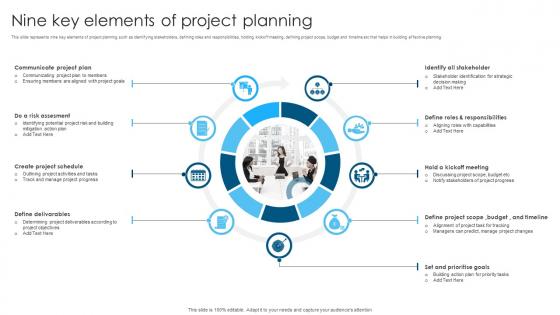
This slide represents nine key elements of project planning such as identifying stakeholders, defining roles and responsibilities, holding kickoff meeting, defining project scope, budget and timeline etc that helps in building effective planning.
People who downloaded this PowerPoint presentation also viewed the following :
Nine Key Elements Of Project Planning with all 6 slides:
Use our Nine Key Elements Of Project Planning to effectively help you save your valuable time. They are readymade to fit into any presentation structure.





FAQs for Nine Key Elements
Key elements for creating a project plan include defining clear objectives, establishing realistic timelines, allocating resources effectively, identifying potential risks, and setting measurable milestones. These components work together by ensuring stakeholder alignment, enabling proactive problem-solving, and facilitating progress tracking, with many organizations finding that comprehensive planning ultimately delivers faster project completion and improved resource efficiency.
Project planning templates enhance team collaboration and communication by standardizing workflows, centralizing information sharing, and establishing clear accountability frameworks across all project phases. These structured tools enable teams to coordinate tasks seamlessly, track progress transparently, and maintain consistent messaging, with many organizations finding that templates reduce miscommunication by up to 40% while accelerating project delivery timelines.
Effective project timeline estimation techniques include historical data analysis, expert judgment, three-point estimation, work breakdown structures, and parametric modeling. These methods enhance accuracy by incorporating past performance metrics, stakeholder insights, and risk considerations, with many project managers finding that combining multiple approaches delivers more realistic schedules and improved resource allocation.
Effective project planning balances flexibility and structure through adaptive frameworks, regular milestone reviews, buffer time allocation, stakeholder feedback loops, and contingency planning protocols. This strategic combination enables organizations to maintain project direction while accommodating changing requirements, with many teams finding that structured flexibility ultimately delivers faster outcomes and enhanced stakeholder satisfaction.
Risk assessment integrates into project planning through systematic risk identification, probability analysis, impact evaluation, contingency planning, and continuous monitoring throughout project phases. This strategic approach enables project managers to proactively address potential bottlenecks, resource constraints, and timeline disruptions, ultimately delivering improved project success rates and stakeholder confidence.
Stakeholder expectations significantly influence project scope, timeline, and resource allocation, often determining project success or failure through their alignment with realistic deliverables. Effective management involves early identification, regular communication, transparent progress updates, and proactive expectation setting, with many organizations finding that structured stakeholder engagement frameworks reduce scope creep while enhancing project buy-in and ultimate satisfaction.
Gantt charts and visualization tools enhance project planning by providing clear timeline visibility, identifying task dependencies, enabling resource allocation tracking, and facilitating team coordination. These visual frameworks streamline complex project management through real-time progress monitoring and bottleneck identification, with many organizations finding that enhanced transparency ultimately delivers faster project completion and improved stakeholder communication.
Task prioritization strategies include the Eisenhower Matrix, MoSCoW method, value-based scoring, dependency mapping, and critical path analysis. These approaches streamline project execution by identifying high-impact activities, managing resource constraints, and aligning deliverables with business objectives, with many project managers finding that strategic prioritization ultimately delivers faster timelines and improved stakeholder satisfaction.
Agile project planning emphasizes iterative development, flexible timelines, and continuous stakeholder feedback, while traditional methodologies follow sequential phases with fixed schedules and detailed upfront documentation. Through shorter sprint cycles and adaptive frameworks, organizations in software development, product design, and digital marketing deliver faster time-to-market, enhanced customer satisfaction, and improved responsiveness to changing requirements.
**INPUT**: What tools or software are recommended for creating and managing project plans? **OUTPUT**: Recommended project planning tools include Microsoft Project, Asana, Trello, Monday.com, Smartsheet, and Gantt chart software like TeamGantt. These platforms streamline project management by enabling task scheduling, resource allocation, and progress tracking, with many organizations finding that integrated dashboards and collaboration features significantly enhance team coordination and ultimately deliver faster project completion.
Ensuring project plan alignment requires establishing clear connections between project deliverables and strategic business objectives, conducting stakeholder consultations with leadership teams, and implementing regular review checkpoints throughout project phases. Through systematic goal mapping and milestone tracking, organizations streamline resource allocation, enhance operational efficiency, and deliver measurable outcomes that support long-term growth, with many finding that structured alignment processes ultimately accelerate project success rates.
Common project planning pitfalls include unrealistic timelines, insufficient resource allocation, poor stakeholder communication, inadequate risk assessment, and scope creep management failures. These challenges can be avoided by conducting thorough feasibility studies, implementing robust change control processes, and establishing clear communication protocols, with many organizations finding that comprehensive planning frameworks ultimately deliver improved project success rates and operational efficiency.
Project plans should be reviewed weekly for tactical adjustments and monthly for strategic assessments, with major updates triggered by scope changes, resource shifts, or milestone completions. Through regular review cycles, project managers can identify potential risks early, reallocate resources effectively, and maintain stakeholder alignment, ultimately delivering projects on time and within budget while adapting to evolving business requirements.
Best practices for documenting project changes include maintaining a formal change log, recording rationale and impact assessments, updating version control systems, communicating modifications to stakeholders, and establishing approval workflows. These documentation methods streamline project management by ensuring transparency, maintaining historical records, and facilitating stakeholder alignment, with many organizations finding that systematic change tracking ultimately delivers improved project outcomes and enhanced team coordination.
Project success measurement begins with establishing clear, quantifiable metrics during initial planning, including timeline adherence, budget compliance, scope delivery, and stakeholder satisfaction benchmarks. These early-defined indicators enable project managers to track progress systematically throughout execution phases, with many organizations finding that well-structured initial metrics ultimately deliver more accurate performance assessments and strategic insights for future project optimization.
-
“Immediate response, professional support, and effective solutions that were customized and immediately provided. Well done- Thank you!”
-
Mesmerized with the fantastic collection! Super sleek, relevant infographics.