

Macro Planning With Project Activities List




Try Before you Buy Download Free Sample Product
 Impress Your
 Audience
 100%
100% Editable
 Save Hours
 of Time


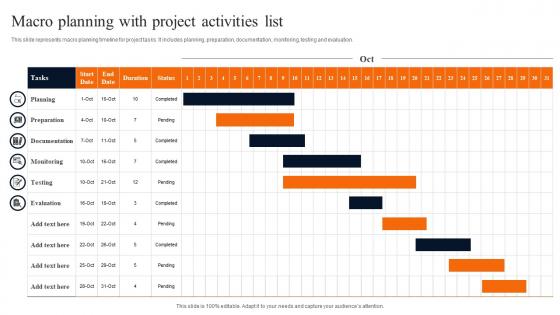
This slide represents macro planning timeline for project tasks. It includes planning, preparation, documentation, monitoring, testing and evaluation.
People who downloaded this PowerPoint presentation also viewed the following :
Macro Planning With Project Activities List with all 6 slides:
Use our Macro Planning With Project Activities List to effectively help you save your valuable time. They are readymade to fit into any presentation structure.





FAQs for Macro Planning With
Start with your major phases and work backward from the end goal - that's honestly the easiest way to wrap your head around it. You'll need clear timelines, realistic milestones, and a good sense of what resources you're working with. Scope definition is huge too. Build in some buffer time because trust me, stuff will go wrong (it always does). Make sure everyone's on the same page about what success actually looks like. Oh, and don't get too granular - stay high-level enough that you're not micromanaging every little task. Communication channels matter more than people think.
So you take your company's big goals and break them down into what each department should actually be doing. Start with the main objectives, then figure out how marketing, operations, etc. can hit specific targets that feed into those bigger wins. Honestly, it's pretty satisfying when everyone finally gets how their work connects - like marketing sees exactly how their campaigns tie to revenue, operations knows their part in keeping customers happy. We tried mapping one major goal to just 2-3 department targets last quarter and it actually worked. No more people working in random directions, you know?
Start with scenario planning - that 2x2 matrix thing really works for mapping out different futures. SWOT's okay for basics but feels kinda old school now. The stuff that actually moves the needle? Systems mapping and Three Horizons framework. They show how your current projects tie into bigger transformation goals down the road. Porter's Five Forces is clutch for competitive analysis too. Honestly though, scenario planning should be your first move since you can't plan effectively if you don't know what you're planning for. Oh, and don't sleep on systems mapping - it's been huge for our team lately.
So macro planning is basically your big picture stuff - quarterly goals, major projects, where you're headed overall. Micro gets into the nitty-gritty daily tasks and exact deadlines. Think of macro as the "what" and "why" behind your long-term goals. Micro handles the "how" and "when" for day-to-day execution. It's kinda like planning a road trip - macro picks your destination, micro figures out every gas station along the way. Both matter, but honestly I'd start with macro first so you don't get stuck obsessing over tiny details that might not even matter for your bigger goals.
Ugh, the worst mistake is diving straight into weekly details when you should be thinking big picture first - like months or quarters. Dependencies will absolutely kill you too. I swear everything takes twice as long because of approvals and people passing things back and forth. Buffer time is your best friend here. Also, don't plan in a vacuum! Get the actual people doing the work involved, otherwise your timeline looks pretty but is totally useless. My rule: start broad, pad everything, then check with your team before you promise anything to leadership.
So you know how you stare at spreadsheets and just... miss stuff? Analytics catches all those patterns you'd never spot manually. Seasonal trends, which factors actually matter for your outcomes - that kind of thing. The predictive modeling is genuinely fascinating once you dive in (probably spent way too much time on that last quarter). You can test your big-picture plans against different scenarios before they blow up in real life. Short version: figure out your biggest planning assumptions first, then dig into whatever historical data you've got to see if they hold water.
Look, you absolutely need everyone on board before you start planning anything big. I've watched so many solid plans completely crash because nobody bothered talking to finance or ops until it was too late. Map out who matters first - like, before you even touch a spreadsheet. Getting their input early means you can actually build their concerns into your assumptions instead of scrambling later. Without that buy-in, you're just making pretty documents that'll collect dust. Trust me on this one - stakeholder engagement isn't optional if you want your macro plan to actually work.
Honestly, macro planning is a game changer - you get this overview of everything happening at once instead of juggling projects separately. You'll spot when one team is drowning while another has nothing to do, or when you've accidentally promised the same expert to three different projects (been there). Think of it like... I dunno, having a dashboard for your whole operation? Way better than just responding to whoever complains the loudest. You can actually move people and money around based on what matters most. Try putting all your current stuff on one big timeline - even if it's messy at first, you'll see the patterns immediately.
Schedule check-ins monthly (though some teams do quarterly - depends on your project really). Track your main metrics against what you originally expected and watch for big changes, not tiny day-to-day stuff. Being honest about real changes vs normal ups and downs is harder than it sounds, trust me. Write down what you learn each time so you're not starting from scratch later. Oh, and don't cling to a crappy plan just because it was your original idea. I've seen teams do this way too much. If the data's screaming that something isn't working, just pivot already.
Honestly, macro planning is your best friend for risk management. You get that bird's eye view where you can actually see trouble coming before it hits. Map out your big milestones first, then ask yourself "what could totally derail this?" for each one. That way you're building backup plans into your timeline and budget from day one instead of panicking later. Dependencies and bottlenecks become way more obvious when you're looking at the whole picture. I learned this the hard way on a project last year - would've saved me so much stress if I'd done this upfront.
Honestly, start with listening sessions before you draft anything - that's huge. Don't assume you know what communities need (learned this the hard way). Get diverse voices involved from day one, not just the regulars who always show up. Think about whether you might accidentally screw over vulnerable groups or push people out. Oh, and make sure resources actually get distributed fairly - sounds obvious but tons of projects mess this up. Community consent isn't just a checkbox thing either. Really dig into long-term impacts because good intentions don't automatically equal good outcomes.
Honestly, the best thing you can do is get tools that automate all that data collection stuff so you're not constantly bugging people for updates. Project management dashboards will pull metrics automatically, and planning software lets you run different scenarios super quickly. Collaboration platforms are a lifesaver too - no more drowning in email threads. But here's the thing that actually matters: make sure whatever tools you pick can talk to each other. I've seen people create even worse messes by trying to connect like five different systems. Just start with one solid integrated platform and you'll thank yourself later.
So you'll need both the "what happened" metrics and the "how are we doing" ones. Revenue growth, market share, customer acquisition costs - that's your results stuff. Then track things like how well you're sticking to the plan and hitting milestones. Oh, and definitely measure if everyone's actually aligned. I swear, I've watched solid strategies completely bomb because people weren't talking to each other. Set up quarterly check-ins so you can change course when needed. Pick maybe 3-5 metrics that actually connect to your big goals and build everything around those.
You gotta actually plan for innovation instead of hoping it'll just happen. I learned this the hard way - without dedicated time and budget, creative projects always get pushed aside for "urgent" stuff. Block out specific months in your calendar where innovation is the main focus. Set aside real money for R&D and give your team permission to experiment. Honestly, most companies talk about innovation but never create the structure for it. It's kinda like working out - sounds great in theory, but you won't do it unless it's scheduled. Quarter three is usually good timing for this stuff.
Dude, you've gotta build cultural stuff into your timeline from day one. Some places won't even talk business until you've had like three coffee meetings - I learned that the hard way in Brazil. Religious holidays will mess up your schedule if you don't research them early. Different cultures make decisions totally differently too. Americans want quick calls, but other places need consensus meetings that take forever. Honestly, just add buffer time everywhere and study their business norms before you even start planning. It'll save you so much stress later.
-
Based on my personal experience, I would recommend other people to subscribe to SlideTeam. No one can be disappointed here!
-
Great work on designing the presentation. I just loved it!