Project Planning Monitoring And Evaluation Lifecycle
Try Before you Buy Download Free Sample Product
Audience
Editable
of Time
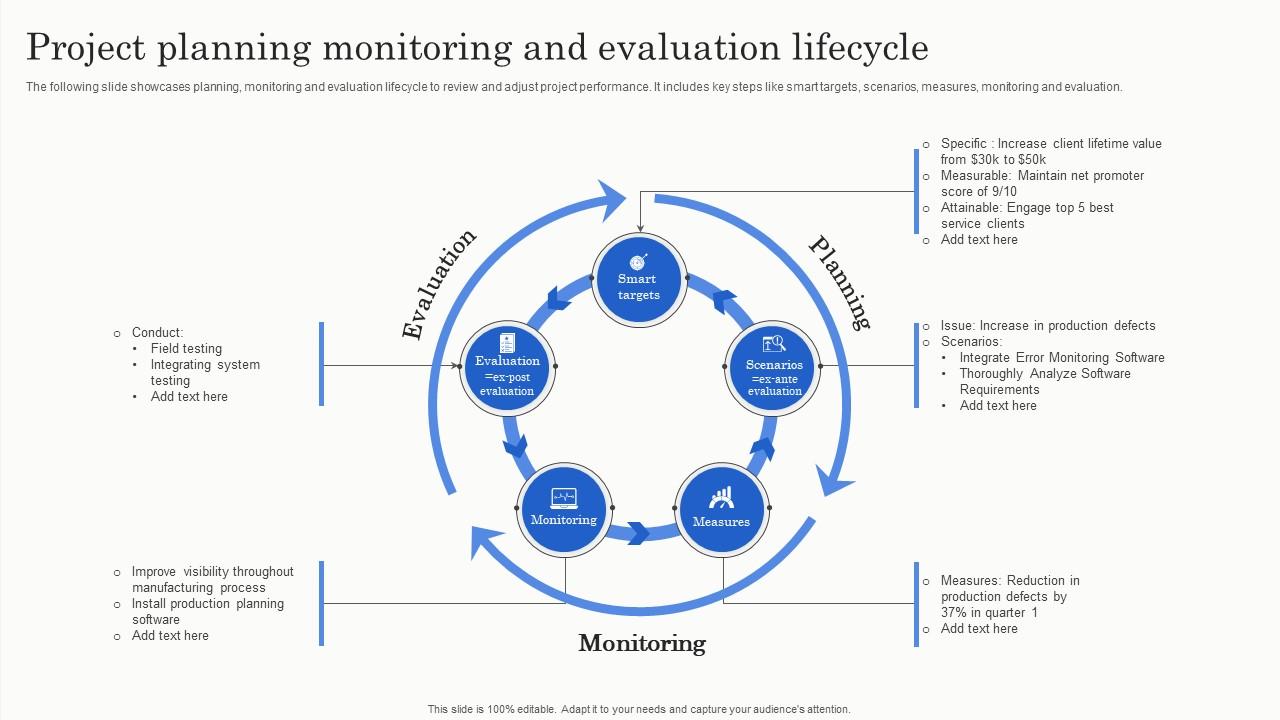
The following slide showcases planning, monitoring and evaluation lifecycle to review and adjust project performance. It includes key steps like smart targets, scenarios, measures, monitoring and evaluation.
People who downloaded this PowerPoint presentation also viewed the following :
Project Planning Monitoring And Evaluation Lifecycle with all 6 slides:
Use our Project Planning Monitoring And Evaluation Lifecycle to effectively help you save your valuable time. They are readymade to fit into any presentation structure.
FAQs for Project Planning Monitoring
The key phases include initiation, planning, execution, monitoring, and closure, each serving critical functions in project success. These phases streamline project delivery by establishing clear objectives, defining resource allocation, coordinating team activities, and tracking progress, with many organizations finding that structured lifecycle management reduces costs, minimizes risks, and ultimately delivers better outcomes.
Agile methodologies enhance project flexibility by enabling iterative development, continuous feedback loops, adaptive planning, cross-functional collaboration, and rapid response to changing requirements. Through short sprints and regular stakeholder reviews, organizations streamline decision-making, minimize project risks, and accelerate delivery timelines, with many companies finding that Agile ultimately delivers better customer satisfaction and competitive market responsiveness.
Stakeholder management ensures project alignment by identifying key stakeholders, understanding their expectations, maintaining regular communication, and addressing concerns proactively throughout the project lifecycle. Effective stakeholder engagement minimizes resistance, secures necessary resources, and builds support for project decisions, with many organizations finding that strong stakeholder relationships ultimately deliver smoother implementations and higher success rates.
Effective project success measurement includes stakeholder satisfaction, budget adherence, quality deliverables, team performance metrics, and long-term business impact assessment. These comprehensive evaluation methods enable organizations to streamline future project planning, enhance resource allocation, and deliver sustained competitive advantage, with many companies finding that multi-dimensional success tracking ultimately improves overall operational efficiency and client relationships.
Project risk management techniques include risk registers, SWOT analysis, brainstorming sessions, expert interviews, and scenario planning. These approaches enable project managers to proactively identify potential issues, assess their impact and likelihood, and develop mitigation strategies, with many organizations finding that systematic risk assessment reduces project delays and cost overruns significantly.
Project managers can leverage technology through cloud-based platforms, real-time messaging tools, video conferencing, collaborative document editing, and automated progress tracking systems. These technologies streamline workflows by centralizing communications, enabling instant updates, and providing transparent project visibility, with many organizations finding that integrated platforms reduce meeting times while enhancing team coordination and ultimately delivering faster project completion.
Resource allocation best practices include accurate demand forecasting, skill-based assignment matching, capacity planning with buffer considerations, regular workload balancing, and transparent priority frameworks. These approaches streamline project delivery by minimizing bottlenecks, optimizing team utilization, and ensuring critical path activities receive adequate support, with many organizations finding that strategic resource planning ultimately delivers faster project completion and improved team productivity.
The choice of project management methodology significantly shapes team dynamics by determining communication patterns, decision-making processes, collaboration structures, and accountability frameworks within organizations. Agile methodologies foster cross-functional teamwork and rapid adaptation, while traditional approaches like Waterfall provide clear hierarchies and defined roles, with many teams finding that aligning methodology with project complexity and team preferences ultimately enhances performance and delivery outcomes.
Common challenges in remote project management include communication barriers, time zone coordination difficulties, reduced team visibility, technology integration issues, and maintaining accountability across distributed teams. These obstacles can be overcome by implementing robust communication platforms, establishing clear protocols and regular check-ins, utilizing comprehensive project tracking tools, and fostering strong team culture through virtual collaboration practices, ultimately delivering enhanced productivity and seamless project execution.
Project managers ensure continuous improvement by implementing regular retrospectives, collecting stakeholder feedback, tracking performance metrics, conducting post-project reviews, and fostering team learning sessions. Through data-driven analysis and iterative refinement, organizations streamline workflows, enhance resource allocation, and deliver superior project outcomes, with many finding that systematic improvement processes ultimately reduce costs and accelerate delivery timelines.
Effective strategies for managing scope creep include establishing clear project boundaries, implementing formal change control processes, maintaining regular stakeholder communication, documenting all requirements thoroughly, and conducting frequent scope reviews. These approaches streamline project delivery by preventing unauthorized changes, ensuring budget adherence, and maintaining timeline integrity, with many organizations finding that proactive scope management ultimately delivers improved client satisfaction and enhanced operational efficiency.
Team diversity significantly drives innovation by bringing varied perspectives, experiences, cultural backgrounds, skill sets, and problem-solving approaches that spark creative solutions and challenge conventional thinking. Organizations across sectors like technology, healthcare, and financial services find that diverse project teams generate more breakthrough ideas, identify potential risks earlier, and develop comprehensive strategies that appeal to broader markets, ultimately delivering competitive advantage and enhanced project outcomes.
**INPUT**: What metrics should be employed to track project performance and progress? **OUTPUT**: Essential project performance metrics include schedule variance, budget adherence, scope completion, resource utilization, and quality indicators like defect rates. These metrics enable project managers to identify bottlenecks, optimize resource allocation, and maintain stakeholder alignment, with many organizations finding that combining leading and lagging indicators ultimately delivers greater project success rates and strategic outcomes. **Word Count: 56**
Effective time management techniques can be implemented through detailed work breakdown structures, realistic timeline estimation, resource allocation planning, milestone tracking, and buffer time integration. These approaches streamline project workflows by identifying critical paths, preventing bottlenecks, and enabling proactive adjustments, with many organizations finding that structured time management reduces project delays and enhances overall delivery efficiency.
Client feedback can be integrated through regular check-ins, milestone reviews, collaborative platforms, iterative prototyping, and structured feedback loops at each project phase. These approaches streamline communication, minimize costly revisions, and enhance project alignment, with many organizations finding that continuous client engagement ultimately delivers faster approvals, improved outcomes, and stronger long-term partnerships.
-
Thank you SlideTeam for such an excellent service.
-
You know what? I'm so glad I opted for this PPT design. It has been a total game-changer for me and my presentations. Thank you!Â