Planning Monitoring And Evaluation Process Framework
Try Before you Buy Download Free Sample Product
Audience
Editable
of Time
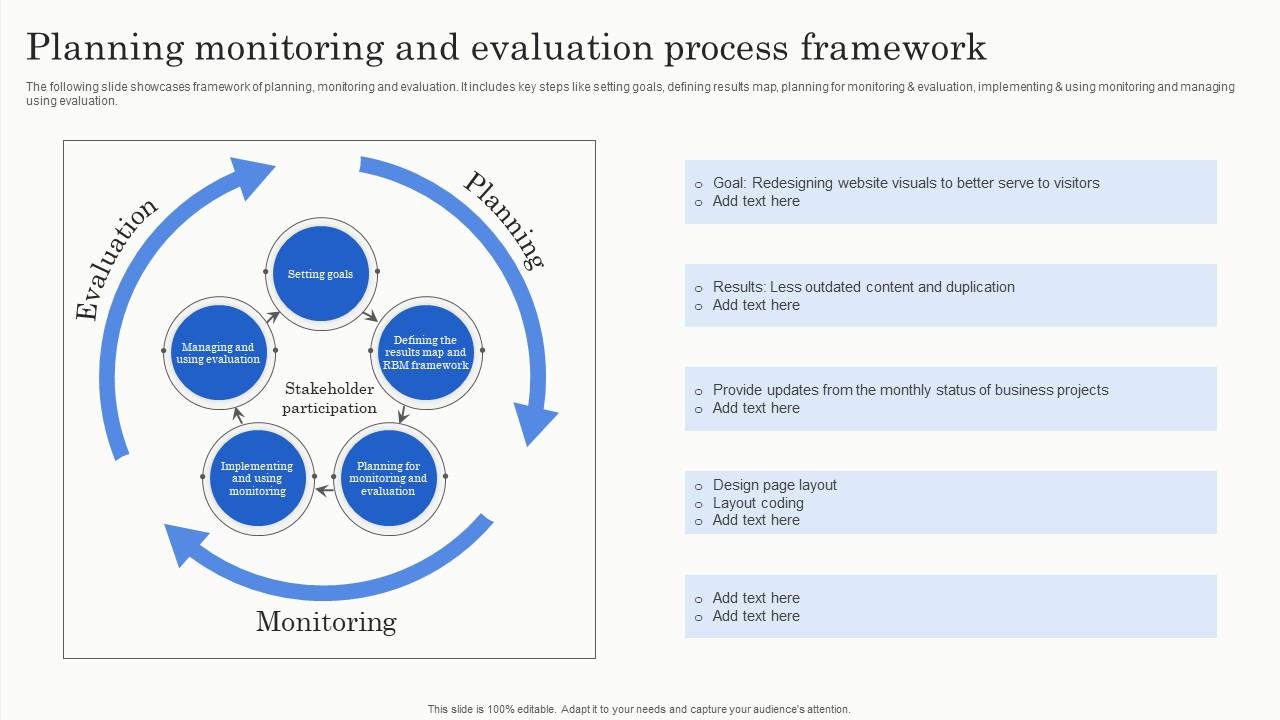
The following slide showcases framework of planning, monitoring and evaluation. It includes key steps like setting goals, defining results map, planning for monitoring and evaluation, implementing and using monitoring and managing using evaluation.
People who downloaded this PowerPoint presentation also viewed the following :
Planning Monitoring And Evaluation Process Framework with all 6 slides:
Use our Planning Monitoring And Evaluation Process Framework to effectively help you save your valuable time. They are readymade to fit into any presentation structure.
FAQs for Planning Monitoring And
So PME breaks down into three parts - Planning, Monitoring, and Evaluation. You start with planning where you figure out your goals and how you'll get there. Monitoring is the ongoing stuff, tracking progress and spotting problems early (though honestly most people slack off here). Then evaluation happens at the end - did you actually achieve what you wanted? What was the real impact? It's basically one big feedback loop where each piece feeds into the others. Oh, and definitely get your planning solid first since everything else depends on it.
PME Framework breaks down into Planning, Monitoring, and Evaluation - pretty straightforward. Basically gives you clear checkpoints so you're not constantly wondering what comes next. The monitoring part is clutch because you'll spot problems while they're still fixable instead of when they've blown up your budget. I've seen too many projects where people skip the evaluation step, which is honestly a waste since that's where you actually learn what worked. Oh, and it stops those awkward meetings where everyone's like "wait, what exactly are we delivering again?" Try mapping your current project to see where you're missing structure.
You know how some problems just feel impossible to wrap your head around? That's when PME really helps. Use it for messy stuff like project planning or when your team's going in circles on strategy. Works great when everyone has different opinions and you need to get on the same page. Breaking huge challenges into bite-sized pieces is honestly where it shines most. Next time something feels overwhelming, just start with P and go step by step. I've found it's a lifesaver for process improvement too - probably because it forces you to actually think things through instead of just winging it.
PME doesn't replace what you're already doing - it just sits on top of it. Already using Agile or Waterfall? Cool, keep doing that. PME adds a monitoring layer around your existing stuff. It's basically like adding analytics to see how things are actually going (which honestly most teams need anyway). Map PME's three phases to whatever milestones you've got now. Planning, Monitoring, Evaluation - find where those naturally fit. Start by figuring out where you'd collect the data PME wants. Don't overthink it.
Yeah, PME can be annoying at first - feels super rigid when you just want to get stuff done quickly. Getting your whole team to actually use it properly? That's the real headache honestly. For simple problems it's probably overkill and will just slow everyone down. But here's the thing - once people get used to it, most of these problems disappear. I'd test it on one project first instead of forcing it everywhere. Oh and make sure it's actually worth the effort for what you're working on, because sometimes you don't need all that structure.
Yeah totally! The PME Framework works across pretty much any industry - healthcare, manufacturing, tech, you name it. Most teams I know start with the basic version then tweak the metrics and evaluation stuff to match their specific needs. Like if you're in healthcare you'd probably need to adjust things for all those regulatory requirements. The core structure stays the same though, which is nice. Honestly I'd just start with the standard setup first, see how it feels, then figure out what needs changing based on your actual day-to-day workflow. Way easier than trying to customize everything upfront.
So the PME Framework actually bakes stakeholder engagement right into every phase, which is pretty smart. Map out your key people during planning first. Then keep them involved throughout your monitoring and evaluation work - don't just collect data by yourself in a corner somewhere. What I really like about this approach is how stakeholders help define what success looks like and then interpret the results with you. Way better than other frameworks I've messed with. Oh, and pro tip: identify your primary and secondary stakeholders early on, then set up regular check-ins instead of scrambling for their input last minute.
So for PME success, track three main things: performance stuff like completion rates and quality scores, how engaged people actually are (participation + feedback), and whether it's hitting business goals/ROI. Here's what nobody talks about though - engagement is honestly the make-or-break factor. People not buying in? Your other numbers become pretty meaningless. Don't just measure at the end either, that's way too late. Set your baselines early so you can see what's actually working and pivot when needed. Makes such a difference when you're tracking throughout instead of scrambling later.
PME works pretty well with agile, actually. It splits things into portfolio, program, and project levels without getting in the way of your sprints. Portfolio stuff keeps everyone aligned on the big picture. Programs handle those annoying cross-team dependencies that always pop up. Projects are where the actual sprint work happens. You can run agile ceremonies at each level too, which is nice. I'd probably start with quarterly portfolio reviews and some kind of increment planning at the program level - see how it fits with what you're already doing. Way better than most frameworks that seem designed to kill agility.
Honestly, PME Framework is pretty solid for catching risks before they bite you. You've got three phases - Planning lets you spot potential problems early and figure out how to handle them. Monitoring is where you actually watch for warning signs that stuff's about to hit the fan. Then Evaluation helps you see which risks showed up and whether your fixes worked. Think of it like having early warning sensors throughout your project. Pro tip: use those built-in checkpoints to update your risk list - don't just set it and forget it.
Honestly, there's so many good tools out there for PME work. I'd start with project management stuff like Asana or Monday.com - super helpful for tracking all your monitoring tasks and deadlines. For presenting data, Tableau's amazing but even Excel works if you're not getting too fancy with it. SurveyMonkey is clutch for getting stakeholder feedback (I literally use it for everything). If you're doing heavy data analysis, R or SPSS are solid choices. Google Workspace works great for sharing reports and collaborating. Oh, and SharePoint too if your org is into Microsoft. My advice? Just start with whatever your team already knows and expand from there.
Honestly, communication rhythms are everything here. During the Plan phase, schedule regular check-ins. Make phase needs structured feedback loops - I've watched teams completely fall apart when they skip these updates (seriously, it gets ugly fast). For Evaluate, set up proper reflection sessions. Oh, and shared docs are clutch so everyone can track decisions in real-time. Don't just bolt communication onto the framework afterward - it should feel natural. Assign someone to own the conversations for each phase. They'll drive discussions and keep people aligned. Short version: someone's gotta be responsible for making sure everyone's actually talking to each other.
Honestly? Most people try tracking like 15 different things right off the bat and just get overwhelmed by all the numbers. Pick 2-3 metrics that actually connect to what you're trying to accomplish - not just stuff that's easy to measure. Also, I know it sounds super boring, but figure out your baseline first. Otherwise you're gonna be kicking yourself later when you can't prove anything worked. Teams love picking flashy metrics that look good in reports but don't mean much. Don't be those people. Start simple, nail down where you're starting from, then add more later. Way less stressful than trying to piece everything together months down the road.
So PME is pretty smart because it forces you to keep improving instead of just winging it. During monitoring, you're grabbing data constantly. Then evaluation helps you figure out what actually worked before you plan the next round. Think of it like built-in reality checks - you can't just plow ahead without stopping to ask "okay, what's broken here?" Each cycle becomes this mini-experiment where you test stuff, learn from the mess-ups (and wins), then adjust. Honestly, it beats the old "set it and forget it" approach most people use.
Dude, you absolutely need leadership buy-in for PME to work. I can't stress this enough - without champions at every level, you're basically dead in the water. Teams won't get the resources they need, stakeholders won't align, and honestly? The whole thing just fizzles out when challenges hit. Train your leadership team on PME principles first, then roll it down through the organization. Leaders have to actually walk the walk - model behaviors, communicate the vision clearly, give teams decision-making power. I've watched so many frameworks crash because leadership saw them as "nice to have" instead of strategic must-dos.
-
They saved me a lot of time because they had exactly what I was looking for. Couldn’t be happier!
-
Great templates that you can use in your next keynote or conference. They are perfect for quick and visually-engaging delivery.Â