


Hazard Identification And Evaluation Workplace Safety To Prevent Industrial Hazards




Try Before you Buy Download Free Sample Product
 Impress Your
 Audience
 100%
100% Editable
 Save Hours
 of Time


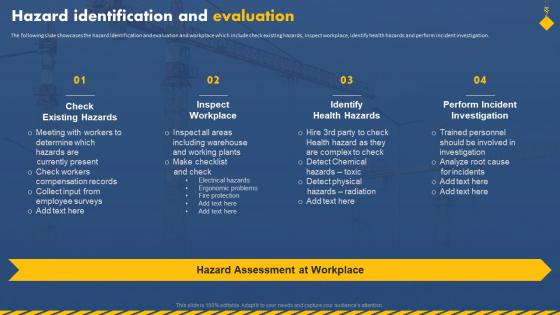
The following slide showcases the hazard identification and evaluation and workplace which include check existing hazards, inspect workplace, identify health hazards and perform incident investigation.
People who downloaded this PowerPoint presentation also viewed the following :
Hazard Identification And Evaluation Workplace Safety To Prevent Industrial Hazards with all 6 slides:
Use our Hazard Identification And Evaluation Workplace Safety To Prevent Industrial Hazards to effectively help you save your valuable time. They are readymade to fit into any presentation structure.





FAQs for Hazard Identification And Evaluation Workplace Safety To
Key components of an effective industrial safety program include hazard identification and risk assessment, comprehensive employee training, safety equipment and protective gear, incident reporting systems, and regular safety audits. These elements work together by creating preventive measures, ensuring regulatory compliance, and fostering safety culture, with many manufacturing and construction companies finding that integrated programs significantly reduce workplace accidents and operational costs.
**INPUT**: How do regulatory standards like OSHA impact industrial safety practices? **OUTPUT**: OSHA standards significantly enhance industrial safety by establishing mandatory protocols, requiring comprehensive training programs, and enforcing regular workplace inspections across all sectors. These regulations streamline safety compliance while driving operational efficiency, with manufacturing, construction, and chemical industries finding that adherence ultimately reduces accident rates, minimizes liability costs, and delivers competitive advantage through improved worker confidence. [Word count: 56 words]
Employee training serves as the foundation of effective workplace safety by building hazard awareness, teaching proper equipment usage, establishing emergency protocols, and reinforcing safety culture throughout organizations. Through comprehensive training programs, companies across manufacturing, construction, and chemical industries significantly reduce accident rates, minimize compliance violations, and enhance operational efficiency, with many organizations finding that well-trained employees become proactive safety advocates who identify risks before incidents occur.
Organizations effectively communicate safety policies through multi-channel approaches including visual displays, regular training sessions, digital platforms, team meetings, and interactive workshops. These methods enhance understanding by combining written guidelines with hands-on demonstrations and peer discussions, with many manufacturing and construction companies finding that consistent, varied communication ultimately delivers better compliance rates and significantly reduces workplace incidents.
Common industrial hazards include chemical exposures, machinery accidents, falls from heights, electrical dangers, and fire risks. These hazards vary significantly across sectors, with manufacturing facilities facing machinery-related injuries, chemical plants dealing with toxic exposures, and construction sites managing fall risks, ultimately requiring comprehensive safety protocols to minimize workplace incidents and ensure operational continuity.
Risk assessments help identify potential safety issues by systematically evaluating workplace hazards, analyzing worker exposure levels, reviewing historical incident data, and examining equipment conditions and operational procedures. Through comprehensive risk mapping, organizations can proactively address dangers in manufacturing plants, construction sites, and chemical facilities, ultimately preventing accidents, reducing liability, and ensuring regulatory compliance while protecting workforce safety.
**INPUT**: What strategies can be implemented to foster a culture of safety within an organization? **OUTPUT**: Effective safety culture strategies include comprehensive training programs, leadership engagement, employee feedback systems, regular safety audits, and recognition programs for safe practices. These approaches work by embedding safety into daily operations, encouraging proactive hazard reporting, and establishing clear accountability, with manufacturing companies and construction firms finding that consistent leadership commitment and worker participation ultimately deliver reduced incidents and enhanced operational efficiency. **Word count: 60**
Technology and automation enhance industrial safety through predictive maintenance systems, real-time monitoring sensors, automated emergency shutdowns, AI-powered risk assessment tools, and robotic systems for hazardous tasks. These solutions enable manufacturing plants, chemical facilities, and oil refineries to prevent accidents, reduce human exposure to dangerous environments, and ensure regulatory compliance, ultimately delivering safer workplaces and lower operational risks.
Personal protective equipment serves as the critical last line of defense against workplace hazards, including respiratory protection, safety helmets, protective eyewear, hearing protection, and specialized clothing. Through proper PPE implementation, manufacturing facilities, chemical plants, and construction sites dramatically reduce injury rates, ensure regulatory compliance, and minimize costly workplace incidents, while enhancing employee confidence and operational continuity in increasingly safety-conscious industrial environments.
Incident reporting and analysis contribute to safety improvements by identifying root causes, revealing patterns in hazardous conditions, and enabling proactive risk mitigation strategies. Through comprehensive data collection and systematic analysis, manufacturing facilities, chemical plants, and construction companies can implement targeted safety protocols, reduce workplace injuries, and ultimately create safer operational environments while minimizing regulatory compliance risks.
Companies ensure safety compliance through regular audits, comprehensive employee training, updated safety protocols, proper documentation systems, and continuous monitoring of workplace conditions. These approaches streamline regulatory adherence by identifying risks early, maintaining accurate records, and fostering safety cultures, with many manufacturing and construction organizations finding that proactive compliance ultimately delivers reduced incidents, lower insurance costs, and enhanced operational efficiency.
Machinery maintenance best practices include scheduled inspections, lubrication protocols, component replacement timelines, safety system checks, and comprehensive documentation. Manufacturing facilities and processing plants enhance operational safety by implementing predictive maintenance technologies, training technicians on proper procedures, and establishing clear lockout protocols, ultimately reducing accident risks while minimizing costly downtime and equipment failures.
Workplace ergonomics significantly influences industrial safety by reducing musculoskeletal injuries, minimizing human error through proper equipment design, and enhancing worker comfort and alertness. Through strategic ergonomic interventions, manufacturing facilities and warehouses experience fewer workplace accidents, lower workers' compensation claims, and improved productivity, ultimately delivering safer operations and reduced operational costs.
**INPUT**: What psychological factors should be considered in promoting safety awareness? **OUTPUT**: Psychological factors include risk perception biases, habitual behavior patterns, peer influence dynamics, cognitive overload responses, and motivational drivers like personal accountability. These human elements significantly impact safety compliance by addressing comfort zones, social pressures, and individual learning styles, with many industrial organizations finding that understanding worker psychology ultimately delivers more effective safety programs and sustained behavioral change.
Ensuring temporary worker safety requires comprehensive orientation programs, mandatory safety training, clear hazard communication, proper PPE provision, and regular supervision with experienced mentors. These measures streamline integration by establishing consistent safety protocols, enhancing accountability through documented training records, and delivering improved incident prevention, with many industrial organizations finding that structured onboarding reduces contractor-related accidents significantly.
-
Much better than the original! Thanks for the quick turnaround.
-
The team is highly dedicated and professional. They deliver their work on time and with perfection.