


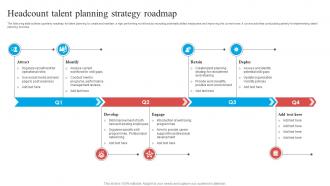
Headcount Talent Planning Strategy Roadmap





Try Before you Buy Download Free Sample Product
 Impress Your
 Audience
 100%
100% Editable
 Save Hours
 of Time


The following slide outlines quarterly roadmap for talent planning to create and maintain a high performing workforce by recruiting potentially skilled employees and improving the current ones. It covers activities conducted quarterly for implementing talent planning process.
People who downloaded this PowerPoint presentation also viewed the following :
Headcount Talent Planning Strategy Roadmap with all 6 slides:
Use our Headcount Talent Planning Strategy Roadmap to effectively help you save your valuable time. They are readymade to fit into any presentation structure.





FAQs for Headcount Talent
Effective talent management strategies include talent acquisition and recruitment, performance management systems, learning and development programs, succession planning, and employee retention initiatives. These components work together by identifying high-potential employees, developing their skills through targeted training, and creating clear career progression paths, with many organizations finding that this strategic combination significantly reduces turnover while enhancing overall operational efficiency.
Organizations identify high-potential employees through performance assessments, leadership competency evaluations, 360-degree feedback, and succession planning frameworks that measure both current results and future capability indicators. Through targeted mentorship programs, stretch assignments, and leadership development initiatives, companies like Google and McKinsey nurture these talents, ultimately building stronger leadership pipelines and competitive advantage.
Continuous feedback enables talent management by facilitating real-time performance adjustments, accelerating skill development, and strengthening employee engagement through regular communication. This approach streamlines career progression while enhancing retention rates, with many organizations finding that ongoing dialogue between managers and employees ultimately delivers improved productivity, faster problem resolution, and stronger alignment with strategic business objectives.
Data analytics enhances talent acquisition and retention by identifying high-performing candidate profiles, predicting employee turnover risks, and optimizing recruitment channels for better quality hires. Through predictive modeling and performance metrics, organizations streamline hiring processes, reduce recruitment costs, and improve employee satisfaction rates, with many companies finding that data-driven approaches ultimately deliver stronger retention outcomes and competitive talent advantages.
Companies should adopt structured orientation programs, mentorship assignments, clear role expectations, comprehensive training modules, and regular check-ins during the first 90 days. These practices streamline integration by reducing time-to-productivity, enhancing employee engagement, and improving retention rates, with many organizations finding that systematic onboarding ultimately delivers stronger performance and long-term organizational commitment.
Talent management aligns with organizational culture through values-based recruitment, cultural competency assessments, leadership development programs, and performance metrics that reflect cultural priorities. Companies like Google and Zappos integrate cultural fit into hiring processes, employee development pathways, and recognition systems, ultimately creating cohesive workforces where talent strategies reinforce cultural identity and drive engagement.
Diversity and inclusion significantly enhance talent management by expanding recruitment pools, improving employee engagement, and fostering innovation through varied perspectives and experiences. Organizations with strong D&I practices achieve better retention rates, enhanced decision-making capabilities, and improved financial performance, while creating more inclusive cultures that attract top talent across all demographics and backgrounds.
Effective skill assessment techniques include competency-based evaluations, 360-degree feedback, behavioral interviews, skills testing platforms, and performance simulations. These methods enable organizations to identify talent gaps, optimize training investments, and align employee capabilities with strategic objectives, with many companies finding that comprehensive assessment frameworks ultimately enhance workforce planning and competitive advantage.
Technology streamlines talent management through automated recruitment systems, AI-powered candidate screening, digital performance tracking, predictive analytics for retention, and integrated learning management platforms. These solutions enable HR teams to reduce hiring timeframes, enhance employee development programs, and make data-driven decisions about workforce planning, ultimately delivering improved talent acquisition and stronger organizational performance.
Common talent management pitfalls include inadequate succession planning, poor performance feedback systems, limited career development opportunities, inconsistent hiring practices, and neglecting employee engagement initiatives. Organizations can avoid these challenges by implementing structured mentorship programs, conducting regular performance reviews with actionable insights, and creating clear advancement pathways, with many companies finding that strategic talent investment significantly reduces turnover while enhancing organizational capability.
Organizations can measure talent management success through employee retention rates, internal promotion percentages, performance improvement metrics, engagement survey scores, and time-to-fill positions. These indicators help companies track recruitment effectiveness, development program impact, and workforce satisfaction, with many finding that comprehensive measurement approaches ultimately deliver stronger competitive advantage and reduced hiring costs.
Employee engagement significantly impacts talent retention by creating emotional connections, reducing turnover costs, and fostering workplace satisfaction through meaningful work and recognition programs. Engaged employees demonstrate higher productivity, stronger loyalty, and increased advocacy for their organizations, with many companies finding that strategic engagement initiatives enhance retention rates by 40-50%, ultimately delivering competitive advantages and reduced recruitment expenses.
Organizations should approach succession planning by identifying critical roles, assessing current talent capabilities, creating development pathways for high-potential employees, and establishing mentorship programs. This strategic combination enables seamless leadership transitions, reduces recruitment costs, and maintains operational continuity, with many companies finding that proactive succession planning delivers stronger performance and competitive advantage in increasingly dynamic markets.
Innovative training methods include microlearning modules, virtual reality simulations, gamification platforms, peer-to-peer mentoring programs, and AI-powered personalized learning paths. These approaches enhance employee development by delivering bite-sized content, creating immersive experiences, and fostering continuous skill building, with organizations across healthcare, finance, and technology finding that strategic learning combinations ultimately accelerate career progression and improve retention rates.
Leadership development serves as a cornerstone of effective talent management strategies, focusing on succession planning, skill enhancement, mentoring programs, and strategic decision-making capabilities. Through targeted development initiatives, organizations across industries like healthcare and financial services cultivate internal talent pipelines, reduce external recruitment costs, and maintain competitive advantage, with many finding that strong leadership development significantly improves employee retention and organizational performance.
-
Love how there are no boring templates here! The design is fresh and creative, just the way I like it. Can't wait to edit and use them for my extended projects!
-
Excellent design and quick turnaround.