


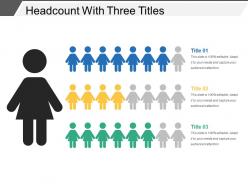
Headcount with three titles





Try Before you Buy Download Free Sample Product
 Impress Your
 Audience
 100%
100% Editable
 Save Hours
 of Time


Highlight interdependence with our Headcount With Three Titles. Encourage individuals to forge friendships.
People who downloaded this PowerPoint presentation also viewed the following :
Headcount with three titles with all 5 slides:
Align individual goals with our Headcount With Three Titles. Focus on achieving the common good.



FAQs for Headcount
Key factors influencing headcount decisions include budget constraints, business growth projections, seasonal demand fluctuations, strategic initiatives, and regulatory requirements. These considerations enable organizations to balance operational efficiency with competitive positioning, with many companies finding that strategic workforce planning across departments like sales, operations, and customer service ultimately delivers cost optimization and enhanced market responsiveness.
Headcount directly influences productivity through resource allocation, skill distribution, and operational capacity, with optimal staffing levels enabling streamlined workflows and enhanced output per employee. While understaffing can limit growth potential and overburden teams, strategic headcount planning allows organizations to balance labor costs with performance goals, ultimately delivering improved efficiency and competitive advantage in increasingly dynamic markets.
Essential headcount efficiency metrics include revenue per employee, cost per hire, employee turnover rates, productivity ratios, and span of control measurements. These metrics enable organizations to optimize workforce allocation, reduce operational costs, and enhance performance outcomes, with many companies finding that strategic headcount analysis delivers improved profitability and competitive advantage.
Companies can effectively forecast headcount needs by analyzing historical project data, evaluating current workforce capacity, assessing skill requirements for upcoming initiatives, and incorporating business growth projections into their planning models. Through strategic workforce analytics, organizations in sectors like technology and consulting streamline resource allocation, minimize recruitment delays, and optimize project timelines, ultimately delivering enhanced operational efficiency and competitive advantage.
Headcount serves as a fundamental driver in budgeting and financial planning, directly impacting salary expenses, benefits costs, operational overhead, and resource allocation strategies. Organizations use headcount projections to forecast revenue capacity, determine facility requirements, and plan technology investments, with many companies finding that accurate headcount planning enables better cost control and strategic growth decisions.
Remote work transforms headcount management by expanding talent pools beyond geographic boundaries, enabling access to global expertise, and reducing location-based salary constraints. Organizations can strategically allocate resources across distributed teams while minimizing office overhead costs, with many companies finding that remote policies enhance retention rates and allow for more flexible workforce scaling during market fluctuations.
HR can optimize headcount during growth through strategic workforce planning, cross-training existing employees, implementing flexible staffing models, leveraging temporary and contract workers, and utilizing data-driven hiring forecasts. These approaches enable organizations to scale efficiently while maintaining operational flexibility, with many companies finding that strategic headcount management reduces costs, accelerates expansion timelines, and ultimately delivers sustainable competitive advantage.
Industry-specific trends significantly shape headcount requirements through technological adoption, regulatory changes, market demand shifts, and consumer behavior evolution. For example, healthcare organizations increasingly require data analysts and telehealth specialists, while manufacturing companies automate processes requiring fewer assembly workers but more technical maintenance staff, ultimately driving strategic workforce planning and competitive positioning.
Legal considerations for headcount reduction include compliance with employment laws, WARN Act requirements, discrimination protections, severance obligations, and union agreements. Organizations must navigate federal and state regulations while ensuring proper documentation, fair selection criteria, and required notifications, with many companies finding that proactive legal counsel streamlines the process and minimizes litigation risks.
Technology streamlines headcount tracking through automated data collection, real-time dashboard reporting, integrated HRIS systems, predictive analytics, and centralized workforce databases. These solutions enhance accuracy by eliminating manual entry errors, accelerating reporting cycles, and delivering comprehensive workforce insights, with many organizations finding that automated tracking reduces administrative overhead while enabling strategic workforce planning.
Headcount represents the total number of individual employees in an organization, regardless of their working hours or employment status. FTE measures the equivalent number of full-time positions based on actual hours worked, converting part-time and contract workers into full-time equivalents, with many organizations finding that FTE provides more accurate workforce planning and budget allocation insights.
Employee turnover significantly impacts headcount strategies by creating recruitment costs, knowledge gaps, and productivity disruptions that require constant workforce planning adjustments. Organizations must balance immediate replacement needs with long-term talent retention initiatives, often finding that high turnover rates force reactive hiring approaches rather than strategic workforce development, ultimately affecting operational efficiency and competitive positioning.
Effective headcount analytics tools include Workday, BambooHR, ADP Workforce Now, Tableau, and Power BI, alongside HRIS platforms that integrate payroll and performance data. These solutions streamline workforce planning by automating data collection, providing real-time dashboards, and enabling predictive modeling, with many organizations finding that strategic combinations deliver enhanced operational efficiency and competitive advantage.
Cultural factors significantly influence headcount stability through employee engagement levels, leadership effectiveness, workplace inclusivity, and organizational values alignment. Organizations with strong, positive cultures experience lower turnover rates and higher retention, while toxic environments drive talent exodus, with many companies finding that investing in cultural development ultimately reduces recruitment costs and enhances long-term workforce stability.
Maintaining morale during headcount changes involves transparent communication about reasons and timeline, providing career transition support and retraining opportunities, and recognizing remaining employees' increased contributions. Organizations like tech companies and financial institutions find that offering severance packages, maintaining open dialogue sessions, and clearly communicating future stability plans helps preserve team cohesion and productivity during transitions.
-
Great product with effective design. Helped a lot in our corporate presentations. Easy to edit and stunning visuals.
-
Enough space for editing and adding your own content.