

Health And Safety Management Training Plan




Try Before you Buy Download Free Sample Product
 Impress Your
 Audience
 100%
100% Editable
 Save Hours
 of Time


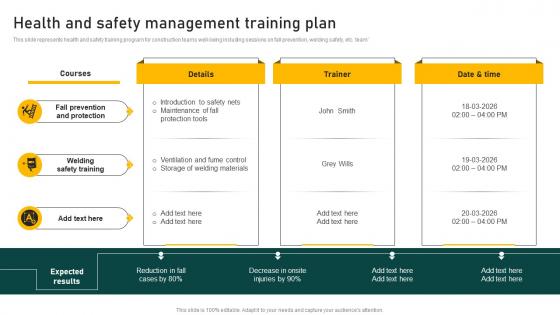
This slide represents health and safety training program for construction teams well-being including sessions on fall prevention, welding safety, etc. team.
People who downloaded this PowerPoint presentation also viewed the following :
Health And Safety Management Training Plan with all 9 slides:
Use our Health And Safety Management Training Plan to effectively help you save your valuable time. They are readymade to fit into any presentation structure.








FAQs for Health And Safety
Key components include hazard identification and risk assessment, safety policies and procedures, employee training programs, incident reporting systems, and regular safety audits. These elements work together by creating comprehensive protection frameworks, ensuring regulatory compliance, and fostering safety cultures, with many organizations finding that systematic approaches significantly reduce workplace incidents while enhancing operational efficiency.
Organizations assess workplace hazards through comprehensive risk evaluations, safety audits, employee feedback systems, incident analysis, and regulatory compliance reviews. These assessments enable strategic mitigation through enhanced training programs, improved safety protocols, and updated equipment standards, with many manufacturing and construction companies finding that proactive hazard management significantly reduces incidents while enhancing operational efficiency.
Employee training serves as the foundation of effective health and safety management by educating workers on hazard identification, proper equipment usage, emergency procedures, and regulatory compliance requirements. Through comprehensive training programs, organizations significantly reduce workplace incidents, enhance safety culture, and ensure regulatory adherence, with many manufacturing and construction companies finding that well-trained employees become active safety advocates, ultimately delivering lower insurance costs and improved operational efficiency.
Technology enhances workplace health and safety through IoT sensors for real-time monitoring, AI-powered predictive analytics, wearable devices for worker tracking, automated safety systems, and digital reporting platforms. These solutions streamline compliance management, enable proactive hazard identification, and deliver faster emergency response times, with manufacturing and construction companies finding significantly reduced incident rates and enhanced operational efficiency.
Health and safety legal requirements vary by industry but typically include hazard assessments, employee training, protective equipment provision, incident reporting, and regulatory compliance documentation. Manufacturing facilities must follow OSHA standards for machinery safety, healthcare organizations adhere to bloodborne pathogen protocols, and construction companies implement fall protection measures, with many organizations finding that proactive compliance ultimately delivers reduced liability costs and enhanced operational efficiency.
Effective risk assessments require systematic identification of hazards, evaluation of exposure likelihood, and implementation of control measures through regular workplace inspections, employee feedback, and incident analysis. Organizations conduct these assessments quarterly or after significant changes, with manufacturing plants and construction sites finding that structured documentation, staff training, and continuous monitoring significantly reduce workplace accidents while ensuring regulatory compliance.
Strategies to promote safety culture include leadership commitment, employee engagement programs, regular training sessions, transparent incident reporting systems, and recognition of safe behaviors. These approaches work by establishing clear safety expectations, empowering workers to identify hazards, and creating accountability at all levels, with many organizations finding that consistent communication and behavioral reinforcement ultimately deliver reduced incidents and improved operational efficiency.
Organizations measure health and safety program effectiveness through leading indicators like training completion rates, safety audits, and near-miss reporting, alongside lagging indicators such as incident rates, workers' compensation costs, and regulatory compliance scores. These metrics enable companies across manufacturing, construction, and healthcare sectors to identify improvement opportunities, reduce operational risks, and ultimately deliver enhanced employee protection while minimizing costly workplace incidents.
Common barriers to successful health and safety management include inadequate leadership commitment, insufficient resource allocation, poor communication systems, lack of employee engagement, and resistance to cultural change. These challenges often manifest in organizations through inconsistent policy enforcement, limited training budgets, and fragmented reporting structures, with many companies finding that addressing leadership buy-in first significantly accelerates overall program effectiveness.
Incident reporting and investigation contribute to continuous improvement by identifying root causes, analyzing failure patterns, and implementing preventive measures across operational systems. Through systematic data collection and analysis, organizations in manufacturing, healthcare, and construction streamline safety protocols, reduce workplace injuries, and enhance regulatory compliance, ultimately delivering stronger safety cultures and operational resilience.
Mental health and workplace safety are interconnected, as psychological stress, fatigue, and anxiety can significantly impair concentration, decision-making, and hazard awareness, increasing accident risks. Organizations implementing comprehensive wellness programs, stress management resources, and mental health support find that addressing psychological wellbeing alongside physical safety protocols creates safer work environments, reduces incidents, and ultimately enhances overall operational performance and employee productivity.
Companies ensure compliance with health and safety regulations through comprehensive risk assessments, regular employee training programs, systematic documentation of safety protocols, and consistent monitoring of workplace conditions. These strategic approaches streamline regulatory adherence by establishing clear accountability frameworks, implementing preventive measures, and maintaining updated safety standards, ultimately delivering reduced liability exposure and enhanced employee protection while strengthening operational resilience.
Emergency preparedness best practices include comprehensive risk assessments, detailed response protocols, regular training programs, clear communication systems, and strategic resource allocation. These approaches streamline crisis management by establishing clear command structures, ensuring rapid notification processes, and maintaining updated evacuation procedures, with many organizations finding that regular drills and cross-departmental coordination ultimately deliver faster response times and enhanced workplace safety.
International standards influence health and safety management by establishing comprehensive frameworks for risk assessment, incident reporting, regulatory compliance, and continuous improvement across organizations globally. These standards, particularly ISO 45001 and OSHA guidelines, enable companies to streamline safety protocols, reduce workplace incidents, and enhance operational efficiency, with many multinational corporations finding that standardized approaches deliver competitive advantages and lower insurance costs.
Leadership and communication serve as the foundation for safe work environments by establishing clear safety expectations, modeling safe behaviors, and ensuring transparent incident reporting processes. Effective leaders in manufacturing, healthcare, and construction sectors demonstrate visible commitment to safety protocols while fostering open dialogue about hazards, ultimately creating cultures where employees feel empowered to prioritize safety without fear of reprisal.
-
The design is very attractive, informative, and eye-catching, with bold colors that stand out against all the basic presentation templates.
-
It's always a delight to see new templates from you! I am extremely pleased with the fact that they are easy to modify and fit any presentation layout in seconds!