


Healthcare Marketing Dashboard To Measure Hospital Marketing Plan To Improve Patient Strategy SS V




Try Before you Buy Download Free Sample Product
 Impress Your
 Audience
 100%
100% Editable
 Save Hours
 of Time


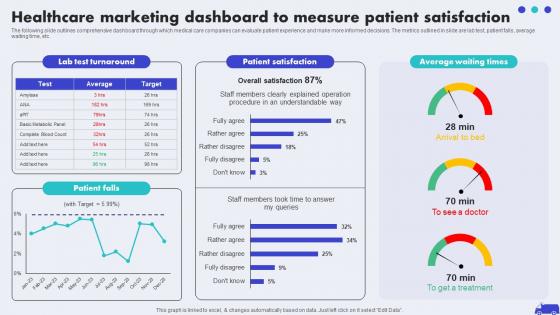
The following slide outlines comprehensive dashboard through which medical care companies can evaluate patient experience and make more informed decisions. The metrics outlined in slide are lab test, patient falls, average waiting time, etc.
People who downloaded this PowerPoint presentation also viewed the following :
Healthcare Marketing Dashboard To Measure Hospital Marketing Plan To Improve Patient Strategy SS V with all 10 slides:
Use our Healthcare Marketing Dashboard To Measure Hospital Marketing Plan To Improve Patient Strategy SS V to effectively help you save your valuable time. They are readymade to fit into any presentation structure.








FAQs for Healthcare Marketing Dashboard To Measure Hospital Marketing Plan To Improve Patient
Healthcare marketing dashboards should include patient acquisition cost, conversion rates across digital channels, appointment booking rates, patient lifetime value, and ROI by campaign type. These metrics enable healthcare organizations to optimize their marketing spend, identify high-performing channels like social media and email campaigns, and ultimately deliver better patient engagement while reducing acquisition costs in an increasingly competitive healthcare landscape.
A healthcare marketing dashboard improves patient engagement and retention by tracking communication touchpoints, analyzing patient journey patterns, and monitoring satisfaction metrics across multiple channels. Through automated campaign tracking and personalized outreach management, healthcare providers can deliver targeted wellness programs, appointment reminders, and follow-up care communications, ultimately enhancing patient experiences while reducing churn rates.
Data visualization transforms healthcare marketing dashboards by converting complex patient demographics, campaign performance metrics, and ROI data into intuitive charts, graphs, and heat maps that enable instant comprehension. Through visual analytics, healthcare marketers can quickly identify trending patient acquisition channels, seasonal service demands, and geographic opportunities, ultimately streamlining decision-making processes and enhancing campaign targeting effectiveness.
Social media metrics integrate into healthcare marketing dashboards through APIs connecting platforms like Facebook, Instagram, and LinkedIn, displaying engagement rates, reach, follower growth, and conversion tracking alongside traditional metrics. This comprehensive approach enables healthcare organizations to correlate social engagement with appointment bookings, patient inquiries, and brand awareness campaigns, ultimately delivering unified insights that streamline marketing decisions and enhance patient acquisition strategies.
**INPUT**: What tools and software are best for creating an effective healthcare marketing dashboard? **OUTPUT**: Effective healthcare marketing dashboards utilize Tableau, Power BI, Google Analytics, HubSpot, and specialized healthcare platforms like Meditech or Epic integrations. These tools streamline patient acquisition tracking, campaign ROI measurement, and compliance reporting, with many healthcare organizations finding that integrated dashboards deliver faster insights, improved resource allocation, and ultimately enhanced patient engagement across multiple service lines.
A healthcare marketing dashboard assists in tracking patient acquisition channels by monitoring referral sources, digital campaign performance, appointment conversions, and cost-per-acquisition metrics across multiple touchpoints. Through real-time analytics, healthcare organizations can identify which channels—social media, physician referrals, or online searches—deliver the highest-quality patients, ultimately optimizing marketing spend and enhancing patient outreach strategies.
Common pitfalls include overcrowding dashboards with excessive metrics, neglecting patient privacy compliance requirements, using inconsistent data sources, ignoring mobile responsiveness, and failing to align metrics with strategic goals. Healthcare organizations often find that focusing on too many KPIs simultaneously reduces actionable insights, while poor data integration leads to conflicting reports that undermine decision-making effectiveness.
Real-time data analytics enhances healthcare marketing decision-making by providing immediate insights into patient engagement, campaign performance, and market trends, enabling rapid strategy adjustments and resource optimization. Through predictive analytics and behavioral tracking, healthcare organizations streamline targeting precision, accelerate response times to market changes, and deliver personalized patient experiences, ultimately achieving higher conversion rates and improved ROI.
Patient feedback significantly enhances healthcare marketing dashboard insights by providing qualitative context to quantitative metrics, revealing patient satisfaction trends, identifying service gaps, and highlighting campaign effectiveness from the patient perspective. This feedback enables healthcare organizations to refine messaging strategies, improve patient experiences, and optimize resource allocation, ultimately delivering more personalized care and stronger patient engagement across all touchpoints.
Segmentation of patient demographics enhances healthcare marketing dashboard utility by enabling targeted campaign development, personalized messaging strategies, and resource allocation optimization based on age, location, insurance type, and health conditions. Healthcare organizations can deliver more relevant communications, improve patient engagement rates, and achieve better ROI on marketing investments, with many hospitals finding that demographic-driven campaigns significantly increase appointment bookings and service utilization.
Healthcare digital marketing KPIs include patient acquisition cost, conversion rates from website visits to appointments, email open rates, social media engagement metrics, and online review scores. These metrics enable healthcare organizations to optimize marketing spend, improve patient outreach effectiveness, and enhance digital presence, with many hospitals and clinics finding that tracking appointment booking rates and patient lifetime value delivers measurable ROI.
A healthcare marketing dashboard facilitates collaboration by providing shared access to patient acquisition metrics, campaign performance data, referral tracking, and ROI analytics across departments. Through centralized reporting, marketing teams, clinical departments, and administration can align strategies, coordinate patient outreach efforts, and optimize resource allocation, while enabling real-time communication and data-driven decision making that ultimately enhances organizational efficiency.
Predictive analytics can be incorporated through patient behavior forecasting, treatment outcome modeling, readmission risk assessment, seasonal demand predictions, and campaign performance optimization algorithms. These capabilities enable healthcare organizations to proactively identify high-risk patients, optimize resource allocation, and personalize marketing campaigns, ultimately delivering more targeted patient outreach and improved care coordination.
Mobile access to healthcare marketing dashboards enhances responsiveness by enabling real-time campaign monitoring, instant performance alerts, and immediate strategy adjustments from any location. Healthcare marketers can quickly respond to patient engagement trends, adjust appointment booking campaigns, and optimize outreach efforts while traveling between facilities, ultimately delivering faster decision-making and improved patient acquisition outcomes.
Team members should undergo training in dashboard navigation, data interpretation, healthcare analytics fundamentals, compliance requirements, and reporting best practices. This comprehensive approach enables marketing professionals to leverage patient insights, campaign performance metrics, and regulatory guidelines effectively, while many healthcare organizations finding that structured training programs ultimately deliver faster decision-making and improved marketing ROI.
-
Great product with effective design. Helped a lot in our corporate presentations. Easy to edit and stunning visuals.
-
Unique research projects to present in meeting.