

Hexagon slides puzzle powerpoint topics




Try Before you Buy Download Free Sample Product
 Impress Your
 Audience
 100%
100% Editable
 Save Hours
 of Time


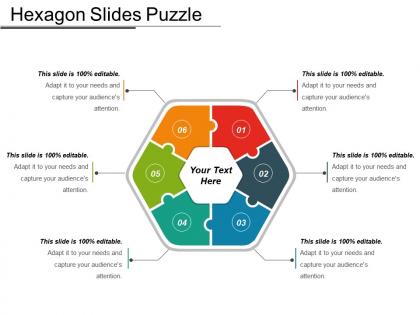
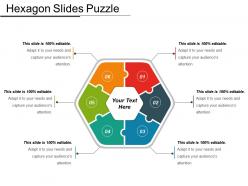
Grab the attention of your audience with the Hexagon Slide Puzzle PowerPoint Topics. The hexagonal puzzle can be used in your presentation to show different yet integrated parts coming from a whole. This six-stage process slide can easily represent a consecutive flow of different tasks, events, ideas, and concepts. Use this PowerPoint puzzle diagram to demonstrate a central idea by explaining its relationship with six components. Various aspects can be shown in just one slide with the help of the hexagon puzzle as it enables the presenter to mention various concepts collectively. This six-stepped infographic template shows information in a radial flow. The hexagonal jigsaw shows various levels and their connectivity to each other. Download this jigsaw puzzle template for casting your ideas and concepts in a proper manner and make your presentations more interesting and comprehensive.
People who downloaded this PowerPoint presentation also viewed the following :
Hexagon slides puzzle powerpoint topics with all 5 slides:
Break through with our Hexagon Slides Puzzle Powerpoint Topics. Clear all the doubts in the minds of your team.


FAQs for Hexagon slides
**INPUT**: What are the primary strategies for solving a Hexagon slides puzzle efficiently? **OUTPUT**: Primary strategies include working from outside edges inward, establishing corner pieces first, creating temporary holding spaces, focusing on one section at a time, and maintaining spatial awareness of the hexagonal geometry. These approaches streamline the solving process by reducing complexity systematically, enabling faster pattern recognition, and minimizing unnecessary moves, with many puzzle enthusiasts finding that sectional completion ultimately delivers more efficient solutions than random sliding. **Word count: 60 words**
Understanding hexagonal properties enhances puzzle-solving by developing spatial reasoning, pattern recognition, and geometric intuition through their unique six-sided symmetry and tessellation capabilities. These skills translate into improved analytical thinking across various challenges, with many educators and cognitive training programs finding that hexagon-based puzzles strengthen problem-solving abilities, enhance visual-spatial intelligence, and ultimately deliver better performance in mathematical and logical reasoning tasks.
Hexagon slides puzzles enhance spatial reasoning, pattern recognition, logical sequencing, working memory, and problem-solving skills through their unique geometric constraints. These cognitive challenges strengthen neural pathways involved in visual processing and strategic thinking, with many educators and cognitive researchers finding that hexagonal puzzle formats deliver superior mental flexibility training compared to traditional square-grid puzzles.
Hexagon slide puzzles enhance user engagement through their unique six-sided geometry, which creates more complex movement patterns, spatial reasoning challenges, and strategic thinking opportunities compared to traditional square puzzles. This distinctive design stimulates cognitive development by requiring users to visualize rotational relationships and multi-directional pathways, ultimately delivering improved problem-solving skills and sustained attention spans.
Color and shape serve as primary visual organizing principles in hexagon slide puzzles, enabling pattern recognition, spatial relationships, and cognitive mapping through distinct visual cues. These design elements streamline problem-solving by creating intuitive pathways for users, enhancing engagement through visual appeal, and ultimately delivering more effective learning experiences across educational and corporate training environments.
Educators can integrate hexagon slides puzzles by incorporating them into mathematics lessons for geometry and spatial reasoning, science classes for molecular structures and biological processes, and language arts for vocabulary building and storytelling sequences. These interactive tools enhance student engagement through hands-on learning, promote collaborative problem-solving skills, and accommodate different learning styles, ultimately delivering improved comprehension and retention across multiple subject areas.
Digital design platforms like Adobe Creative Suite, Articulate Storyline, H5P, Unity, and specialized puzzle generators enable interactive hexagon slide puzzle creation. These tools streamline development by offering drag-and-drop functionality, animation capabilities, and cross-platform compatibility, with many educational institutions and training organizations finding that interactive puzzles enhance engagement and learning retention significantly.
Hexagon slide puzzles can be adapted through varying grid sizes, piece complexity, image difficulty, and time constraints to match different developmental stages. Educational institutions and puzzle manufacturers increasingly customize these puzzles by adjusting from simple 3-piece designs for young children to intricate 15+ piece configurations for adults, ultimately delivering age-appropriate cognitive challenges while maintaining engagement across all skill levels.
Common mistakes in hexagon slide puzzles include moving tiles randomly without strategy, focusing on individual pieces rather than patterns, neglecting corner and edge positioning, failing to work systematically from one section, and attempting multiple areas simultaneously. These strategic errors significantly increase solving time and complexity, with many puzzle enthusiasts finding that methodical approaches, working outward from established sections, and maintaining spatial awareness ultimately streamline the solving process and enhance completion rates.
Looking at this question about hexagon slides puzzles and their educational value, I need to follow the established patterns while staying within 50-60 words. This appears to be a "How does..." question, so I should use Pattern 2: Impact statement with mechanisms, then specific examples and outcomes. Let me structure this as: 1. First sentence: Direct answer about how complexity affects educational value with multiple mechanisms 2. Second sentence: Expansion with specific applications/sectors and outcomes **OUTPUT:** Complexity in hexagon slides puzzles enhances educational value by developing spatial reasoning, critical thinking, and problem-solving persistence through increasingly challenging geometric patterns. Educational institutions leverage these puzzles across mathematics and cognitive development programs, with teachers finding that progressive difficulty levels ultimately deliver improved analytical skills and strategic thinking capabilities in students. [Word count: 53 words]
Creative themes for hexagon slides puzzles include process workflows, customer journey mapping, strategic frameworks, team collaboration models, and product development cycles. These versatile designs work particularly well for consulting presentations, project management workflows, and organizational restructuring proposals, with many presenters finding that hexagonal layouts enhance visual engagement while streamlining complex information into digestible, interconnected segments.
Hexagon slides puzzles promote teamwork by requiring multiple perspectives, shared strategy development, and coordinated problem-solving approaches among team members. These collaborative activities enhance communication skills, foster collective decision-making, and build trust through shared challenges, with many organizations finding that such puzzle-based exercises ultimately strengthen workplace relationships and improve group problem-solving capabilities.
Hexagon slides puzzle difficulty can be measured through move count requirements, solution path complexity, branching factor analysis, positional entropy levels, and algorithmic solving time benchmarks. These metrics enable puzzle designers to create progressively challenging experiences, while educational institutions and gaming companies use standardized difficulty assessments to enhance user engagement and maintain optimal challenge progression across different skill levels.
Hexagon slides puzzles can enhance corporate training by developing problem-solving skills, strategic thinking, and collaborative teamwork through hands-on engagement. These interactive tools help teams practice systematic approaches to complex challenges, improve communication during group problem-solving, and build persistence, with many organizations finding that puzzle-based activities increase retention rates and create memorable learning experiences that translate into workplace innovation.
Hexagon slides puzzles find successful applications in education for teaching spatial reasoning and problem-solving, corporate training for team-building exercises, cognitive therapy for memory enhancement, and software development for algorithm testing. These versatile tools enhance learning outcomes by engaging multiple cognitive processes, improving analytical thinking, and fostering collaborative problem-solving skills, with many organizations finding that hexagonal puzzle formats deliver superior engagement compared to traditional square-grid approaches.
-
Great quality slides in rapid time.
-
Informative presentations that are easily editable.