


High And Low Risk Exposure Jobs ChatGPT Future And Impact Assessment ChatGPT SS




Try Before you Buy Download Free Sample Product
 Impress Your
 Audience
 100%
100% Editable
 Save Hours
 of Time


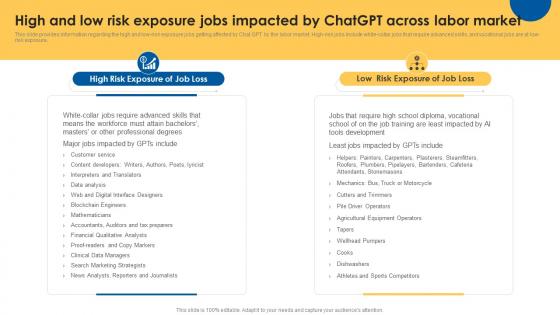
This slide provides information regarding the high and low risk exposure jobs getting affected by Chat GPT by the labor market. High risk jobs include white collar jobs that require advanced skills, and vocational jobs are at low risk exposure.
People who downloaded this PowerPoint presentation also viewed the following :
High And Low Risk Exposure Jobs ChatGPT Future And Impact Assessment ChatGPT SS with all 9 slides:
Use our High And Low Risk Exposure Jobs ChatGPT Future And Impact Assessment ChatGPT SS to effectively help you save your valuable time. They are readymade to fit into any presentation structure.








FAQs for High And Low Risk Exposure Jobs ChatGPT Future And Impact
Primary factors in job risk assessment include workplace hazards, employee capabilities, task complexity, environmental conditions, and regulatory compliance requirements. These comprehensive evaluations streamline safety protocols by identifying potential risks, implementing preventive measures, and establishing monitoring systems, with many organizations finding that systematic assessments reduce workplace incidents while enhancing operational efficiency and employee confidence.
Job risk assessments can be tailored by identifying sector-specific hazards, regulatory requirements, operational environments, and worker exposure patterns unique to each industry. Manufacturing focuses on machinery safety and chemical exposure, while healthcare emphasizes infectious diseases and ergonomic risks, with financial services prioritizing cybersecurity threats and workplace ergonomics, ultimately delivering targeted protection strategies.
Employee feedback provides critical frontline insights into actual workplace hazards, near-miss incidents, safety concerns, and procedural gaps that formal assessments might overlook. This input enhances risk identification accuracy, validates control measures, and improves safety protocols, with many organizations finding that incorporating worker perspectives delivers more comprehensive assessments and stronger safety cultures.
Job risk assessments should be updated annually, after significant workplace changes, following incidents or near-misses, when new equipment or processes are introduced, and whenever regulations change. Many organizations find that establishing quarterly review cycles enables proactive identification of emerging hazards, ensures compliance with evolving safety standards, and ultimately delivers enhanced workplace safety and reduced liability exposure.
Effective job risk assessment tools include hazard identification software, risk matrix platforms, mobile inspection apps, compliance tracking systems, and integrated safety management solutions. These technologies streamline assessment processes by automating data collection, standardizing evaluation criteria, and generating comprehensive reports, with many organizations finding that digital platforms significantly enhance accuracy, reduce assessment time, and improve regulatory compliance across multiple workplace environments.
Organizations ensure compliance with local labor laws during job risk assessments by incorporating regulatory requirements into evaluation frameworks, consulting legal experts familiar with jurisdiction-specific standards, and maintaining updated documentation that meets statutory obligations. Through systematic compliance audits, regular training programs, and collaboration with labor law specialists, companies streamline regulatory adherence while enhancing workplace safety protocols, ultimately delivering legal protection and operational confidence.
Common pitfalls in job risk assessment include inadequate stakeholder involvement, relying on outdated data, overlooking human factors, insufficient follow-up monitoring, and failing to consider interdependent risks across departments. These oversights can compromise workplace safety and regulatory compliance, with many organizations finding that regular assessment updates, cross-functional input, and systematic documentation ultimately deliver more accurate risk profiles and stronger safety outcomes.
Training and education enhance job risk assessment effectiveness by developing employee hazard recognition skills, improving risk evaluation accuracy, and fostering proactive safety cultures within organizations. Through comprehensive safety programs, companies across manufacturing, construction, and healthcare sectors streamline incident reporting, enhance workplace compliance, and ultimately deliver reduced accident rates while building stronger safety awareness among teams.
Key metrics for evaluating job risk assessment program success include incident reduction rates, employee engagement scores, compliance audit results, cost-benefit ratios, and training completion percentages. These measurements enable organizations to track safety improvements, operational efficiency gains, and regulatory adherence, with many companies finding that comprehensive metrics deliver enhanced workplace safety, reduced insurance costs, and stronger competitive positioning in increasingly safety-conscious industries.
AI improves job risk assessments through predictive analytics, real-time monitoring systems, automated hazard detection, machine learning pattern recognition, and data-driven insights from multiple sources. These technologies enable organizations to identify potential workplace dangers before incidents occur, streamline safety protocols, and enhance worker protection across industries like manufacturing, construction, and healthcare, ultimately delivering proactive risk management and reduced workplace injuries.
Cultural factors significantly influence job risk assessments through varying attitudes toward hierarchy, individual versus collective responsibility, communication styles, and risk tolerance levels. Organizations operating across diverse cultural contexts find that Western cultures often emphasize individual accountability and direct reporting, while collectivist cultures may prioritize group harmony over reporting hazards, ultimately requiring tailored assessment approaches that respect cultural values while maintaining safety standards.
Promoting workplace safety culture requires comprehensive training programs, regular safety communications, employee involvement in safety committees, recognition systems for safe behaviors, and leadership commitment at all levels. These strategies streamline risk identification, enhance reporting transparency, and minimize incident rates, with many organizations finding that engaged employees become safety advocates, ultimately delivering reduced insurance costs and improved operational efficiency.
Job risk assessments contribute to organizational sustainability by reducing workplace incidents, minimizing operational disruptions, and ensuring regulatory compliance across all business functions. Through systematic hazard identification and mitigation strategies, organizations streamline safety protocols, reduce insurance costs, and enhance employee retention, with many companies finding that proactive risk management ultimately delivers competitive advantage and long-term operational resilience.
Leadership plays a crucial role in job risk assessments by establishing safety cultures, allocating necessary resources, ensuring regulatory compliance, and championing employee training programs. Effective leaders in manufacturing, construction, and healthcare organizations demonstrate commitment through regular safety communications, invest in advanced assessment tools, and empower supervisors to act on identified risks, ultimately delivering reduced workplace incidents and enhanced operational efficiency.
Job risk assessments inform emergency preparedness by identifying potential hazards, vulnerable processes, and high-risk scenarios that require specific response protocols. These assessments enable organizations to develop targeted evacuation procedures, establish appropriate safety equipment placement, and create role-specific emergency responses, with many workplaces finding that risk-informed preparedness plans significantly reduce response times and enhance employee safety outcomes.
-
Appreciate the research and its presentable format.
-
The ease of modifying templates is just superb! Also, the vast collection offers plenty of options to choose from.