


Home Healthcare Business Plan Effective Revenue Generation Model Of The Home Care Start Up BP SS




Try Before you Buy Download Free Sample Product
 Impress Your
 Audience
 100%
100% Editable
 Save Hours
 of Time


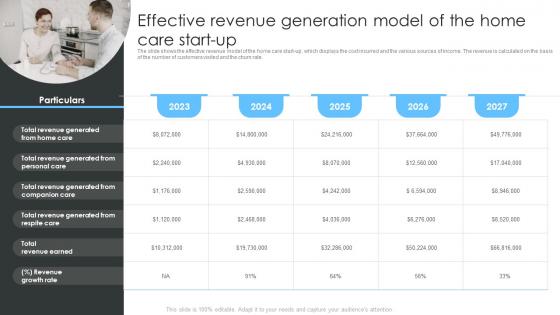
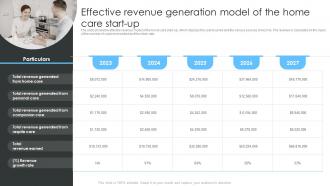
The slide shows the effective revenue model of the home care start-up, which displays the cost incurred and the various sources of income. The revenue is calculated on the basis of the number of customers visited and the churn rate.
People who downloaded this PowerPoint presentation also viewed the following :
Home Healthcare Business Plan Effective Revenue Generation Model Of The Home Care Start Up BP SS with all 9 slides:
Use our Home Healthcare Business Plan Effective Revenue Generation Model Of The Home Care Start Up BP SS to effectively help you save your valuable time. They are readymade to fit into any presentation structure.








FAQs for Home Healthcare Business Plan Effective Revenue Generation Model Of The Home Care Start
A successful home healthcare business plan includes market analysis, service offerings, staffing strategies, regulatory compliance frameworks, financial projections, and operational protocols. These components work together by identifying target demographics, ensuring quality care delivery, and maintaining sustainable growth, with many healthcare entrepreneurs finding that comprehensive planning ultimately delivers competitive advantage and scalable patient care solutions.
Market research for home healthcare startups involves analyzing demographic data, surveying potential clients and their families, studying competitor services and pricing, and consulting with healthcare professionals and insurance providers. Through focus groups with seniors, interviews with discharge planners at hospitals, and analysis of local aging populations, startups can identify unmet needs, optimal service areas, and pricing strategies, ultimately delivering targeted care solutions that address specific community healthcare gaps.
Starting a home healthcare business requires addressing licensing requirements, Medicare/Medicaid certification, HIPAA compliance, state health department regulations, and professional liability insurance mandates. These regulatory frameworks ensure quality care standards while enabling sustainable operations, with many healthcare entrepreneurs finding that early compliance investment streamlines expansion and builds competitive advantage in increasingly regulated markets.
Essential financial projections include revenue forecasts, operating expense budgets, cash flow statements, break-even analysis, and profit and loss projections over three to five years. These projections enable home healthcare providers to demonstrate viability to investors, secure funding, and track performance metrics, with many healthcare startups finding that detailed financial modeling ultimately delivers better resource allocation and sustainable growth in an increasingly competitive healthcare landscape.
Technology can be integrated through telemedicine platforms, electronic health records systems, mobile health apps, remote patient monitoring devices, and automated scheduling software. These digital solutions streamline care delivery by enabling virtual consultations, real-time health tracking, and seamless communication between patients and providers, ultimately reducing operational costs while enhancing patient outcomes and accessibility.
Differentiation strategies include specialized care programs, advanced telehealth integration, 24/7 availability, personalized care plans, and outcome-based pricing models. These approaches enhance patient experiences by delivering targeted services, seamless technology integration, and flexible scheduling, with many healthcare providers finding that specialization in areas like chronic disease management or post-surgical care creates sustainable competitive advantages.
A home healthcare business plan should address workforce recruitment through targeted strategies for certified nursing assistants, physical therapists, and social workers, while outlining comprehensive training protocols for patient care standards, technology systems, and regulatory compliance. These initiatives streamline service delivery, enhance patient outcomes, and ensure regulatory adherence, with many healthcare organizations finding that structured recruitment and continuous training programs ultimately deliver improved patient satisfaction and operational efficiency.
LLC and corporation structures are most suitable for home healthcare businesses, offering liability protection, tax flexibility, professional credibility, and regulatory compliance capabilities essential for healthcare operations. These structures enable owners to separate personal assets from business liabilities, streamline insurance requirements, and facilitate growth through investment opportunities, with many healthcare entrepreneurs finding that LLCs provide optimal operational flexibility while corporations enhance credibility with insurance providers and referral sources.
A business plan effectively communicates mission and values by weaving them throughout executive summaries, service descriptions, and operational frameworks, demonstrating alignment between stated principles and practical delivery methods. Healthcare organizations achieve this by showcasing patient-centered approaches, community impact metrics, and quality care standards, with many home healthcare providers finding that mission-driven narratives enhance stakeholder trust and operational clarity.
Partnerships with hospitals and care facilities serve as critical referral sources, revenue streams, and credibility enhancers in home healthcare business plans. These strategic alliances enable seamless patient transitions, shared care protocols, and expanded service capabilities, with many home healthcare providers finding that hospital partnerships deliver consistent patient flow, reduced marketing costs, and enhanced operational efficiency in an increasingly integrated healthcare landscape.
Client demographics significantly influence home healthcare service design through age-specific care protocols, cultural sensitivity training, income-based payment options, geographic accessibility planning, and language accommodation services. Healthcare providers increasingly tailor their offerings by analyzing local population data, with many finding that demographic-focused approaches enhance patient satisfaction, improve health outcomes, and ultimately deliver competitive advantage in an increasingly personalized healthcare landscape.
**INPUT**: What marketing strategies are most effective for attracting clients to a home healthcare business? **OUTPUT**: Effective marketing strategies include digital presence optimization, healthcare provider partnerships, community outreach programs, patient referral systems, and targeted online advertising. These approaches streamline client acquisition by building trust through local networks, enhancing visibility among medical professionals, and delivering personalized messaging, with many home healthcare agencies finding that combining physician partnerships with digital marketing ultimately drives sustainable growth and competitive advantage. [Word count: 58 words]
A home healthcare business plan should incorporate flexible staffing models, scalable technology infrastructure, standardized care protocols, and strategic partnership frameworks to support growth across multiple service areas. These elements enable organizations to expand their patient capacity, geographic reach, and service offerings while maintaining quality standards, with many successful home healthcare providers finding that early scalability planning reduces operational costs and accelerates market penetration.
Key metrics include patient satisfaction scores, clinical outcomes and readmission rates, staff utilization and retention rates, revenue per patient, and operational efficiency measures like visit completion rates. These indicators enable healthcare providers to optimize care delivery, reduce costs, and enhance patient experiences, with many home healthcare organizations finding that balanced scorecards ultimately deliver competitive advantage and sustainable growth.
Common pitfalls include underestimating regulatory compliance requirements, inadequate financial projections, insufficient market research, overlooking staffing challenges, and neglecting technology integration needs. Many healthcare entrepreneurs find that successful plans address licensing complexities, insurance reimbursement timelines, and competitive positioning early, while incorporating scalable operational models that deliver sustainable growth and quality patient outcomes.
-
The slides are remarkable with creative designs and interesting information. I am pleased to see how functional and adaptive the design is. Would highly recommend this purchase!
-
Impressive templates. Designing a presentation is fun now!