

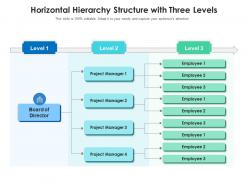
Horizontal hierarchy structure with three levels





Try Before you Buy Download Free Sample Product
 Impress Your
 Audience
 100%
100% Editable
 Save Hours
 of Time


Our Horizontal Hierarchy Structure With Three Levels are topically designed to provide an attractive backdrop to any subject. Use them to look like a presentation pro.
People who downloaded this PowerPoint presentation also viewed the following :
Horizontal hierarchy structure with three levels with all 2 slides:
Use our Horizontal Hierarchy Structure With Three Levels to effectively help you save your valuable time. They are readymade to fit into any presentation structure.
FAQs for Horizontal hierarchy structure
Horizontal hierarchy structures deliver enhanced collaboration, faster decision-making, improved employee engagement, reduced operational costs, and increased organizational agility. These flatter structures streamline communication by eliminating bureaucratic layers, enable cross-functional innovation, and accelerate response times, with many organizations finding that employees demonstrate greater ownership and creativity, ultimately delivering competitive advantage in increasingly dynamic markets.
Horizontal hierarchy enhances employee empowerment by distributing decision-making authority across multiple levels, reducing bureaucratic bottlenecks, and enabling faster responses to market changes. This structure streamlines communication between departments, encourages collaborative problem-solving, and ultimately delivers increased job satisfaction and operational efficiency, with many organizations finding that employees demonstrate greater initiative and accountability.
Horizontal hierarchy enhances collaboration by reducing communication barriers, accelerating decision-making processes, and promoting cross-functional teamwork through flatter organizational structures. This approach enables teams to share information more freely, respond to challenges faster, and leverage diverse expertise across departments, with many organizations finding that streamlined hierarchies ultimately deliver improved innovation, enhanced operational efficiency, and stronger competitive advantage.
Organizations transitioning to horizontal hierarchies often face resistance from middle management losing authority, confusion over decision-making responsibilities, and initial productivity dips during role adjustments. While these challenges require careful change management, many companies find that strategic communication, clear accountability frameworks, and gradual implementation ultimately deliver enhanced collaboration, faster innovation, and improved employee engagement across departments.
Horizontal hierarchy distributes leadership across multiple roles and teams rather than concentrating it at the top, creating shared decision-making authority, faster communication flows, and reduced bureaucratic layers. This approach enables quicker responses to market changes, enhanced collaboration between departments, and increased employee autonomy, with many organizations finding that flatter structures deliver greater operational agility and innovation capacity.
Technology companies, startups, creative agencies, consulting firms, and research organizations benefit most from horizontal hierarchy models. These sectors thrive on innovation, rapid decision-making, and collaborative problem-solving, with many finding that flatter structures enhance communication, accelerate project delivery, and foster the creative flexibility essential for competitive advantage.
Horizontal hierarchy enhances company culture by promoting open communication, collaborative decision-making, and increased employee autonomy across all organizational levels. This flattened structure enables faster information flow, reduces bureaucratic barriers, and empowers employees to contribute meaningfully to strategic initiatives, with many organizations finding that teams demonstrate higher engagement, creativity, and job satisfaction when hierarchical constraints are minimized.
Maintaining accountability in horizontal hierarchies requires peer review systems, transparent goal-setting frameworks, cross-functional project ownership, and regular 360-degree feedback mechanisms. These strategies enhance collaboration by establishing clear performance metrics, shared responsibility structures, and mutual evaluation processes, with many organizations finding that distributed accountability actually strengthens team cohesion and delivers superior operational outcomes.
Technology facilitates horizontal hierarchy by enabling seamless communication across departments, automating routine decision-making processes, and providing real-time data access to all team members. Through collaboration platforms, cloud-based systems, and integrated dashboards, organizations streamline information flow, enhance cross-functional coordination, and accelerate project delivery, ultimately creating more agile and responsive business operations.
Organizations should track employee engagement scores, decision-making speed, cross-functional collaboration frequency, innovation rates, and leadership development progression to assess horizontal hierarchy effectiveness. These metrics reveal whether flattened structures deliver faster decision cycles, enhanced communication flow, and increased employee autonomy, with many companies finding that reduced bureaucratic layers ultimately improve organizational agility and competitive responsiveness.
Horizontal hierarchy supports innovation by eliminating bureaucratic barriers, encouraging cross-functional collaboration, and empowering employees to contribute ideas directly without lengthy approval chains. This structure enables faster decision-making, promotes knowledge sharing across departments, and creates psychological safety for creative risk-taking, with many organizations finding that flattened hierarchies accelerate product development and enhance competitive responsiveness.
Horizontal structures enhance talent acquisition by attracting professionals seeking autonomy, collaboration, and faster career development through lateral skill expansion rather than traditional promotions. While these organizations often experience higher engagement and retention through empowerment and diverse learning opportunities, they must creatively address compensation progression and clearly communicate advancement pathways to retain ambitious talent.
Organizations can ensure all voices are heard in horizontal hierarchies through structured communication channels, regular cross-functional meetings, rotating leadership roles, and collaborative decision-making platforms. These approaches facilitate open dialogue by eliminating traditional power barriers, encouraging diverse perspectives, and creating multiple touchpoints for input, with many companies finding that distributed leadership and transparent communication systems ultimately deliver enhanced innovation and employee engagement.
Feedback serves as the foundation for horizontal hierarchy success by enabling peer-to-peer communication, continuous improvement, and collaborative decision-making across all organizational levels. Through regular feedback loops, teams streamline project coordination, enhance cross-functional collaboration, and accelerate problem-solving, with many organizations finding that transparent feedback cultures ultimately deliver faster innovation and stronger employee engagement.
Horizontal hierarchy transforms performance evaluation by emphasizing collaborative achievements, cross-functional contributions, and peer feedback rather than traditional top-down assessments. Promotions become less about climbing vertical ladders and more about expanding expertise, leading projects, and developing specialized skills, with many organizations finding that lateral career development ultimately enhances employee engagement and retention.
-
Easily Understandable slides.
-
Visually stunning presentation, love the content.
-
Graphics are very appealing to eyes.
-
Appreciate the research and its presentable format.
-
Qualitative and comprehensive slides.