


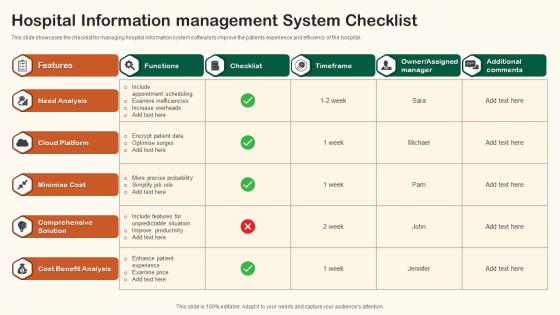
Hospital Information Management System Checklist




Try Before you Buy Download Free Sample Product
 Impress Your
 Audience
 100%
100% Editable
 Save Hours
 of Time


This slide showcases the checklist for managing hospital information system software to improve the patients experience and efficiency of the hospital.
People who downloaded this PowerPoint presentation also viewed the following :
Hospital Information Management System Checklist with all 9 slides:
Use our Hospital Information Management System Checklist to effectively help you save your valuable time. They are readymade to fit into any presentation structure.








FAQs for Hospital Information
Key features of an effective HIMS include patient record management, appointment scheduling, billing integration, inventory tracking, and clinical decision support systems. These technologies streamline hospital operations by automating administrative tasks, enhancing patient care coordination, and improving data accuracy, with many healthcare institutions finding that comprehensive HIMS ultimately delivers faster patient services, reduced operational costs, and better clinical outcomes.
A HIMS improves patient care by enabling real-time access to medical records, automated medication management, and coordinated care across departments, while streamlining operations through digital workflows and resource optimization. Through integrated systems, hospitals deliver faster diagnoses, reduce medical errors, and enhance patient safety, ultimately improving treatment outcomes and operational efficiency in increasingly complex healthcare environments.
Data security serves as the foundation for Hospital Information Management System implementation, encompassing patient data encryption, access controls, audit trails, compliance protocols, and breach prevention measures. Through advanced cybersecurity frameworks, healthcare institutions streamline regulatory compliance, enhance patient trust, and minimize liability risks, while ensuring seamless integration with existing systems, ultimately delivering operational efficiency and competitive advantage in an increasingly digital healthcare landscape.
HIMS integration with EHR systems enhances clinical workflows by centralizing patient data, automating documentation processes, reducing duplicate entries, and enabling real-time information sharing across departments. This seamless connectivity allows healthcare providers to access comprehensive patient histories instantly, streamline care coordination, and minimize administrative burdens, ultimately delivering faster diagnoses and improved patient outcomes.
Hospitals face significant challenges including staff resistance to workflow changes, data migration complexities, integration with existing medical equipment, extensive training requirements, and temporary productivity declines during implementation. While these transitions present initial operational disruptions, many healthcare institutions find that strategic planning, phased rollouts, and comprehensive staff support ultimately deliver enhanced patient care, streamlined operations, and improved clinical outcomes.
A HIMS supports HIPAA compliance by implementing robust access controls, comprehensive audit trails, and automated data encryption protocols. These systems streamline regulatory adherence through role-based permissions, detailed logging of patient data interactions, and secure communication channels, ultimately delivering enhanced privacy protection and reduced compliance risks for healthcare organizations.
A Hospital Information Management System streamlines patient billing and insurance claims through automated charge capture, real-time eligibility verification, electronic claims submission, and integrated payment processing. These systems minimize billing errors, accelerate reimbursement cycles, and enhance revenue cycle management by automatically coding procedures, tracking claim status, and flagging discrepancies, ultimately delivering improved cash flow and reduced administrative costs.
Cloud-based HIMS solutions offer reduced IT infrastructure costs, automatic updates, scalability, and remote accessibility, while on-premises systems provide greater data control, customization options, and regulatory compliance assurance. Healthcare organizations increasingly find that cloud solutions streamline operations and reduce maintenance overhead, though many hospitals balance these approaches based on their specific security requirements and budget constraints.
Data analytics in HIMS transforms hospital decision-making by providing real-time insights into patient flow, resource utilization, operational efficiency, and clinical outcomes through comprehensive reporting dashboards. These analytics enable administrators to optimize staffing schedules, reduce wait times, and improve patient satisfaction, while identifying cost-saving opportunities and enhancing care quality across departments.
Best practices for training staff on a new Hospital Information Management System include role-based training modules, hands-on simulation environments, phased implementation approaches, ongoing support systems, and comprehensive documentation resources. These training strategies enhance user adoption by reducing resistance to change, minimizing errors during patient care workflows, and ensuring seamless integration across departments, with many healthcare institutions finding that structured training programs ultimately deliver improved patient outcomes and operational efficiency.
A HIMS improves communication through patient portals, secure messaging systems, automated appointment reminders, real-time test result sharing, and digital care coordination tools. These technologies streamline information exchange by enabling instant access to medical records, facilitating direct provider-patient messaging, and delivering timely health updates, ultimately enhancing patient engagement and care coordination across healthcare networks.
A robust HIMS significantly enhances administrative efficiencies by automating patient registration, streamlining billing processes, reducing paperwork, and enabling real-time data access across departments. Through integrated scheduling and resource management, hospitals minimize wait times, optimize staff allocation, and accelerate insurance processing, ultimately delivering faster patient services and reduced operational costs.
Patient engagement technology integrates with Hospital Information Management Systems through APIs, mobile applications, patient portals, and real-time data synchronization capabilities. These integrations enable seamless appointment scheduling, secure messaging between patients and providers, automated medication reminders, and direct access to medical records, ultimately enhancing patient satisfaction while reducing administrative workload for healthcare staff.
Ensuring HIMS interoperability requires implementing standardized data formats like HL7 and FHIR, adopting cloud-based integration platforms, establishing robust API frameworks, and maintaining consistent data governance protocols. These measures enable seamless information exchange between electronic health records, laboratory systems, and imaging platforms, with many healthcare networks finding that strategic interoperability ultimately delivers faster patient care and reduced operational costs.
Hospitals should anticipate AI-driven predictive analytics, enhanced interoperability standards, cloud-based infrastructure, mobile-first interfaces, and blockchain security integration in HIMS development. These advancing technologies streamline patient care workflows, reduce administrative costs, and enable real-time data sharing across healthcare networks, with many medical institutions finding that early adoption delivers significant competitive advantages.
-
Crisp and neat slides. Makes it fun and easier to curate presentations.
-
Very unique and reliable designs.