


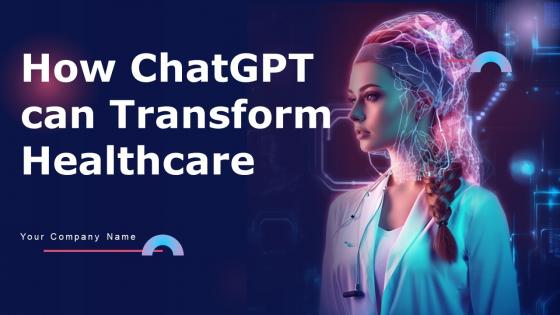
How ChatGPT Can Transform Healthcare ChatGPT CD V




Try Before you Buy Download Free Sample Product
 Impress Your
 Audience
 100%
100% Editable
 Save Hours
 of Time


ChatGPT is transforming healthcare with its advanced AI capabilities. It assists in patient support, medical documentation, diagnosis, drug interaction checking, health education, and telemedicine. Our PowerPoint Presentation titled, How ChatGPT can Transform Healthcare covers the benefits of increased efficiency as ChatGPT handles administrative tasks, enabling healthcare professionals to focus on patient care. Additionally, this Chat GPT in Healthcare deck shows how Patients receive timely and accurate information, improving their overall experience. It also shows how medical documentation is precise and comprehensive, reducing errors. Moreover, this GPT 3 Healthcare deck shows how ChatGPT aids diagnosis by analyzing symptoms and histories, and it enhances patient safety by identifying drug interactions. It further incorporates that with GPT, Health education becomes more accessible, promoting informed decision-making. Lastly, this Open AI Healthcare module Integrates ChatGPT into healthcare operations to improve efficiency, patient care, and documentation accuracy. Lastly, our GPT 3 Healthcare deck offers a promising future for AI in healthcare, where technology and patient well-being go hand in hand. Get our 100 percent editable chatgpt ppt right now.
People who downloaded this PowerPoint presentation also viewed the following :
Content of this Powerpoint Presentation
Slide 1: This slide introduces How ChatGPT can Transform Healthcare. State Your Company Name and begin.
Slide 2: This slide is an Agenda slide. State your agendas here.
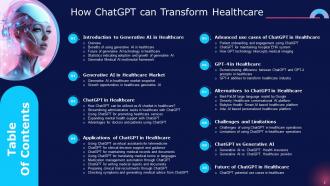
Slide 3: This slide shows a Table of Contents for the presentation.
Slide 4: This slide is an introductory slide.
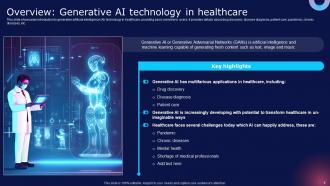
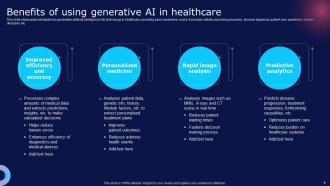
Slide 5: This slide showcases introduction to generative artificial intelligence (AI) technology in healthcare, providing basic overview to users.
Slide 6: This slide is in continuation with the previous slide.
Slide 7: This slide is in continuation with the previous slide.
Slide 8: This slide presents statistics which can be referred by industrial experts and doctors which point towards growth and adoption of generative AI.
Slide 9: This slide showcases statistics which can be referred by industrial experts and doctors to familiarize with Generalist Medical AI (GMAI).
Slide 10: This slide is an introductory slide.
Slide 11: This slide entails market snapshot of generative AI in healthcare, necessary for investors and companies to take actionable decisions.
Slide 12: This slide focuses on growth opportunities of generative AI in healthcare, necessary for investors and companies to take actionable decisions.
Slide 13: This slide is an introductory slide.
Slide 14: This slide represents how ChatGPT generative chatbot tool can be used by healthcare professionals to aid them in different tasks.
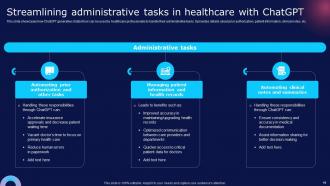
Slide 15: This slide illustrates on how ChatGPT generative chatbot tool can be used by healthcare professionals to handle their administrative tasks.
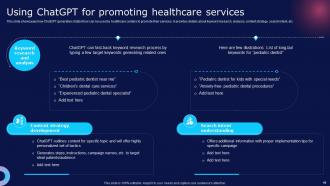
Slide 16: This slide focuses on how ChatGPT generative chatbot tool can be used by healthcare centers to promote their services.
Slide 17: This slide is in continuation with the previous slide.
Slide 18: This slide showcases how ChatGPT can help patients and healthcare professionals consider this platform for mental-healthcare assistance.
Slide 19: This slide is an introductory slide.
Slide 20: This slide focuses on why ChatGPT is a crucial platform to consider it as virtual assistant.
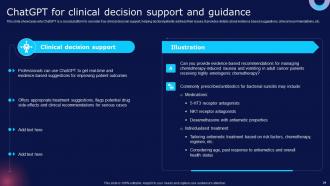
Slide 21: This slide presents why ChatGPT is a crucial platform to consider it as clinical decision support, helping doctors/patients address their issues.
Slide 22: This slide entails why ChatGPT is a crucial platform to consider it as medical records manager, helping doctors address their issues.
Slide 23: This slide is in continuation with the previous slide.
Slide 24: This slide showcases why ChatGPT is a crucial platform to consider it as medication management, helping doctors/patients address their issues.
Slide 25: This slide is in continuation with the previous slide.
Slide 26: This slide shows why ChatGPT is a crucial platform to consider it as clinical trial recruitment tool, helping doctors generate questions.
Slide 27: This slide encompasses why ChatGPT is a crucial platform for checking symptoms and generating medical advice.
Slide 28: This slide is an introductory slide.
Slide 29: This slide illustrates patient onboarding and engagement using ChatGPT, helping healthcare professionals increase operational efficiency.
Slide 30: This slide focuses on applications of ChatGPT in maintaining electronic health record (EHR) systems of hospitals.
Slide 31: This slide showcases how doctors or individuals can use generative pre transformer (GPT) technology to scan their health/radiology scans.
Slide 32: This slide is an introductory slide.
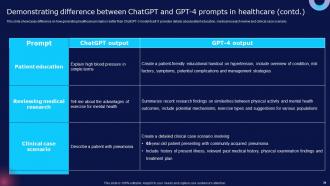
Slide 33: This slide showcases difference on how generating healthcare prompts is better than ChatGPT-3 model itself.
Slide 34: This slide shows difference on how generating healthcare prompts is better than ChatGPT-3 model itself.
Slide 35: This slide focuses on how GPT-4 is capable of transforming healthcare industry, particularly helpful for doctors seeking growth.
Slide 36: This slide is an introductory slide.
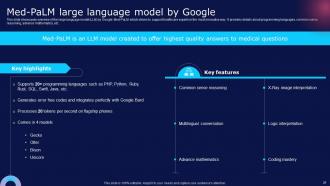
Slide 37: This slide presents an overview of the large language model (LLM) by Google: Med-PaLM which strives to support healthcare experts in the most innovative way.
Slide 38: This slide represents an overview of conversational AI tool Sensely which helps patients and doctors manage their tasks through virtual assistance.
Slide 39: This slide puts an overview of smart AI tool Babylon Health which helps patients and doctors manage their tasks through virtual assistance.
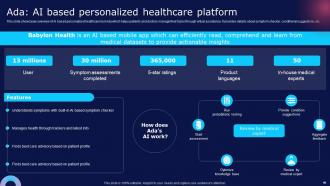
Slide 40: This slide showcases overview of AI based personalized healthcare tool Ada which helps patients and doctors manage their tasks through virtual assistance.
Slide 41: This slide is an introductory slide.
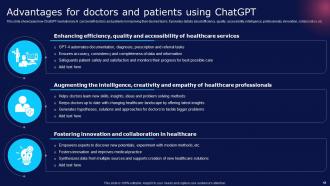
Slide 42: This slide contains how ChatGPT revolutionary AI can benefit doctors and patients in improving their desired tasks.
Slide 43: This slide showcases how ChatGPT revolutionary AI can be disadvantageous for doctors and patients in healthcare related decisions.
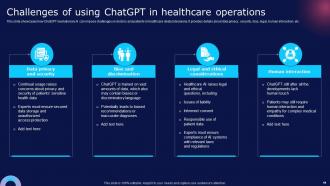
Slide 44: This slide contains how ChatGPT revolutionary AI can impose challenges on doctors and patients in healthcare related decisions.
Slide 45: This slide is an introductory slide.
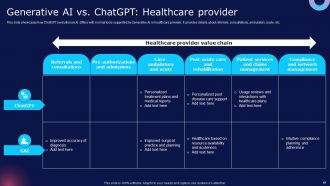
Slide 46: This slide caters to how ChatGPT revolutionary AI differs with normal tools supported by Generative AI in health insurance application.
Slide 47: This slide is in continuation with the previous slide.
Slide 48: This slide is an introductory slide.
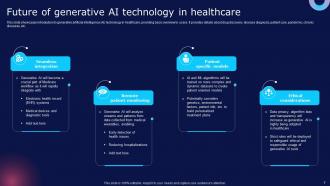
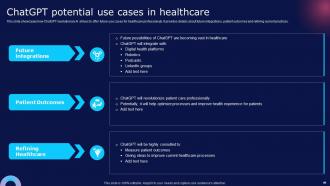
Slide 49: This slide represents how ChatGPT revolutionary AI strives to offer future use cases for healthcare professionals.
Slide 50: This slide shows all the icons included in the presentation.
Slide 51: This slide is titled Additional Slides for moving forward.
Slide 52: This slide is a Timeline slide. Show data related to time intervals here.
Slide 53: This slide depicts a Venn diagram with text boxes.
Slide 54: This slide presents a Roadmap with additional text boxes.
Slide 55: This slide shows SWOT describing- Strength, Weakness, Opportunity, and Threat.
Slide 56: This slide is a thank-you slide with address, contact numbers, and email address.
How ChatGPT Can Transform Healthcare ChatGPT CD V with all 64 slides:
Use our How ChatGPT Can Transform Healthcare ChatGPT CD V to effectively help you save your valuable time. They are readymade to fit into any presentation structure.

































FAQs for How ChatGPT Can Transform Healthcare
ChatGPT enhances diagnostic accuracy by analyzing patient symptoms, medical histories, and clinical data to suggest potential conditions, cross-reference rare diseases, and highlight overlooked possibilities. Through natural language processing, healthcare professionals streamline differential diagnosis workflows, reduce diagnostic errors, and access comprehensive medical knowledge databases, ultimately delivering faster patient assessments and more informed clinical decisions.
ChatGPT enhances patient education by providing accessible explanations of medical conditions, treatment options, medication instructions, and preventive care measures in understandable language. Through conversational interactions, healthcare organizations can deliver personalized health information, answer common patient questions, and improve health literacy rates, with many hospitals and clinics finding that AI-powered education tools significantly reduce patient anxiety while increasing treatment compliance and engagement.
ChatGPT enhances healthcare communication by providing 24/7 patient support, simplifying complex medical information into understandable language, and streamlining appointment scheduling and follow-up reminders. Through automated responses and personalized interactions, hospitals and clinics can deliver faster patient services, reduce administrative burdens on staff, and ultimately improve patient satisfaction while enabling providers to focus on direct care delivery.
ChatGPT facilitates mental health support by providing 24/7 accessibility, personalized coping strategies, preliminary symptom assessment, and immediate crisis intervention guidance through digital platforms. While not replacing licensed therapists, it enables healthcare systems to extend reach and reduce wait times, with many mental health organizations finding that AI-powered chatbots deliver consistent support between appointments, ultimately enhancing patient engagement and therapeutic outcomes.
Ethical concerns include patient privacy breaches, diagnostic accuracy limitations, informed consent challenges, potential bias in responses, and reduced human empathy in care delivery. While ChatGPT enhances accessibility and streamlines initial consultations, healthcare institutions must establish robust oversight protocols, transparent AI disclosure practices, and maintain physician supervision to ensure patient safety and trust remain paramount.
ChatGPT streamlines healthcare administration by automating appointment scheduling, patient intake documentation, insurance verification, and medical record updates through natural language processing. Many hospitals and clinics find that implementing AI-powered systems reduces administrative workload by 40-60%, enabling staff to focus on patient care while minimizing errors and accelerating routine processes.
Healthcare organizations can ensure ChatGPT accuracy through clinical validation protocols, integration with verified medical databases, continuous model training with peer-reviewed sources, and mandatory human oversight by licensed professionals. Many hospitals and medical institutions are implementing multi-layer verification systems, combining AI insights with physician review and evidence-based guidelines, ultimately delivering enhanced diagnostic support while maintaining rigorous safety standards.
ChatGPT contributes to personalized medicine by analyzing patient data patterns, medical histories, and genetic information to suggest tailored treatment approaches. Through natural language processing, healthcare providers can quickly interpret complex patient information, identify relevant treatment protocols, and generate personalized care recommendations, ultimately enabling more precise interventions and improved patient outcomes.
ChatGPT enhances telemedicine by automating patient intake, providing preliminary symptom assessment, and enabling 24/7 virtual assistance for routine inquiries and appointment scheduling. These capabilities streamline remote consultations, reduce physician workload, and improve patient access to healthcare services, with many healthcare systems finding that AI-powered platforms ultimately deliver faster response times and more efficient resource allocation.
ChatGPT supports clinical decision-making by analyzing patient symptoms, suggesting differential diagnoses, recommending evidence-based treatment protocols, and providing real-time access to medical literature and guidelines. Through natural language processing, healthcare teams can streamline diagnostic workflows, enhance patient consultations, and reduce documentation time, with many hospitals finding that AI-assisted tools ultimately improve care quality while minimizing clinical errors.
ChatGPT integration into EHR systems enhances usability through natural language interfaces, automated documentation, intelligent search capabilities, and streamlined data entry workflows. Healthcare providers increasingly find that AI-powered EHRs reduce administrative burden, accelerate patient record updates, and enable more intuitive system navigation, ultimately delivering faster clinical decision-making and improved patient care efficiency.
Healthcare providers face implementation challenges including data privacy compliance, integration with existing electronic health records, staff training requirements, and ensuring clinical accuracy across diverse medical scenarios. While these hurdles require strategic planning and resource allocation, many hospitals and clinics find that phased deployment approaches, combined with robust validation protocols, ultimately streamline operations and enhance patient care delivery.
ChatGPT enhances continuous medical education by providing personalized learning pathways, instant access to updated medical knowledge, interactive case study discussions, and real-time answers to clinical questions. Through AI-powered content delivery, healthcare professionals can streamline their education schedules, access specialized training modules, and engage with simulated patient scenarios, ultimately delivering more informed care while maintaining current certifications in an increasingly complex medical landscape.
ChatGPT can automate patient follow-ups through personalized appointment reminders, medication adherence prompts, post-treatment check-ins, and care plan updates, while providing 24/7 accessibility for routine inquiries. This technology streamlines administrative workflows by reducing manual outreach tasks, minimizing no-show rates, and enhancing patient engagement, with many healthcare providers finding that automated follow-up systems ultimately deliver improved care continuity and operational efficiency.
Healthcare organizations maintain data privacy and security with ChatGPT through robust encryption, secure API configurations, anonymization protocols, HIPAA-compliant hosting environments, and strict access controls. These comprehensive safeguards enable hospitals and medical institutions to leverage AI assistance for clinical documentation and patient communication while ensuring sensitive health information remains protected, ultimately delivering enhanced operational efficiency without compromising regulatory compliance.
-
Great product, helpful indeed!
-
The design is very attractive, informative, and eye-catching, with bold colors that stand out against all the basic presentation templates.