


HR Data Governance Integrated Framework




Try Before you Buy Download Free Sample Product
 Impress Your
 Audience
 100%
100% Editable
 Save Hours
 of Time


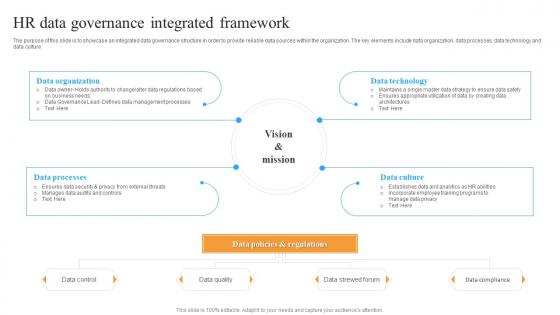
The purpose of this slide is to showcase an integrated data governance structure in order to provide reliable data sources within the organization. The key elements include data organization, data processes, data technology and data culture
People who downloaded this PowerPoint presentation also viewed the following :
HR Data Governance Integrated Framework with all 6 slides:
Use our HR Data Governance Integrated Framework to effectively help you save your valuable time. They are readymade to fit into any presentation structure.





FAQs for HR Data
HR data governance encompasses accuracy, privacy, accessibility, retention, and compliance principles that ensure workforce information remains reliable and secure. These principles enable organizations to streamline recruitment processes, enhance employee experiences, and maintain regulatory compliance, with many companies finding that strategic data governance ultimately delivers improved decision-making and operational efficiency across their entire workforce management ecosystem.
Organizations ensure compliance with data protection regulations through comprehensive data mapping, regular access audits, employee training programs, automated compliance monitoring, and robust encryption protocols. These governance frameworks streamline regulatory adherence by establishing clear data handling procedures, implementing role-based access controls, and maintaining detailed audit trails, with many HR departments finding that proactive compliance measures ultimately deliver enhanced data security and reduced regulatory risk.
Data quality serves as the foundation of effective HR data governance through accurate employee records, consistent data standards, regular validation processes, and comprehensive audit trails. These quality measures streamline compliance reporting, enhance decision-making accuracy, and minimize costly errors, with many organizations finding that automated data cleansing and standardized input protocols ultimately deliver improved workforce analytics and strategic HR insights.
Organizations measure HR data governance effectiveness through key performance indicators like data accuracy rates, compliance audit scores, user access reviews, and policy adherence metrics. These measurements typically include tracking data quality improvements, regulatory compliance percentages, incident response times, and employee training completion rates, with many companies finding that regular governance assessments ultimately deliver enhanced decision-making capabilities and reduced compliance risks.
HR departments face key challenges including data silos across multiple systems, ensuring compliance with evolving privacy regulations, managing data quality and accuracy, securing employee consent, and establishing clear ownership responsibilities. These obstacles often stem from legacy HR systems, limited technical expertise, and resistance to change, with many organizations finding that strategic investment in integrated platforms and cross-functional training ultimately delivers improved compliance and operational efficiency.
Technology enhances HR data governance through automated compliance monitoring, real-time analytics platforms, centralized data repositories, and integrated reporting systems. These solutions streamline data accuracy by eliminating manual processes, ensuring regulatory compliance, and providing predictive insights, with many organizations finding that automated governance delivers faster decision-making and significantly improved workforce planning capabilities.
HR data classification best practices include defining sensitivity levels, establishing clear data categories, implementing role-based access controls, creating standardized labeling systems, and conducting regular audits. These frameworks enhance security by protecting confidential employee information, streamlining compliance with regulations like GDPR, and enabling efficient data retrieval, with many organizations finding that structured classification significantly reduces data breach risks while improving operational efficiency.
Organizations should approach employee consent through transparent data collection policies, clear opt-in/opt-out mechanisms, regular consent renewals, and comprehensive privacy notifications that explain data usage purposes. This strategic combination builds trust while ensuring compliance, with many companies finding that transparent consent processes enhance employee engagement, reduce legal risks, and ultimately strengthen organizational credibility in an increasingly privacy-conscious workplace environment.
HR data governance automation tools include HRIS platforms, data quality management software, identity access management systems, workflow automation tools, and compliance monitoring solutions. These technologies streamline data validation, access controls, and audit trails by automating routine compliance checks, flagging data inconsistencies, and ensuring policy adherence, with many organizations finding that automated governance reduces manual oversight while maintaining data integrity and regulatory compliance.
HR data governance contributes to diversity and inclusion by establishing systematic data collection, analysis, and reporting frameworks that identify representation gaps, track progress metrics, and ensure equitable hiring practices. Through standardized demographic tracking and bias detection analytics, organizations can measure diversity outcomes across recruitment, promotions, and retention, while ensuring compliance with equality regulations, ultimately delivering more inclusive workplaces and improved organizational performance.
HR professionals should develop data literacy skills, privacy law knowledge, analytics capabilities, database management expertise, and cybersecurity awareness to effectively govern HR data. These competencies enable streamlined compliance monitoring, enhanced decision-making through workforce analytics, and robust data protection protocols, with many organizations finding that skilled HR data stewards deliver improved operational efficiency, reduced legal risks, and ultimately stronger strategic workforce planning capabilities.
Data governance practices vary significantly across HR functions, with recruitment focusing on candidate privacy and compliance screening, payroll emphasizing financial accuracy and regulatory reporting, and performance management prioritizing confidentiality and retention policies. These specialized approaches enable organizations to maintain function-specific security protocols while ensuring seamless data integration, with many companies finding that tailored governance frameworks ultimately deliver both operational efficiency and enhanced employee trust.
HR departments should prioritize metrics including data accuracy rates, compliance audit scores, employee data access times, privacy incident frequency, and policy adherence levels. These measurements enable organizations to track operational efficiency, regulatory compliance, and user satisfaction, with many companies finding that strong governance metrics ultimately deliver reduced risk exposure, faster HR processes, and enhanced strategic decision-making capabilities.
Collaboration between IT and HR enhances data governance through shared technical expertise, standardized data protocols, streamlined compliance monitoring, and integrated security frameworks. This strategic partnership enables organizations to implement robust access controls, automate data quality checks, and maintain regulatory compliance more effectively, with many companies finding that cross-functional governance teams deliver significantly improved data accuracy and operational efficiency.
Organizations align HR data governance strategies with business goals by establishing clear data ownership, implementing standardized collection processes, ensuring compliance frameworks, and creating analytics capabilities that support strategic decision-making. Through integrated governance platforms, companies enhance talent acquisition, optimize workforce planning, and improve employee experiences while maintaining data integrity, ultimately delivering competitive advantage and operational efficiency.
-
This design is not only aesthetically pleasing but it has many uses making the cost worthwhile. The graphics look stunning, and you can edit them as per your needs.
-
A beautiful, professional design paired with high-quality images and content that is sure to impress. It is a must-use PPT template in my opinion.