


Hr shared service centre delivery model transforming human resource ppt download




Try Before you Buy Download Free Sample Product
 Impress Your
 Audience
 100%
100% Editable
 Save Hours
 of Time


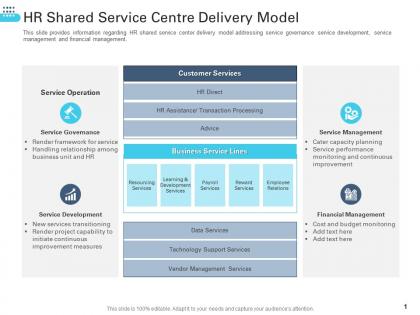
This slide provides information regarding HR shared service center delivery model addressing service governance service development, service management and financial management.
People who downloaded this PowerPoint presentation also viewed the following :
Hr shared service centre delivery model transforming human resource ppt download with all 2 slides:
Use our HR Shared Service Centre Delivery Model Transforming Human Resource Ppt Download to effectively help you save your valuable time. They are readymade to fit into any presentation structure.
FAQs for Hr shared service centre delivery model transforming human
Honestly, it's a game changer for cutting costs and getting everyone on the same page. Instead of each department doing payroll and benefits their own way, you centralize all that stuff - way less duplicate work. Your HR people can actually focus on the big picture instead of drowning in paperwork, which is refreshing. The consistency thing is huge too. No more "wait, how does the Seattle office handle onboarding again?" Plus if you're growing fast, it scales really well. I'd start by figuring out which routine processes are currently sucking up all your time - that's your low-hanging fruit right there.
Honestly, HR shared services makes things way smoother for employees. Dedicated teams handle payroll questions and benefits stuff, so you're not waiting forever for answers. The best part? No more getting different responses depending on who you ask - that used to drive me crazy at my old job. Self-service portals are clutch too; you can update your address or check PTO without bothering anyone. Just make sure they set clear service standards and actually survey people regularly. Otherwise it's just fancy reorganization that doesn't help anyone.
Honestly, go with a centralized hub - one main shared services center doing all the transactional stuff for every business unit. Payroll, benefits, basic employee questions, you know the drill. Clear service agreements are crucial here. Some places do hybrid where strategic HR stays with each unit but operations get centralized. Map out what you're currently doing first though - figure out what can actually be standardized across the board. Oh and don't create a nightmare of red tape in the process! That defeats the whole point. Start small if you need to.
Honestly, tech is a lifesaver for all that boring repetitive work your team probably hates doing anyway. Self-service portals let people update their own stuff instead of bugging you constantly. Chatbots handle the same five questions everyone asks at 2am. Analytics show you exactly where things get stuck - way better than just guessing what's broken. Cloud systems mean your team can work from literally anywhere without security nightmares. Oh, and workflow automation routes stuff automatically so nothing sits in someone's inbox forever. Start with whatever manual process makes you want to scream - that's where you'll see results fastest.
Track cost per transaction and how fast you're processing stuff like onboarding or payroll questions. First-call resolution rates matter too. But honestly, employee satisfaction scores are probably the most important - nobody cares if you're saving money if people are miserable using the system. Error rates and whether you're actually hitting your SLAs round out the basics. Oh, and don't go crazy with metrics at first. Pick 3-4 key ones that show you're cutting costs AND making life easier for employees. That's really what you're after.
So basically HR Shared Services just means everyone follows the same playbook instead of each department doing their own random thing. Marketing can't have some weird onboarding process while finance does something totally different - everything gets standardized. Templates, workflows, policies, all of it. One team handles everything from hiring to performance stuff to when people leave. Makes reporting way easier too since you're not dealing with five different systems. Honestly saves so much headache. I'd start by figuring out where your departments are doing things most differently right now.
Dude, change management will kill you - people hate new processes more than anything. Your data's gonna be a disaster too, way messier than anyone admits upfront. Then suddenly everyone wants their random side projects crammed in (classic scope creep). Integrating with old systems is its own nightmare. Weirdly enough, the actual tech stuff is usually the easy part compared to getting humans to cooperate. Timeline's gonna blow up because nobody gets how hard it is to standardize stuff across different teams. Oh, and definitely lock down executive support first - learned that one the hard way. Start overcommunicating from day one.
Start with solid access controls and encrypt everything - data moving around and stored data. Train your shared services team properly on handling protocols because honestly, most breaches happen when someone screws up, not from hackers. Create clear governance policies about who accesses what and when. Regular compliance audits are crucial too. Set up incident response procedures and keep detailed logs of everything. Oh, and don't treat this like a one-and-done thing - I'd schedule quarterly reviews to spot problems early. Security's more like maintaining your car than buying it, you know?
Honestly, start with project management skills - that's your foundation for everything else. Process optimization and data analysis are huge since you're always hunting for ways to make HR ops smoother across different teams. Excel will basically become your life (seriously, get comfortable with it now). HRIS systems and automation tools are part of the daily grind too. Communication skills matter tons because each business unit has totally different needs and expectations. Oh, and change management experience is clutch - you're constantly rolling out new processes that affect people company-wide, so knowing how to handle that resistance makes life way easier.
So basically HR Shared Services puts all your hiring and onboarding stuff in one place with the same processes everywhere. Pretty smart actually. New hires get the same experience no matter which department they're joining, and onboarding isn't this chaotic mess anymore - you know how some managers just wing it? Yeah, that stops. Hiring usually gets faster since there's actual dedicated people doing this instead of random HR folks wearing ten different hats. Downside is it can feel kinda impersonal sometimes. But honestly, most companies see quicker hiring and new employees who aren't completely lost their first week.
Look, good customer service can literally make or break your whole HR shared services thing. People lose trust super quickly when they can't get straight answers about their benefits or payroll stuff. Nobody's got patience for crappy chatbots first thing Monday morning - trust me on that one. You need reps who actually know what they're talking about and can fix problems fast. The whole point falls apart if employees start finding workarounds instead of using your system. Response times and how quickly you resolve issues? Those numbers don't lie. Track those religiously.
Honestly, start by actually asking your different employee groups what they need - sounds basic but most companies skip this step entirely. Multilingual support is huge, especially if you've got global teams. Remote workers need totally different onboarding than office people, and don't even get me started on compliance variations across locations. Build different service pathways but keep your core stuff standardized (trust me on this one). Survey each workforce segment first to find their biggest headaches. You'll probably discover pain points you didn't even know existed. The flexibility comes from understanding these differences upfront.
Start with the systems training obviously, but don't sleep on the customer service stuff - your team's gonna be fielding complaints and weird questions constantly. Cross-training is huge so nobody gets stuck doing only payroll forever (trust me on this one). Role-playing helps with the tricky situations they'll face. Oh, and definitely pair newbies with someone experienced for their first couple weeks. Document everything as you go though, even if it feels tedious now. You'll thank yourself later when you're not explaining the same process for the tenth time.
Track your cost savings first - compare what you spent before (staff, tech, overhead) vs now. Processing times, error rates, and how much strategic work your HR folks can actually do instead of paperwork - those are your efficiency wins. The soft benefits are honestly the hardest to measure but usually where you see the biggest impact. Maybe I'm biased, but a quarterly dashboard with key metrics really helps when you need to show leadership actual numbers. Otherwise they just see it as another expense, you know?
Dude, AI automation is seriously taking over HR right now. Chatbots are handling all the basic questions employees used to bug HR about. Self-service portals let people update their own info too. Data analytics has gotten crazy good - like, companies can actually predict who's gonna quit before it happens. Cloud platforms make scaling way easier than the old clunky systems. Instead of just pushing paperwork around, HR teams are finally doing strategic stuff that matters. You should honestly look at what you've got now and see where bots could take over the boring tasks.
-
Great designs, really helpful.
-
Very unique, user-friendly presentation interface.