

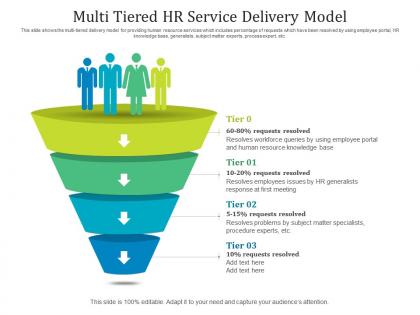
Multi tiered hr service delivery model




Try Before you Buy Download Free Sample Product
 Impress Your
 Audience
 100%
100% Editable
 Save Hours
 of Time


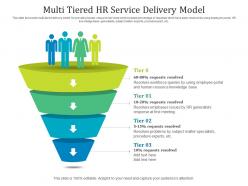
This slide shows the multi-tiered delivery model for providing human resource services which includes percentage of requests which have been resolved by using employee portal, HR knowledge base, generalists, subject matter experts, process expert, etc.
People who downloaded this PowerPoint presentation also viewed the following :
Multi tiered hr service delivery model with all 2 slides:
Use our Multi Tiered HR Service Delivery Model to effectively help you save your valuable time. They are readymade to fit into any presentation structure.
FAQs for Multi tiered hr
So there's three main tiers you'll want to set up. Self-service handles the easy stuff - employees can update their info, request time off, that kind of thing. Shared services is your central hub for payroll and benefits admin. Centers of excellence focus on the strategic work like talent management. That's honestly where you get the biggest bang for your buck business-wise. The tricky part is making sure they all connect smoothly so people aren't getting bounced around. I'd start by figuring out what goes where based on how complex it is and how often it happens. Pretty straightforward once you map it out.
So basically, you set up different levels of HR support depending on what people need. Quick questions? Self-service portal. More complicated stuff gets routed to dedicated teams, and the really messy situations go to specialists. Think grocery store checkout - express lane vs full service, you know? Honestly, it cuts down on so much frustration because people aren't waiting forever in the wrong line. Resolution times speed up. Everyone gets help that actually matches their problem. I'd start by figuring out what your team bugs HR about most - that'll show you where to focus first.
So here's the thing - you'll want self-service portals and chatbots handling the easy stuff first (password resets, basic policy questions). Your Tier 2 people need solid case management systems and knowledge bases for the trickier issues. Good routing algorithms are clutch here, otherwise everything just becomes chaos. Oh, and make sure your systems actually talk to each other so cases can move up tiers without losing all the context - that's where most companies mess up. I'd map out what you're doing now before adding any automation. Focus on cutting out manual handoffs first since those are usually the biggest pain points.
Track your basics first - resolution times, first-call fixes, customer satisfaction for each tier. Compare how many issues get solved at tier 1 vs. escalated up (lower escalation = better, obviously). Don't forget employee satisfaction because miserable HR staff creates miserable employees. Cost per transaction matters too since efficiency is the whole point. I'd also throw in quarterly reviews to spot bottlenecks in your service delivery. Honestly, the escalation rate is probably gonna be your most telling metric - if everything's getting bumped up to tier 2, something's broken at the foundation level.
Honestly, people hate change - that's gonna be your biggest headache. Everyone's used to just calling Sarah in HR directly, you know? They don't want some tiered system telling them to start with level 1 support. Training your team on what issues go where is trickier than it sounds too. I'd probably spend way too much time on that part tbh. Your tech stack better be rock solid or people will just bypass the whole thing. Oh, and draw out super specific examples before you go live - like "password reset goes here, harassment complaint goes there." Makes the boundaries way clearer.
You need solid communication between your tiers - that's the biggest thing. Weekly syncs work great for Tier 1, 2, and 3 teams to actually talk through cases together. Shared case systems are crucial so everyone sees the full picture, not just their piece. I've watched way too many tickets get lost when teams don't talk! The feedback part is huge though - let your frontline folks tell specialists what's breaking constantly, and have specialists train the service desk on new trends. Oh, and those case review meetings? They're honestly a game-changer for catching patterns early.
Start by figuring out what each tier actually needs to know - sounds obvious but most people skip this step. Your Tier 1 team needs rock-solid basics and clear escalation rules. Tier 2 should dive deeper into the messy, complex stuff. Cross-training between levels is honestly where the magic happens though. When everyone gets how the whole chain works, handoffs stop being a nightmare. Oh, and don't forget soft skills training - I've seen too many technically brilliant people crash and burn because they can't talk to frustrated employees. Regular knowledge sharing sessions help tons too.
Honestly, you've gotta nail down some solid communication protocols first. Regular sync meetings between tiers are clutch - I can't stress this enough. Map out clear escalation paths so everyone knows exactly when to hand stuff off. Those weekly cross-tier huddles? Total game changer. They catch problems before everything goes sideways. Make sure all your tiers are updating the knowledge base in real-time, and use the same documentation templates so messaging doesn't get weird between Tier 1 and Tier 3. Oh, and definitely start by figuring out where your current communication is breaking down - then build around fixing those specific headaches.
Yeah, so different tiers need different metrics since they're doing totally different stuff. Tier 1 (self-service) - track adoption rates, user satisfaction, and whether people actually find answers without escalating. First-call resolution and handle time matter most for Tier 2, plus customer satisfaction obviously. Tier 3's trickier since it's complex cases - resolution time, escalation accuracy, outcome quality. Don't go crazy with like 10 KPIs though, you'll drown in data. Pick 2-3 solid ones per tier first. Once you've got baseline numbers, then you can add more if needed.
Build feedback loops at every tier - pulse surveys, exit interviews, regular check-ins with HR partners. Make sure feedback actually travels up from Tier 1 self-service stuff all the way to complex Tier 3 issues. Here's what kills me though: so many companies collect all this feedback then do absolutely nothing with it. That's honestly worse than not asking! Set up quarterly reviews where each tier shares common problems and fixes with leadership. But here's the crucial part - you've got to close the loop. Tell people what you're changing based on their input, or they'll just stop bothering to give feedback next time.
Check out IBM, GE, and Shell - they're the gold standard for multi-tiered models. IBM started this whole shared services thing in the early 2000s (God, that makes me feel old). Accenture, P&G, and Microsoft also killed it with their implementations. The secret sauce? They actually figured out how to separate transactional work from complex cases and strategic consulting. Honestly, IBM's probably your best starting point - their case studies are surprisingly detailed about what worked and what totally bombed. Way more honest than most companies are about their failures.
Honestly, the multi-tier thing works because it sorts your HR mess into buckets that actually make sense. Basic stuff like password resets goes to self-service. Standard processes hit shared services. Complex strategy work? That's your centers of excellence. Your HR people stop wasting time on routine junk and can focus on the big picture stuff - talent strategy, change management, whatever's on fire that week. When business needs shift (and they always do), you can move resources around way faster. Map out what each tier should handle first - trust me, it'll save you headaches later.
So self-service tech is basically your go-to for all the boring stuff employees can handle themselves - updating their info, requesting PTO, checking paystubs, you know the drill. It keeps your HR team from getting bombarded with the same questions over and over. Honestly, it's pretty awesome when it actually works right. Your HR people can focus on the messy stuff that needs real human brains instead. Just make sure the portal doesn't suck to use or people will still call HR anyway and you're back where you started.
Honestly, don't just copy what other companies are doing - that's where most people mess up. Map out your actual workforce first. What are your demographics? Where are people located? Then figure out where employees get stuck most often - that's your goldmine right there. Basic tier handles password resets and policy stuff. Complex employee relations or exec comp goes to your top tier. The escalation paths should flow around those real pain points, not some textbook model. Oh, and start small! Pick one or two services, see what works, then build from there. Clear handoff protocols between tiers will save you so much headache later.
First thing - map out what you're currently doing and figure out what can be automated versus what actually needs a human touch. Break it into those three buckets: self-service, shared services, and your expert teams. Honestly, the hardest part is convincing managers they don't need HR holding their hand for basic stuff (they really don't though). Build up your self-service tools first, then slowly move the routine questions away from your generalists. Oh, and definitely explain WHY you're changing things - people hate surprises. Pilot it somewhere small before going company-wide or you'll regret it.
-
Great quality slides in rapid time.
-
Great quality product.
-
Innovative and attractive designs.
-
Enough space for editing and adding your own content.
-
Enough space for editing and adding your own content.