

HR Software Dashboard To Improve Operational Effectiveness Guide For Integrating Technology Strategy SS V




Try Before you Buy Download Free Sample Product
 Impress Your
 Audience
 100%
100% Editable
 Save Hours
 of Time


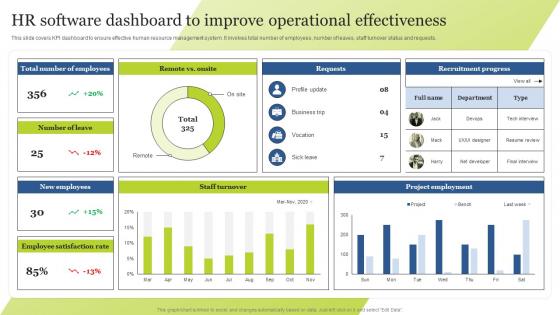
This slide covers KPI dashboard to ensure effective human resource management system. It involves total number of employees, number of leaves, staff turnover status and requests.
People who downloaded this PowerPoint presentation also viewed the following :
HR Software Dashboard To Improve Operational Effectiveness Guide For Integrating Technology Strategy SS V with all 10 slides:
Use our HR Software Dashboard To Improve Operational Effectiveness Guide For Integrating Technology Strategy SS V to effectively help you save your valuable time. They are readymade to fit into any presentation structure.








FAQs for HR Software Dashboard To Improve Operational Effectiveness Guide For Integrating Technology
Key metrics for HR software dashboards include employee turnover rates, time-to-hire, absenteeism patterns, performance scores, and training completion rates. These metrics enable HR leaders to streamline recruitment processes, enhance employee retention strategies, and optimize workforce productivity, with many organizations finding that real-time visibility into these indicators delivers faster decision-making and improved operational efficiency.
Real-time data visualization transforms HR processes by enabling instant tracking of employee performance metrics, attendance patterns, engagement scores, and recruitment pipelines, while providing immediate insights for strategic decision-making. This transparency allows HR teams to quickly identify retention risks, streamline onboarding workflows, and enhance employee satisfaction through data-driven initiatives, ultimately delivering improved workplace experiences and organizational efficiency.
HR professionals should prioritize real-time analytics, employee self-service portals, automated reporting capabilities, integration with existing HRIS systems, and customizable visualization tools when evaluating dashboard solutions. These features streamline workforce management by enhancing data accessibility, reducing administrative overhead, and enabling strategic decision-making, with many organizations finding that comprehensive dashboards ultimately deliver improved employee experiences and operational efficiency.
An HR dashboard facilitates workforce planning by providing real-time analytics on employee performance, skill gaps, retention rates, turnover predictions, and succession planning metrics. Through automated data visualization, organizations streamline talent acquisition processes, enhance strategic resource allocation, and optimize workforce deployment, with many companies finding that comprehensive dashboards ultimately deliver faster hiring decisions and improved employee engagement across departments.
Employee feedback plays a crucial role in shaping HR software dashboard design by identifying pain points, workflow preferences, user interface needs, and feature priorities from actual end-users. This input enables organizations to create more intuitive, efficient dashboards that streamline daily HR tasks, reduce training time, and enhance user adoption, with many companies finding that employee-driven design improvements ultimately deliver better workforce management outcomes and higher system utilization rates.
Data-driven insights from HR dashboards enhance diversity and inclusion initiatives by tracking recruitment demographics, identifying promotion disparities, monitoring pay equity gaps, and measuring employee engagement across different groups. These analytics enable organizations to spot unconscious bias patterns, set targeted diversity goals, and implement strategic interventions, with many companies finding that transparent data reporting ultimately accelerates inclusive workplace transformation and improves retention rates.
Best practices for customizing HR dashboards include role-based access controls, configurable KPI widgets, personalized notification settings, departmental filtering options, and scalable layout designs. These customization features streamline decision-making by delivering relevant metrics to executives, managers, and HR teams simultaneously, with organizations across healthcare, manufacturing, and retail finding that tailored dashboards enhance operational efficiency and strategic workforce planning.
Integration with other software systems enhances HR dashboard functionality by connecting payroll, benefits administration, applicant tracking, and performance management platforms into a unified interface. This strategic combination eliminates data silos, automates routine processes, and delivers real-time insights across all HR functions, with many organizations finding that seamless integration significantly streamlines operations while improving decision-making accuracy.
Essential security measures include multi-factor authentication, role-based access controls, end-to-end encryption, regular security audits, and automated logout protocols. These safeguards streamline data protection by restricting unauthorized access, encrypting sensitive information, and monitoring system vulnerabilities, with many organizations finding that comprehensive security frameworks ultimately deliver enhanced employee trust and regulatory compliance.
HR dashboards improve compliance by automatically tracking regulatory requirements, generating audit trails, and providing real-time alerts for policy violations or deadline approaches. These systems streamline documentation processes, monitor employee classifications and overtime thresholds, and ensure consistent application of labor standards across departments, with many organizations finding that centralized compliance tracking significantly reduces legal risks while enhancing operational transparency.
Strategies for user-friendly HR dashboards include intuitive navigation design, mobile-responsive interfaces, customizable views, clear data visualization, and comprehensive training programs. These approaches streamline employee self-service by minimizing clicks, enhancing accessibility across devices, and personalizing experiences, with many organizations finding that simplified dashboard layouts and role-based permissions ultimately deliver higher adoption rates and improved HR operational efficiency.
Visual storytelling through HR dashboards transforms complex workforce data into compelling narratives that drive strategic decisions, featuring interactive charts, trend visualizations, and performance metrics that communicate insights instantly. By presenting employee engagement scores, retention patterns, and productivity trends through intuitive graphics, HR leaders can effectively communicate workforce challenges and opportunities to executives, ultimately enhancing data-driven decision making and organizational transparency.
Common pitfalls include overwhelming users with excessive data, poor navigation design, lack of mobile optimization, inconsistent visual hierarchies, and insufficient user role customization. These design flaws significantly reduce adoption rates and operational efficiency, with many HR teams finding that streamlined interfaces featuring intuitive workflows, responsive design, and role-based access ultimately deliver better user engagement and strategic workforce insights.
Predictive analytics in HR dashboards enables proactive management by forecasting employee turnover, identifying flight risks, predicting hiring needs, and anticipating skill gaps before they occur. Through machine learning algorithms, organizations can streamline workforce planning, enhance retention strategies, and optimize talent acquisition, with many companies finding that predictive insights reduce turnover costs while improving employee engagement and operational efficiency.
Cloud-based HR dashboards offer enhanced accessibility, real-time data synchronization, automatic updates, reduced IT overhead, and scalable storage compared to traditional on-premise solutions. These platforms enable remote workforce management, seamless integration across multiple locations, and significantly lower maintenance costs, with many organizations finding that cloud solutions deliver faster implementation and improved collaboration while eliminating expensive hardware investments.
-
I am really satisfied with their XYZ products. Used their slides for my business presentations and now I am taking their help for my son's high-school assignments. Super satisfied!!
-
The visual appeal of the templates is just unparalleled! I was so worried about the design of my presentation but SlideTeam made it all so easy.