

Idea screening methods powerpoint presentation slides




Try Before you Buy Download Free Sample Product
 Impress Your
 Audience
 100%
100% Editable
 Save Hours
 of Time


Avoid complications with our Idea Screening Methods Powerpoint Presentation Slides.They enable you to head away from hassles.
People who downloaded this PowerPoint presentation also viewed the following :
Content of this Powerpoint Presentation
Slide 1: This slide introduces Idea screening methods. State Your Company Name and begin.
Slide 2: This is an Agenda slide. State your agendas here.
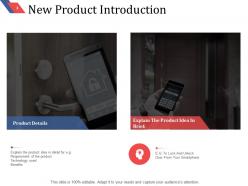
Slide 3: This slide showcases New Product Introduction with Product Details.
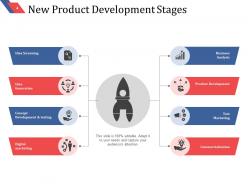
Slide 4: This slide showcases New Product Development Stages. These are- Idea Screening, Idea Generation, Concept Development & testing, Marketing Strategy, Business Analysis, Product Development, Test Marketing, Commercialization.
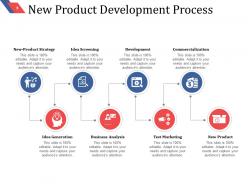
Slide 5: This slide showcases New Product Development Process with the following steps- New-Product Strategy, Idea Generation, Idea Screening, Test Marketing, Development, Business Analysis, Commercialization, New Product.
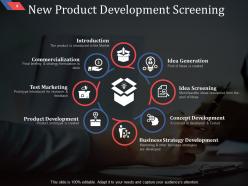
Slide 6: This slide shows New Product Development Screening consisting of- Introduction, Idea Generation, Idea Screening, Concept Development, Business Strategy Development, Product Development, Test Marketing, Commercialization, New Product Development.
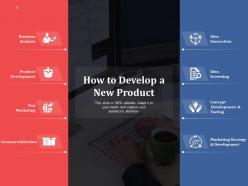
Slide 7: This slide showcases How to Develop a New Product.
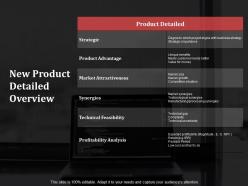
Slide 8: This slide presents New Product Detailed Overview. Use this step to ensure that unsuitable ideas are rejected as soon as possible.
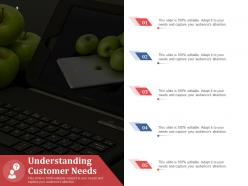
Slide 9: This is Understanding Customer Needs slide with the following points to discuss- What they do? Understand your customer, When they buy? What they expect of you? How they buy?
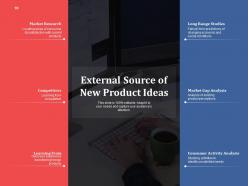
Slide 10: This slide shows External sources of New Product ideas. Some possible sources of data has been listed out to give you a fair idea, and it can be altered as per your requirement.
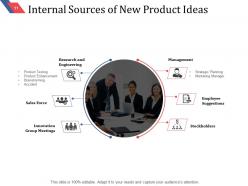
Slide 11: This slide showcases Internal Sources of New Product Ideas such as- Sales Force, Innovation Group Meetings, Stockholders, Employee Suggestions, Research and Engineering, Management.
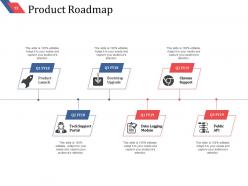
Slide 12: This slide presents Product Roadmap showing- Product Launch, Tech Support Portal, Bootstrap Upgrade, Data Logging Module, Chrome Support, Public API.
Slide 13: This is Idea screening methods Icons slide.
Slide 14: This slide is titled Additional slides to proceed forward.
Slide 15: This slide reminds about 15 minutes coffee break.
Slide 16: This slide contains Our Mission with text boxes.
Slide 17: This is Our Team slide with name and designation.
Slide 18: This is a Puzzle slide to show information, specifications etc.
Slide 19: This is Target slide. State your targets here.
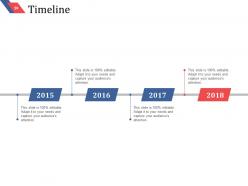
Slide 20: This is a Timeline slide to present important dates, journey, evolution, milestones etc.
Slide 21: This is a Bulb or Idea slide to state a new idea or highlight specifications/ information etc.
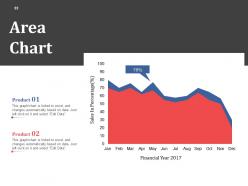
Slide 22: This slide displays Area chart with two products comparison.
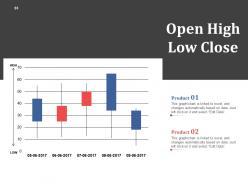
Slide 23: This slide shows Open-high-low-close chart with two products comparison.
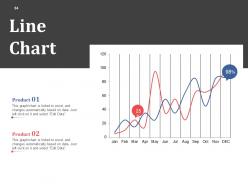
Slide 24: This slide displays Line Chart with two products comparison.
Slide 25: This is a Thank You slide with address, contact numbers and email address.
Idea screening methods powerpoint presentation slides with all 25 slides:
Deliver intelligent advice with our Idea Screening Methods Powerpoint Presentation Slides. Folks will accept the fact that you are clever.








FAQs for Idea screening methods
Effective idea screening criteria include market potential, feasibility assessment, resource requirements, competitive advantage, and alignment with organizational goals. These evaluation frameworks streamline decision-making by analyzing financial viability, technical complexity, and implementation timelines, with many organizations finding that systematic screening reduces development costs while accelerating time-to-market for promising innovations.
Businesses can utilize SWOT analysis in idea screening by evaluating each concept's strengths, weaknesses, opportunities, and threats against market realities and internal capabilities. This strategic framework enables organizations to systematically assess idea viability, identify potential risks early, and prioritize concepts with the strongest competitive positioning, ultimately streamlining resource allocation and enhancing innovation success rates.
Market research provides critical validation during idea screening by assessing market demand, identifying target audiences, analyzing competitor landscapes, and evaluating commercial viability. Through surveys, focus groups, and market analysis, organizations can minimize development risks, prioritize high-potential concepts, and allocate resources strategically, with many companies finding that early market insights significantly reduce product failure rates and accelerate time-to-market.
Balancing qualitative and quantitative metrics requires using structured frameworks that weight both customer feedback, market potential, and feasibility scores alongside financial projections, resource requirements, and timeline assessments. Organizations increasingly combine scoring matrices with stakeholder interviews, enabling teams to evaluate ideas through multiple lenses while maintaining objectivity, ultimately delivering more comprehensive assessments that reduce risk and enhance strategic decision-making.
Techniques to eliminate bias include blind evaluation processes, diverse screening committees, structured scoring matrices, devil's advocate assignments, and rotating evaluator roles. These methods enhance objectivity by removing personal identifiers from initial reviews, incorporating varied perspectives from different departments, and establishing consistent criteria, with many organizations finding that systematic approaches ultimately deliver more innovative solutions and reduce groupthink risks.
Collaborative idea screening enhances team dynamics by fostering inclusive participation, transparent evaluation criteria, and collective ownership of decisions, while encouraging diverse perspectives and constructive feedback. Through structured group evaluation processes, teams build stronger communication patterns, reduce individual bias, and create psychological safety for innovation, with many organizations finding that collaborative screening ultimately delivers both higher-quality ideas and increased team cohesion.
Scoring models deliver systematic idea evaluation through quantifiable criteria, consistent assessment standards, and reduced subjective bias. These frameworks enable organizations to compare diverse concepts objectively, streamline decision-making processes, and allocate resources more strategically, with many innovation teams finding that structured scoring accelerates project selection while minimizing costly evaluation errors.
Digital tools enhance idea screening efficiency by automating evaluation processes, enabling real-time collaboration among stakeholders, and providing data-driven analytics for objective assessment. These platforms streamline workflows through centralized databases, automated scoring algorithms, and integrated feedback systems, with many innovation teams finding that digital screening reduces evaluation time by up to 70% while improving decision accuracy.
Common pitfalls in idea screening include over-reliance on quantitative metrics, groupthink in evaluation committees, premature rejection of disruptive concepts, insufficient market validation, and rigid criteria that favor incremental improvements. These challenges can limit innovation potential by filtering out breakthrough opportunities, with many organizations finding that balanced evaluation frameworks combining diverse perspectives, flexible criteria, and strategic market insight deliver more comprehensive screening outcomes.
Different industries customize their idea screening processes by emphasizing sector-specific criteria, regulatory requirements, market dynamics, and risk tolerance levels. While pharmaceutical companies prioritize clinical feasibility and FDA compliance, technology firms focus on scalability and user adoption potential, and manufacturing organizations evaluate production costs and supply chain integration, ultimately enabling more targeted innovation strategies and faster time-to-market outcomes.
Idea screening serves as the strategic filter that aligns potential innovations with a company's broader innovation strategy, market positioning, and resource capabilities. This systematic evaluation process enables organizations to prioritize initiatives that support long-term strategic goals while eliminating concepts that lack commercial viability, ultimately delivering focused innovation portfolios and enhanced competitive advantage.
Customer feedback integration enhances idea screening through surveys, focus groups, beta testing, social media monitoring, and direct interviews with target audiences. These methods enable organizations to validate market demand, identify potential pain points, and refine concepts before full development, ultimately reducing development costs and increasing product-market fit success rates.
Effective brainstorming practices include establishing clear objectives, creating diverse cross-functional teams, setting time boundaries, encouraging quantity over quality initially, and maintaining judgment-free environments. These approaches streamline idea generation by fostering creative thinking, building on others' concepts, and documenting all suggestions systematically, with many organizations finding that structured facilitation and follow-up categorization ultimately delivers richer idea pools for subsequent screening phases.
Companies can measure idea screening success through conversion rates from screening to development, time-to-market improvements, revenue generated from approved ideas, and resource allocation efficiency. By tracking these metrics across screening cycles, organizations in sectors like consumer goods and technology can refine their processes, ultimately delivering faster innovation timelines and stronger competitive advantage.
Leadership establishes screening criteria, allocates resources, and creates innovation cultures that encourage both creative thinking and strategic evaluation. Effective leaders balance risk tolerance with business objectives, ensuring screening processes align with organizational goals while fostering environments where teams feel empowered to propose bold ideas, ultimately delivering sustainable innovation pipelines and competitive advantage.
No Reviews