


Ideal prospect profile sales department initiatives




Try Before you Buy Download Free Sample Product
 Impress Your
 Audience
 100%
100% Editable
 Save Hours
 of Time


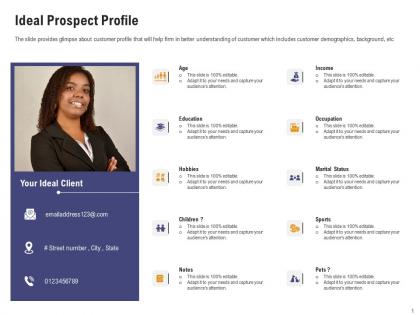
The slide provides glimpse about customer profile that will help firm in better understanding of customer which includes customer demographics, background, etc
People who downloaded this PowerPoint presentation also viewed the following :
Ideal prospect profile sales department initiatives with all 2 slides:
Use our Ideal Prospect Profile Sales Department Initiatives to effectively help you save your valuable time. They are readymade to fit into any presentation structure.
FAQs for Ideal prospect profile
An ideal prospect profile includes specific demographics, behavioral patterns, pain points, budget capacity, and decision-making authority within your target market. These characteristics enable sales teams to prioritize leads more effectively, customize messaging strategies, and allocate resources efficiently, with many organizations finding that well-defined profiles increase conversion rates and reduce sales cycle times significantly.
Customer demographics significantly influence ideal prospect profiles by defining age ranges, income levels, geographic locations, education backgrounds, and lifestyle preferences that align with product offerings. These demographic insights enable marketers to create targeted presentations with relevant messaging, appropriate communication channels, and compelling value propositions, with many organizations finding that demographic-driven profiles increase conversion rates and streamline resource allocation across campaigns.
Buyer behavior significantly shapes prospect profiles by revealing purchasing patterns, decision-making processes, communication preferences, and timing triggers that indicate readiness to buy. Through analyzing behavioral data like website interactions, content engagement, and past purchasing decisions, organizations can identify high-intent prospects more accurately, ultimately delivering more targeted outreach and higher conversion rates.
Sales team feedback enhances ideal prospect profiles by identifying successful deal patterns, revealing common objections and pain points, and highlighting characteristics of high-converting leads. Through regular feedback sessions, sales teams help refine targeting criteria, improve lead qualification processes, and update prospect definitions based on market changes, ultimately delivering more qualified leads and higher conversion rates.
**INPUT**: What data sources are most reliable for building an ideal prospect profile? **OUTPUT**: Reliable data sources for building ideal prospect profiles include CRM analytics, website behavioral data, social media insights, industry databases, and customer survey responses. These sources streamline targeting by revealing purchase patterns, engagement preferences, and demographic trends, with many sales teams finding that combining internal customer data with external market intelligence ultimately delivers higher conversion rates and more strategic prospecting efforts. **Word count: 60 words**
Companies should revisit their ideal prospect profile quarterly, with major updates annually, incorporating feedback from sales teams, customer success data, and market evolution insights. Through regular analysis of closed deals, lost opportunities, and industry shifts, organizations enhance targeting accuracy, streamline prospecting efforts, and adapt to changing buyer behaviors, ultimately delivering improved conversion rates and competitive positioning.
**INPUT**: What specific pain points should our ideal prospect profile address? **OUTPUT**: Your ideal prospect profile should address pain points including inefficient processes, resource constraints, competitive pressures, customer retention challenges, and scalability limitations. These areas represent opportunities where prospects actively seek solutions, with businesses in manufacturing, financial services, and healthcare finding that targeting operational bottlenecks, compliance burdens, and growth barriers creates compelling value propositions. [Word count: 54 words]
Segment your audience by analyzing key prospect characteristics including industry vertical, company size, decision-making authority, budget parameters, and specific pain points or challenges. Through behavioral data analysis and CRM insights, organizations can create distinct audience clusters that enable personalized messaging, tailored value propositions, and strategic presentation approaches, ultimately delivering higher engagement rates and improved conversion outcomes across different prospect segments.
Customer relationship management (CRM) systems, marketing automation platforms, data analytics tools, social media analytics, and customer survey software enable comprehensive prospect analysis through behavioral tracking, demographic insights, and engagement patterns. These technologies streamline profile development by identifying high-converting characteristics, segmenting audiences, and predicting purchase intent, with many organizations finding that integrated platforms ultimately deliver more targeted campaigns and improved conversion rates.
The ideal prospect profile directly shapes presentation content by determining messaging focus, pain point emphasis, industry-specific examples, visual design preferences, and communication tone. This strategic alignment ensures presentations resonate with target audiences through relevant case studies, appropriate technical depth, and compelling value propositions, with many organizations finding that profile-driven content significantly increases engagement rates and conversion outcomes.
Key metrics include conversion rates, customer acquisition cost, sales cycle length, lead quality scores, and lifetime customer value. These measurements enable organizations to optimize their targeting strategies by identifying which prospect characteristics drive higher engagement, faster closes, and greater revenue potential, with many sales teams finding that refined ideal prospect profiles significantly reduce acquisition costs while improving overall campaign ROI.
Industry trends significantly reshape ideal prospect profiles by altering customer priorities, budgets, technology adoption rates, and operational challenges that determine buying readiness. Organizations in sectors like healthcare, retail, and financial services find that evolving regulations, digital transformation demands, and market pressures create new pain points, ultimately enabling more targeted prospecting strategies that align solutions with emerging industry-specific needs.
Yes, ideal prospect profiles often vary significantly by geographic location due to cultural preferences, regulatory environments, economic conditions, and market maturity levels. Companies operating globally find that prospects in emerging markets may prioritize cost-effectiveness and scalability, while developed regions focus on innovation and compliance, ultimately requiring localized messaging, pricing strategies, and product positioning to achieve optimal conversion rates.
Strategies include targeted digital advertising, account-based marketing, strategic partnerships, content marketing, and social selling through platforms like LinkedIn. These approaches enable precise audience targeting, personalized outreach, and relationship building, with many organizations finding that combining multiple channels significantly enhances prospect engagement, shortens sales cycles, and ultimately delivers higher conversion rates and stronger customer relationships.
Social media insights refine ideal prospect profiles by analyzing engagement patterns, content preferences, demographic data, and behavioral triggers across platforms. Through social listening tools and analytics, organizations identify prospects' pain points, decision-making processes, and communication styles, while tracking competitor interactions, ultimately delivering more targeted outreach strategies and higher conversion rates.
-
Really like the color and design of the presentation.
-
Out of the box and creative design.
-
Really like the color and design of the presentation.