


IKEA Marketing Strategy IKEA Business Model Key Partners Strategy SS




Try Before you Buy Download Free Sample Product
 Impress Your
 Audience
 100%
100% Editable
 Save Hours
 of Time


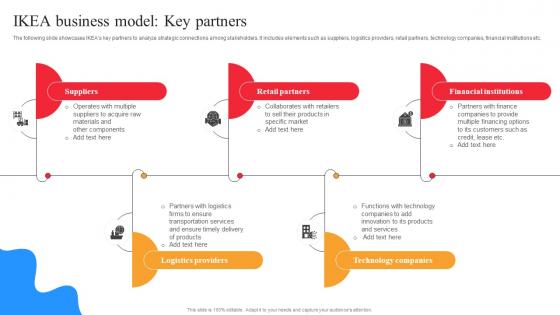
The following slide represents major resources owned by IKEA to attain business goals and achievements. It includes elements such as retail stores, supply chain, brand identity, customer relationships, product design etc.
People who downloaded this PowerPoint presentation also viewed the following :
IKEA Marketing Strategy IKEA Business Model Key Partners Strategy SS with all 9 slides:
Use our IKEA Marketing Strategy IKEA Business Model Key Partners Strategy SS to effectively help you save your valuable time. They are readymade to fit into any presentation structure.








FAQs for IKEA Marketing Strategy IKEA Business Model Key
IKEA's brand identity centers on democratic design, affordability, sustainability, and DIY assembly, creating accessible Swedish home solutions for global consumers. This strategic combination enables the company to maintain consistent pricing across markets while delivering functional, minimalist furniture experiences, with many international customers finding that IKEA's self-service model and flat-pack innovation streamline both logistics and costs.
IKEA leverages customer insights through comprehensive data analytics, customer journey mapping, behavioral analysis, and feedback systems to understand shopping patterns, preferences, and pain points. These insights enable strategic marketing decisions across product positioning, store layouts, and digital campaigns, with many retailers finding that customer-driven approaches ultimately deliver higher engagement rates, improved conversion metrics, and stronger brand loyalty in competitive markets.
IKEA utilizes digital marketing through interactive mobile apps, augmented reality room visualizers, personalized email campaigns, social media inspiration content, and targeted online advertising. These digital touchpoints enhance customer engagement by enabling virtual furniture placement, streamlining purchasing decisions, and delivering customized home solutions, ultimately creating seamless omnichannel experiences that drive both online and in-store conversions.
IKEA's sustainability initiatives have transformed its marketing from product-focused messaging to purpose-driven campaigns emphasizing circular economy, renewable energy investments, and responsible sourcing practices. These campaigns showcase specific commitments like carbon neutrality goals and sustainable material usage, ultimately positioning IKEA as an environmentally conscious brand while appealing to increasingly eco-aware consumers seeking affordable, responsible home solutions.
In-store experience serves as IKEA's primary marketing differentiator, featuring showroom displays, self-service warehouses, food courts, and guided pathways that transform shopping into an immersive lifestyle journey. This strategic approach enables customers to visualize products in realistic settings, encourages longer visits and higher spending, while building brand loyalty through memorable experiences that traditional furniture retailers struggle to replicate.
IKEA segments its target audience by adapting to local demographics, cultural preferences, income levels, and housing characteristics across different regions. While maintaining its core value proposition of affordable furniture, IKEA tailors product selections, store layouts, and marketing messages to regional needs, with European markets emphasizing sustainability, Asian markets focusing on space optimization, and North American markets highlighting DIY convenience, ultimately delivering localized experiences that drive competitive advantage.
IKEA's product design fundamentally shapes its marketing messages by emphasizing functional simplicity, affordability, and democratic design principles that resonate across diverse consumer segments. The minimalist aesthetic and flat-pack innovation enable marketing campaigns focused on accessibility, space optimization, and DIY empowerment, with retailers finding that design-driven messaging creates emotional connections while reinforcing value propositions.
IKEA leverages social media platforms through user-generated content campaigns, room inspiration posts, DIY tutorials, and interactive design challenges that showcase real customer homes. These strategies enhance brand visibility by encouraging community engagement, demonstrating product versatility in authentic settings, and creating shareable content that amplifies reach organically, ultimately building stronger customer relationships while driving both online engagement and in-store traffic.
IKEA incorporates user-generated content through customer room showcases on social media, real home photography campaigns, and interactive design challenges where customers share their furniture arrangements. These strategies enhance authenticity and community engagement by featuring actual customer experiences, ultimately building stronger brand loyalty while providing cost-effective marketing content that resonates with potential buyers.
IKEA creates emotional connections through experiential showrooms that let customers envision products in real home settings, storytelling that emphasizes affordable quality and democratic design, and community-building initiatives like family-friendly store experiences. These strategies work by fostering aspirational lifestyle messaging, hands-on product interaction, and brand values alignment, with many consumers finding that IKEA represents accessible home transformation and personal expression.
During economic downturns, IKEA emphasizes value-focused messaging, promotes affordable product lines, and increases digital marketing investments while reducing traditional advertising spend. The company strategically reposits its "democratic design" philosophy to highlight cost-effectiveness and durability, with many retailers finding that economic challenges ultimately strengthen IKEA's competitive advantage in budget-conscious markets.
IKEA has formed strategic partnerships with designers like Virgil Abloh, Hay, and Tom Dixon, collaborations with tech companies including Google and Sonos for smart home integration, and alliances with delivery services and influencers. These partnerships enhance brand visibility, expand customer reach across demographics, and deliver innovative product offerings, with many retailers finding that designer collaborations significantly boost market appeal and competitive positioning.
IKEA's pricing strategy directly supports its marketing objectives by making stylish, functional furniture accessible to mass markets through cost leadership, flat-pack efficiency, and self-service models. This approach enables the company to deliver on its "democratic design" promise while building customer loyalty, driving high store traffic, and maintaining competitive advantage in global markets, ultimately positioning IKEA as the go-to destination for affordable home solutions.
IKEA has introduced augmented reality apps for furniture placement, pop-up store concepts, and experiential marketing through temporary installations in urban spaces. These innovative approaches enhance customer engagement by streamlining the shopping experience, reducing purchase uncertainty, and creating memorable brand interactions, with many retailers finding that immersive technologies ultimately deliver higher conversion rates and stronger customer loyalty.
IKEA leverages customer feedback through social media monitoring, post-purchase surveys, and in-store feedback systems to continuously refine its marketing messaging, product positioning, and campaign effectiveness. This data-driven approach enables the retailer to adjust its promotional strategies, enhance customer experiences, and maintain relevance across diverse markets, ultimately delivering more targeted campaigns and stronger brand loyalty.
-
“Easy to use. I always wanted to have a quick search for products and SlideTeam has helped me have it.”
-
Delighted to see unique and eye-catching PowerPoint designs that are so easy to customize.