


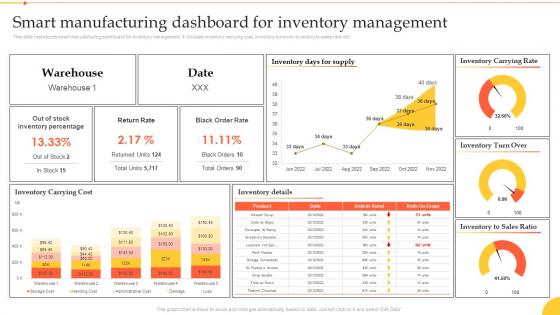
Implementation Manufacturing Technologies Smart Manufacturing Dashboard For Inventory Management




Try Before you Buy Download Free Sample Product
 Impress Your
 Audience
 100%
100% Editable
 Save Hours
 of Time


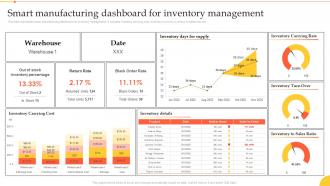
This slide represents smart manufacturing dashboard for inventory management. It includes inventory carrying cost, inventory turnover, inventory to sales ratio etc.
People who downloaded this PowerPoint presentation also viewed the following :
Implementation Manufacturing Technologies Smart Manufacturing Dashboard For Inventory Management with all 7 slides:
Use our Implementation Manufacturing Technologies Smart Manufacturing Dashboard For Inventory Management to effectively help you save your valuable time. They are readymade to fit into any presentation structure.





FAQs for Implementation Manufacturing Technologies Smart Manufacturing Dashboard
Smart manufacturing dashboards typically visualize production efficiency, equipment utilization rates, real-time quality metrics, energy consumption, and predictive maintenance indicators. These metrics enable manufacturers to streamline operations by identifying bottlenecks, minimizing downtime, and optimizing resource allocation, with many automotive and electronics companies finding that integrated dashboards ultimately deliver faster decision-making and enhanced competitive advantage.
Real-time data analytics enhances manufacturing decision-making by providing instant visibility into production metrics, equipment performance, quality indicators, and supply chain status, enabling immediate responses to operational changes. Through smart dashboards and predictive analytics, manufacturers streamline workflow optimization, minimize downtime, and accelerate problem resolution, ultimately delivering improved efficiency and competitive advantage in increasingly dynamic production environments.
IoT serves as the foundational data collection layer for smart manufacturing dashboards, with sensors, connected machinery, and monitoring devices generating real-time operational insights across production lines. These IoT networks enable manufacturers to track equipment performance, predict maintenance needs, and optimize resource allocation through centralized visualization, ultimately delivering enhanced operational efficiency and reduced downtime costs.
Predictive analytics integrates into smart manufacturing dashboards through machine learning algorithms, real-time sensor data analysis, IoT connectivity, and historical pattern recognition. These systems enable manufacturers to identify potential equipment failures days or weeks in advance, automatically schedule preventive maintenance, and optimize production workflows, with automotive and pharmaceutical companies finding significant reductions in unplanned downtime and maintenance costs.
Customizable dashboards deliver role-specific insights by tailoring metrics, alerts, and visualizations to each user's responsibilities, enabling production managers to monitor efficiency while executives track strategic KPIs. This targeted approach streamlines decision-making across manufacturing teams, reduces information overload, and accelerates response times, with many organizations finding that personalized interfaces enhance operational visibility and ultimately improve overall manufacturing performance.
Smart manufacturing dashboards improve supply chain transparency by providing real-time visibility into inventory levels, supplier performance, production bottlenecks, and delivery schedules across multiple locations and partners. Through integrated data streams, manufacturers can track materials from suppliers to finished products, enabling proactive decision-making, faster issue resolution, and enhanced coordination with partners, ultimately delivering reduced costs and improved customer satisfaction.
Smart manufacturing dashboards commonly employ IoT sensors, SCADA systems, MES platforms, PLCs, and edge computing devices to gather real-time operational data. These technologies streamline data collection by monitoring equipment performance, tracking production metrics, and capturing quality parameters, with many manufacturers finding that integrated sensor networks ultimately deliver enhanced visibility, predictive maintenance capabilities, and improved operational efficiency across their facilities.
Smart manufacturing dashboards facilitate cross-departmental collaboration by providing unified data visibility, real-time performance metrics, shared KPI tracking, and integrated communication tools. Through centralized platforms, production teams, quality control, maintenance, and supply chain departments can coordinate seamlessly, identify bottlenecks faster, and align strategic priorities, ultimately delivering enhanced operational efficiency and accelerated decision-making processes.
UX design principles enhance smart manufacturing dashboards by prioritizing intuitive navigation, data visualization clarity, and responsive interfaces that adapt to different devices and user roles. Through user-centered design approaches, manufacturers streamline decision-making processes, reduce training time, and improve operational efficiency, with many facilities finding that well-designed dashboards significantly accelerate problem identification and resolution across production lines.
Manufacturers face challenges including data integration from legacy systems, cybersecurity vulnerabilities, employee training requirements, and initial implementation costs when deploying smart manufacturing dashboards. While these obstacles require strategic planning and resource allocation, many manufacturing organizations find that systematic rollouts with phased integration ultimately deliver enhanced operational efficiency, improved decision-making capabilities, and significant competitive advantages.
Machine learning algorithms enhance smart manufacturing dashboards by analyzing vast datasets to identify patterns, predict equipment failures, and optimize production schedules in real-time. Through predictive analytics and anomaly detection, manufacturers can anticipate maintenance needs, reduce downtime, and streamline operations, with many factories finding that ML-driven insights deliver significantly faster decision-making and improved operational efficiency.
Smart manufacturing dashboards typically integrate data from IoT sensors, ERP systems, MES platforms, quality control systems, and supply chain networks. These integrated data sources streamline operations by enabling real-time monitoring, predictive maintenance, and automated quality checks, with manufacturers finding that unified visibility reduces downtime, optimizes resource allocation, and ultimately delivers faster production cycles and enhanced operational efficiency.
A smart manufacturing dashboard supports regulatory compliance by providing real-time monitoring of quality metrics, automated documentation of production processes, and instant alerts for deviations from regulatory standards. Through integrated sensors and data analytics, manufacturers can track compliance parameters continuously, generate audit-ready reports automatically, and demonstrate adherence to industry regulations, ultimately reducing compliance risks while streamlining regulatory reporting processes.
Training employees on smart manufacturing dashboards requires comprehensive onboarding programs, hands-on workshops, role-specific customization, regular refresher sessions, and peer mentoring systems. These approaches streamline adoption by building confidence through practical experience, ensuring dashboard insights translate into actionable decisions, and ultimately delivering improved operational efficiency, with many manufacturing organizations finding that structured training reduces implementation time and enhances productivity.
Dashboards foster continuous improvement by providing real-time visibility into performance metrics, enabling data-driven decision making, and creating accountability across manufacturing teams. Through automated alerts and trend analysis, organizations can quickly identify inefficiencies, track improvement initiatives, and celebrate successes, with many manufacturers finding that transparent performance data naturally drives competitive behavior and innovation among departments.
-
Wow! The design and quality of templates on SlideTeam are simply the best.
-
Superb! The innovative and inspiring template designs provide an edge to the presentation.