


Implementation Of Digital Transformation Core Functions Of Insurance Policy Lifecycle





Try Before you Buy Download Free Sample Product
 Impress Your
 Audience
 100%
100% Editable
 Save Hours
 of Time


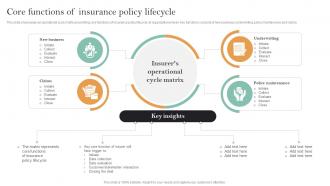
This slide showcases an operational cycle matrix presenting core functions of insurance policy lifecycle at organizational level. Key functions consists of new business, underwriting, policy maintenance and claims.
People who downloaded this PowerPoint presentation also viewed the following :
Implementation Of Digital Transformation Core Functions Of Insurance Policy Lifecycle with all 9 slides:
Use our Implementation Of Digital Transformation Core Functions Of Insurance Policy Lifecycle to effectively help you save your valuable time. They are readymade to fit into any presentation structure.








FAQs for Implementation Of Digital Transformation Core Functions Of
Key components driving digital transformation in insurance include cloud computing, artificial intelligence, IoT devices, mobile applications, and data analytics platforms. These technologies streamline operations by automating claims processing, enabling real-time risk assessment, and delivering personalized customer experiences, with many insurers finding that this strategic combination ultimately reduces operational costs while enhancing competitive advantage.
Artificial intelligence enhances customer service in insurance by automating claims processing, providing 24/7 chatbot support, personalizing policy recommendations, and enabling predictive analytics for risk assessment. Through AI-powered systems, insurance companies streamline customer interactions, reduce response times, and deliver more accurate underwriting decisions, ultimately improving customer satisfaction while reducing operational costs.
Big data analytics revolutionizes insurance risk assessment by analyzing vast datasets from social media, IoT devices, telematics, medical records, and financial histories to predict customer behavior and potential claims. Through advanced algorithms, insurers streamline underwriting processes, enhance pricing accuracy, and minimize fraud detection time, with many companies finding that data-driven approaches ultimately deliver faster policy approvals and improved profitability.
Insurance companies can leverage blockchain for policy management through smart contracts that automate claims processing, immutable ledgers that ensure transparent policy records, and decentralized networks that streamline verification processes. This technology enables faster claim settlements, reduces administrative costs, and enhances customer trust through transparent transactions, with many insurers finding that blockchain significantly improves operational efficiency while minimizing fraud risks.
Traditional insurers face challenges including legacy system integration complexities, regulatory compliance requirements, customer data security concerns, workforce digital skills gaps, and substantial technology investment costs. While these obstacles present significant hurdles, many insurance companies are finding that phased digital transformation approaches enable them to modernize gradually, ultimately delivering enhanced customer experiences and operational efficiency.
Mobile applications are revolutionizing insurance client interactions by enabling real-time policy management, instant claims filing, personalized coverage recommendations, and seamless communication channels. Through intuitive mobile platforms, insurers deliver faster claim processing, 24/7 customer support, and enhanced transparency, with many insurance companies finding that mobile-first approaches significantly improve customer satisfaction while reducing operational costs.
Essential cybersecurity measures include multi-factor authentication, end-to-end encryption, advanced threat detection systems, regular security audits, and employee training programs. These technologies streamline protection by securing customer data, preventing fraud, and ensuring regulatory compliance, with many insurance companies finding that comprehensive cybersecurity frameworks ultimately deliver enhanced customer trust and operational resilience.
Insurers can utilize chatbots to enhance customer engagement by providing 24/7 support, automating claims processing, offering personalized policy recommendations, and streamlining quote generation. These AI-powered tools enable insurance companies to deliver faster response times, reduce operational costs, and improve customer satisfaction, with many insurers finding that chatbots significantly enhance service accessibility while freeing human agents for complex interactions.
Digital transformation significantly accelerates claims processing by automating workflows, enabling real-time data analysis, and streamlining customer communications through digital channels. Through AI-powered assessment tools and mobile claim submission platforms, insurance companies reduce processing times from weeks to days, minimize manual errors, and enhance customer satisfaction, while ultimately delivering cost savings and competitive advantage in an increasingly digital marketplace.
Insurance companies ensure regulatory compliance during digital transformation by implementing robust data governance frameworks, automated compliance monitoring systems, and regular audit protocols throughout their modernization process. These strategic approaches enable insurers to maintain regulatory adherence while streamlining operations, enhancing customer experiences, and reducing compliance costs, with many finding that proactive compliance integration ultimately delivers competitive advantage in an increasingly regulated marketplace.
InsurTech partnerships deliver enhanced customer experiences, accelerated digital capabilities, cost reduction, improved risk assessment, and faster product development for traditional insurers. Through strategic collaborations, insurers streamline claims processing, automate underwriting, and leverage advanced analytics, while maintaining regulatory compliance and market credibility, ultimately gaining competitive advantage in an increasingly digital insurance landscape.
Customer feedback refines digital strategies through systematic collection via multiple touchpoints, data analytics to identify pain points, and iterative improvements to user interfaces and service delivery. Insurance companies leverage customer insights to enhance mobile app functionality, streamline claims processing, and personalize policy recommendations, ultimately delivering superior customer experiences and competitive advantage in an increasingly digital marketplace.
Essential skills include data analytics for interpreting customer insights, digital literacy for navigating new platforms, cybersecurity awareness for protecting sensitive information, customer experience design, and adaptability to emerging technologies. These competencies enable insurance professionals to leverage automated underwriting, enhance personalized policy recommendations, and deliver seamless omnichannel experiences, ultimately positioning organizations for competitive advantage in an increasingly digital marketplace.
Digital advancements have fundamentally shifted customer expectations toward instant, self-service capabilities, omnichannel experiences, and personalized policy recommendations through mobile apps and online platforms. Insurance customers increasingly demand 24/7 access, seamless claim processing, and transparent pricing, with many finding that digital-first insurers deliver faster approvals, reduced paperwork, and enhanced convenience, ultimately driving competitive pressure across the industry.
Future trends insurers should monitor include AI-driven underwriting, IoT-enabled risk assessment, blockchain for claims processing, personalized customer portals, and automated policy management systems. These technologies streamline operations by reducing manual processes, enhancing fraud detection, and enabling real-time data analysis, with many insurance companies finding that early adoption delivers significant competitive advantages and improved customer satisfaction.
-
Their designing team is so expert in making tailored templates. They craft the exact thing I have in my mind…..really happy.
-
Unique research projects to present in meeting.