


Implementing IoT For Effective Water Management System




Try Before you Buy Download Free Sample Product
 Impress Your
 Audience
 100%
100% Editable
 Save Hours
 of Time


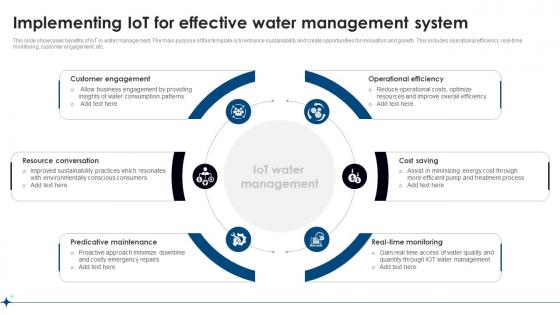
This slide showcases benefits of IoT in water management. The main purpose of this template is to enhance sustainability and create opportunities for innovation and growth. This includes operational efficiency, real time monitoring, customer engagement, etc.
People who downloaded this PowerPoint presentation also viewed the following :
Implementing IoT For Effective Water Management System with all 9 slides:
Use our Implementing IoT For Effective Water Management System to effectively help you save your valuable time. They are readymade to fit into any presentation structure.








FAQs for Implementing IoT For Effective
IoT solutions in water management deliver real-time monitoring, predictive maintenance, automated leak detection, optimized resource allocation, and enhanced operational efficiency. These technologies streamline water distribution by minimizing waste, reducing infrastructure costs, and enabling proactive system maintenance, with many municipalities and industrial facilities finding that IoT implementation ultimately delivers significant cost savings and improved service reliability.
Predictive analytics enhances water conservation by analyzing consumption patterns, weather data, and infrastructure conditions to forecast demand and identify potential leaks before they occur. Through IoT sensors and machine learning algorithms, cities like Barcelona and Singapore optimize distribution networks, reduce waste by up to 30%, and enable proactive maintenance, ultimately delivering significant cost savings and sustainable resource management.
Sensors enable real-time water quality monitoring by detecting pH levels, dissolved oxygen, turbidity, temperature, and chemical contaminants continuously. These devices streamline data collection, enhance regulatory compliance, and minimize manual testing costs, with municipalities and industrial facilities finding that automated monitoring delivers faster contamination detection and improved public safety outcomes.
IoT devices enhance leak detection by deploying smart sensors throughout water networks that monitor pressure, flow rates, and acoustic signatures in real-time. These systems enable utilities to identify potential failures before major breaks occur, reducing water loss by up to 30% while minimizing costly emergency repairs, ultimately delivering more efficient resource management and improved service reliability.
Integrating IoT technology in existing water infrastructure presents challenges including legacy system compatibility, cybersecurity vulnerabilities, high implementation costs, data management complexity, and technical skill requirements. While these obstacles require strategic planning and investment, many utilities find that phased implementation approaches streamline integration processes, ultimately delivering enhanced operational efficiency and predictive maintenance capabilities across aging water networks.
Machine learning optimizes agricultural water usage by analyzing soil moisture sensors, weather patterns, crop growth stages, and historical yield data to predict precise irrigation needs. Through predictive algorithms, farms can reduce water consumption by 20-40%, prevent over-watering that damages crops, and automatically adjust irrigation schedules, ultimately delivering higher yields while conserving this critical resource.
Essential security measures include encrypted data transmission, multi-factor authentication, network segmentation, regular software updates, and intrusion detection systems. These protocols streamline protection by isolating critical infrastructure, monitoring suspicious activities, and ensuring secure communications, with water utilities and smart cities finding that layered security approaches ultimately deliver operational resilience and regulatory compliance.
IoT-enabled water management enhances citizen engagement through real-time consumption dashboards, mobile alerts for leaks or quality issues, community-wide conservation challenges, and transparent billing systems. These technologies empower residents to monitor usage patterns, participate in neighborhood water-saving initiatives, and receive immediate feedback on conservation efforts, ultimately fostering environmental responsibility while reducing municipal costs.
IoT solutions significantly enhance regulatory compliance for water utilities by enabling continuous monitoring, automated reporting, and real-time data collection across distribution networks. Through smart sensors and connected devices, utilities streamline compliance documentation, reduce manual reporting errors, and ensure consistent adherence to quality standards, while delivering improved transparency and operational efficiency in an increasingly regulated environment.
Transitioning to IoT-based water management systems involves initial infrastructure investments for sensors, connectivity, and analytics platforms, but delivers significant long-term savings through reduced water waste, optimized usage, and predictive maintenance. With many utilities and industrial facilities finding operational cost reductions of 20-30%, these systems ultimately enhance resource efficiency while providing competitive advantage through data-driven optimization.
IoT devices enhance flood management by providing real-time water level monitoring, early warning systems, and predictive analytics that enable proactive response measures. Through connected sensors and automated alerts, emergency services can deploy resources more strategically, evacuate areas efficiently, and coordinate relief efforts seamlessly, ultimately minimizing damage while saving lives and reducing recovery costs.
IoT water management privacy concerns include unauthorized data access, consumer usage pattern tracking, third-party data sharing, inadequate encryption protocols, and potential surveillance capabilities. While these technologies streamline resource monitoring and operational efficiency, organizations must implement robust cybersecurity measures and transparent data policies, with many utilities finding that proactive privacy frameworks ultimately enhance customer trust and regulatory compliance.
IoT facilitates better water resource allocation during scarcity by providing real-time monitoring, predictive analytics, and automated distribution controls that optimize usage across multiple demand points. Smart sensors enable municipalities and agricultural operations to identify high-priority areas, reduce waste through leak detection, and implement dynamic pricing models, ultimately delivering more equitable distribution and enhanced conservation outcomes.
Leading smart water management initiatives include Singapore's Smart Water Grid, Amsterdam's circular water economy programs, Barcelona's sensor-driven distribution networks, and California's precision irrigation systems. These programs streamline resource allocation through real-time monitoring, predictive analytics, and automated controls, with many municipalities finding that integrated IoT approaches reduce waste by 30-40% while enhancing service reliability and operational efficiency.
Interoperability and standardization enhance IoT water management effectiveness by enabling seamless data exchange between diverse sensors, systems, and platforms from different manufacturers. Without these frameworks, utilities face integration challenges and data silos, while standardized protocols allow comprehensive monitoring across treatment plants, distribution networks, and smart meters, ultimately delivering unified insights and operational efficiency.
-
Loved the collection. Editing the presentation was seamless with their templates.
-
Awesome presentation, really professional and easy to edit.