

Incentives And Benefits For Employee Engagement Powerpoint Presentation Slides




Try Before you Buy Download Free Sample Product
 Impress Your
 Audience
 100%
100% Editable
 Save Hours
 of Time


Select our content ready Incentives and Benefits for Employee Engagement PowerPoint Presentation Slides to retain or engage employees. The employee benefits plan PowerPoint complete deck contains twenty ready-to-use PPT slides. Effective benefits strategies can attract and retain top talent. List down the types of perks such as health insurance, paid vacations, meal breaks, social security, pay raise, achievement awards, perks, and bonuses, etc using benefits and perks presentation design. Outline the process of managing the employee benefits administration with the help of staff benefits and rewards editable presentation design. Furthermore, these PowerPoint templates are completely customizable, users can edit the color, size, font style as per their needs. The staff benefits and perks PPT visuals are useful for HR managers. HR managers can educate their employees on benefits plans. Download professionally designed employees benefit package management Presentation deck to discuss the various benefits an organization provides to its employees. Deliver on your promises through our Incentives And Benefits For Employee Engagement Powerpoint Presentation Slides. Prove that you stand by your word.
People who downloaded this PowerPoint presentation also viewed the following :
Content of this Powerpoint Presentation
Slide 1: This slide introduces Incentives & Benefits for Employee Engagement. State Your Company Name and begin.
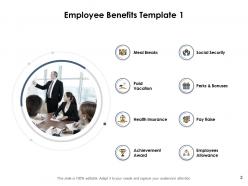
Slide 2: This slide shows Employee Benefits Template 1 describing- Social Security, Meal Breaks, Perks & Bonuses, Paid Vacation, Pay Raise, Health Insurance, Employees Allowance, Achievement Award.
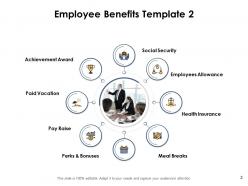
Slide 3: This slide presents Employee Benefits Template 2. You can add or edit data as per requirements.
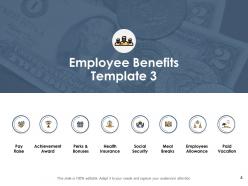
Slide 4: This slide represents Employee Benefits Template 3 with related imagery and text.
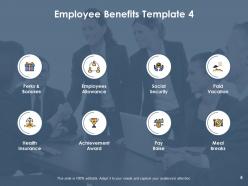
Slide 5: This slide displays Employee Benefits Template 4 with related icons and imagery. You can modify the template as per requirements.
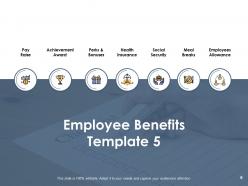
Slide 6: This slide represents Employee Benefits Template 5.
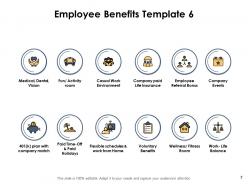
Slide 7: This slide shows Employee Benefits Template 6 describing- Fun/ Activity Room, Medical, Dental, Vision, Casual Work Environment, Company Paid, Life Insurance, Company Events, Employee Referral Bonus, 401(k) Plan With Company Match, Paid Time-off & Paid Holidays, Voluntary Benefits, Flexible Schedules & Work From Home, Wellness/ Fitness Room, Work- Life Balance.
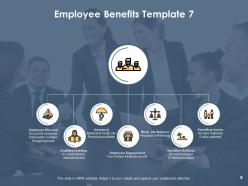
Slide 8: This slide presents Employee Benefits Template 7 describing- Employee Discount, Enabling Learning, Insurance, Employee Engagement, Vacation Holidays, Parenting Leaves, Work- Life Balance.
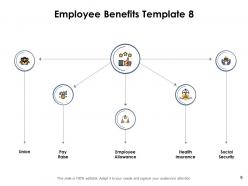
Slide 9: This slide displays Employee Benefits Template 8 describing- Union, Pay Raise, Employee Allowance, Health Insurance, Social Security.
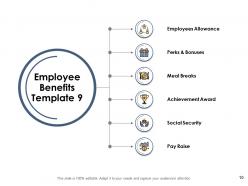
Slide 10: This slide represents Employee Benefits Template 9.
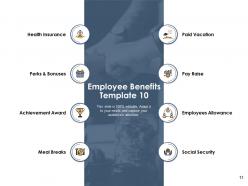
Slide 11: This slide showcases Employee Benefits Template 10 describing- Health Insurance, Perks & Bonuses, Achievement Award, Meal Breaks, Social Security, Employees Allowance, Pay Raise, Paid Vacation.
Slide 12: This slide displays Employee Benefits Icons.
Slide 13: This slide is titled as Additional Slides for moving forward.
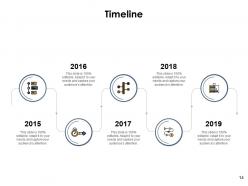
Slide 14: This is a Timeline slide to show information related with time period.
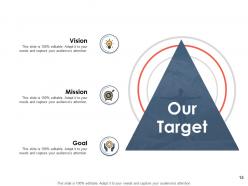
Slide 15: This is Our Target slide. State your targets here.
Slide 16: This is Our Goal slide. Show your goals here.
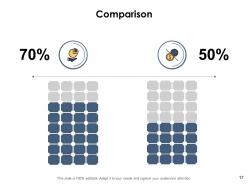
Slide 17: This is a Comparison slide to state comparison between commodities, entities etc.
Slide 18: This is a Bulb or Idea slide to state a new idea or highlight information, specifications etc.
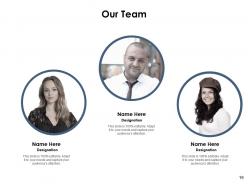
Slide 19: This is Our Team slide with names and designation.
Slide 20: This is a Thank you slide with address, contact numbers and email address.
Incentives And Benefits For Employee Engagement Powerpoint Presentation Slides with all 20 slides:
Acquire expertise and experience with our Incentives And Benefits For Employee Engagement Powerpoint Presentation Slides. They are an excellent aid for growth.
FAQs for Incentives And Benefits For Employee Engagement
Honestly, it comes down to a few key things. Communication has to be clear - nobody can succeed when they're guessing what you want. Recognition is huge too, even just acknowledging good work makes a difference. Give people some control over how they tackle their tasks instead of breathing down their necks. Trust me, micromanaging kills engagement faster than anything. People also need to see how their work connects to the bigger picture. And don't sleep on growth opportunities - even small chances to learn something new keeps people interested. My advice? Just ask your team what would make work more meaningful for them.
Dude, communication is huge for keeping people engaged at work. Nobody wants to feel left out or like their voice doesn't count - that stuff kills morale fast. Regular check-ins build trust. Listen when your team talks to you (actually listen, not just waiting for your turn to speak). Respond to their feedback too. I swear, half the workplace drama I see could've been avoided with better communication. When people feel heard and know what's going on, they're way more invested. It cuts down on confusion and frustration big time.
Dude, your leaders literally make or break everything. Good ones listen, communicate openly, and actually care about helping people grow - that creates the kind of environment where people want to show up. Bad leaders? They'll destroy morale faster than you can blink (honestly, we've all had those nightmare bosses). What works is when they model the right stuff, recognize good work, and don't micromanage every little thing. My advice? Start small with your own interactions. Ask better questions, give real feedback, follow through on promises. I know it sounds basic, but those tiny moments build your whole culture over time.
Honestly, mix surveys with actual data - that's where you'll get real answers. Those yearly engagement surveys? Pretty much useless on their own these days. Do shorter pulse surveys monthly or quarterly instead, way better for spotting trends. But here's the thing - also track stuff like turnover rates, how many people get promoted internally, who actually shows up to optional events. That data doesn't lie like survey responses sometimes do. The trick is asking good questions then actually doing something about what you find out.
Honestly, most engagement issues come down to crappy communication from the top and people feeling invisible. Micromanaging kills morale fast - like, nobody wants their boss breathing down their neck constantly. Growth opportunities matter too. Start doing regular one-on-ones where you actually ask what's frustrating them. Be transparent about where the company's headed. Celebrate wins more often (we're all terrible at this). Give people real ownership of projects instead of controlling every detail. Oh, and create actual career paths - not just vague promises about "future opportunities." The feedback thing is huge though. Ask for it, then do something with it.
Dude, recognition is honestly game-changing for keeping people engaged. Makes them feel like their work actually matters, you know? I'd start with being super specific when you praise someone - way better than just saying "nice work." Public shoutouts work great too, doesn't have to cost anything. Even flexible schedules can be more motivating than bonuses sometimes. The timing matters though - don't wait weeks to acknowledge good work. I've seen teams completely flip their vibe just from doing weekly recognition stuff. It's probably the lowest-effort, highest-impact thing managers can do.
Honestly, feedback mechanisms are total game-changers. They make people feel heard - like their opinions actually matter. Set up regular pulse surveys, one-on-ones, maybe even anonymous suggestion boxes. But here's the thing (and this is where most managers mess up) - you can't just collect feedback and ignore it. Share what you learned with your team. Tell them what changes you're making based on their input. That's when engagement really takes off because suddenly employees realize they have actual influence over their work environment. It's pretty powerful stuff.
Honestly, mixing things up is what saves you here. Virtual coffee chats work great - just 15 minutes can make a huge difference. Those peer recognition platforms are solid too, plus async video updates where people actually share what's going on. I was skeptical about online team building at first, but it's not as cringey as you'd think! Give people control over their schedules though - that's big. Small cross-functional projects help break the monotony. Don't go overboard with fancy stuff. Pick one thing this week and stick with it. Consistency beats grand gestures every time.
Dude, the numbers on this are actually crazy - engaged employees perform 20-25% better and you'll see up to 40% less turnover. Makes total sense though, right? People who give a shit about their job naturally work harder and don't bail as quickly. Here's what's wild: it spreads too. One engaged person gets their whole team more pumped up. Honestly, if you're dealing with productivity problems or people constantly quitting, check your engagement scores first. That's probably where your problem is hiding.
Honestly, training is such a game-changer for keeping people engaged. It shows you actually care about where they're headed, not just what they can do right now. People stick around way longer when they see growth opportunities - like, it's probably one of the best retention strategies out there. But here's the thing (and I learned this the hard way) - don't just throw random courses at them. Actually ask what skills they want to develop. Make it about their goals. When employees feel like you're investing in their future, they'll be so much more engaged with the work they're doing today.
Look, each generation really does want different things at work. Boomers prefer face-to-face recognition and clear hierarchies. Gen X? They're all about work-life balance and being left alone to do their job. Millennials are honestly the easiest to figure out since they'll straight-up tell you they want constant feedback and meaningful work. Gen Z expects everything to be tech-savvy and socially conscious. My advice? Run some focus groups with each age group - you'll be surprised what you learn. Then build flexible programs instead of assuming everyone wants pizza parties or whatever.
Ugh, low engagement is the worst because it spreads so fast. Disengaged people complain constantly and skip team stuff, which kills the vibe for everyone else. Then your good employees get stuck doing extra work and start getting pissed off. Before you know it, even your star players are updating their resumes - I've seen this happen so many times. Plus you're always training new people who don't get how things work yet. Honestly, the only way to stop it is catching it early with regular one-on-ones and actually caring about what people tell you.
Honestly, tech can be a game-changer for keeping people engaged. Start with communication - Slack or Teams work wonders for remote folks. Digital recognition tools are pretty cool too, lets people give instant shout-outs to coworkers. I'd also throw in some pulse surveys to actually see how everyone's doing (the data you get is fascinating). Mobile apps are clutch if you've got employees who aren't desk-bound all day. But here's the thing - don't go crazy with everything at once. Pick one tool that fixes your biggest headache first, then build from there.
Honestly, just start listening to them more. Set up feedback sessions and actually do something with their ideas - doesn't have to be huge changes. Cross-functional teams work great too since people love sharing different perspectives. Anonymous surveys help if some folks are shy about speaking up directly (which, let's be real, happens a lot). The biggest mistake? Not following through. That makes everything feel fake. Maybe try involving them in one decision this week and see what happens. People really do want their voice to matter at work.
Honestly, just talk to people way more than you think you need to. Like, overcommunicate everything - what's happening, why it's happening, when stuff will change. Get them involved too - ask what they think, set up ways for feedback, and actually listen when they complain. People absolutely hate being kept in the dark more than the changes themselves sometimes. Your managers need to be ready for difficult conversations and give updates regularly, even boring "nothing's changed" ones. Oh, and don't pretend change isn't rough - it sucks! Celebrate the small stuff when you can. I'd start with weekly team check-ins to see how everyone's really doing.
No Reviews