


Information security risk scorecard powerpoint presentation slides




Try Before you Buy Download Free Sample Product
 Impress Your
 Audience
 100%
100% Editable
 Save Hours
 of Time


Information security risk management enables the safe operation of applications and protects the organizations ability to function, use, and protect the data. The concept is used in companies by preparing scorecards for each activity and ensuring that the desired business outcomes are free from risks and uncertainties. Check out our professionally designed Information Security Risk Scorecard template to identify, evaluate, and treat risks around the firms valuable information and mitigate compliance failures. It brings out the security overview in a creative cum visual look. Using a compliance matrix, a company can demonstrate its key parameters like information security, network security, application security, etc. The proposal displays the deliverables using pie charts, tables, bar graphs, etc. The products have a breakdown for web rating, email security, domain reputation, and more. The proposal includes the minutest details of the risk-rating factors, assets, relative value, etc. Highlights emphasize action plan breakdown, risk rating breakdown, risk heat map, and more. The scorecard displays the details for eight essential elements with risk gaps and solutions in the risk scorecard. The format underlines the critical points of security. Get access to our 100 percent editable Information Security Risk Scorecard template and download it now.
People who downloaded this PowerPoint presentation also viewed the following :
Content of this Powerpoint Presentation
Slide 1: This slide displays title i.e. 'Information Security Risk Scorecard' and your company name.
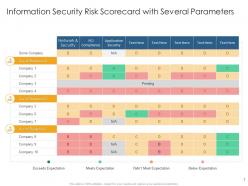
Slide 2: This slide presents 'Information Security Risk Scorecard with Several Parameters'.
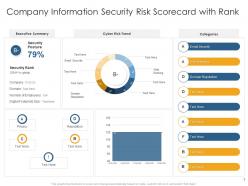
Slide 3: This slide exhibits 'Company Information Security Risk Scorecard with Rank'.
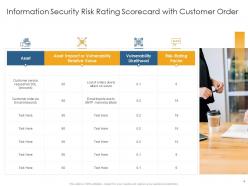
Slide 4: This slide shows 'Information Security Risk Rating Scorecard with Customer Order'.
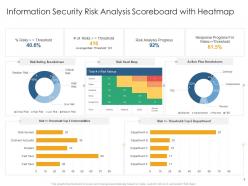
Slide 5: This slide depicts 'Information Security Risk Analysis Scoreboard with Heatmap'.
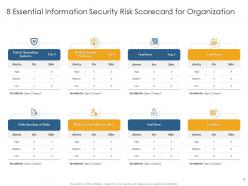
Slide 6: This slide highlights '8 Essential Information Security Risk Scorecard for Organization'.
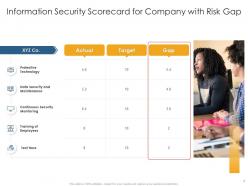
Slide 7: This slide illustrates 'Information Security Scorecard for Company with Risk Gap'.
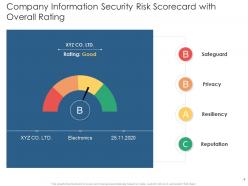
Slide 8: This slide showcases 'Company Information Security Risk Scorecard with Overall Rating'.
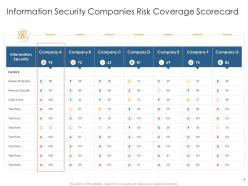
Slide 9: This slide displays 'Information Security Companies Risk Coverage Scorecard'.
Slide 10: This is the icons slide.
Slide 11: This slide presents title for additional slides.
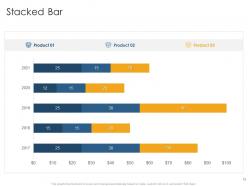
Slide 12: This slide exhibits yearly stacked bar charts for different products. The charts are linked to Excel.
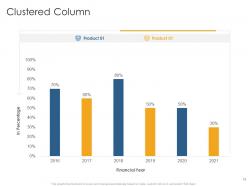
Slide 13: This slide displays yearly clustered column charts for different products. The charts are linked to Excel.
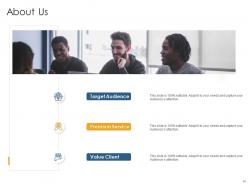
Slide 14: This slide shows about your company, target audience and its client's values.
Slide 15: This slide presents your company's vision, mission and goals.
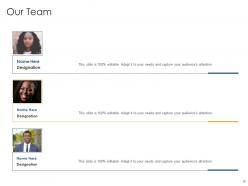
Slide 16: This slide shows details of team members like name, designation, etc.
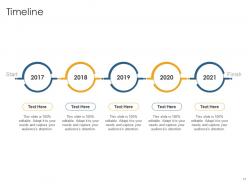
Slide 17: This slide exhibits yearly timeline.
Slide 18: This slide depicts posts for past experiences of clients.
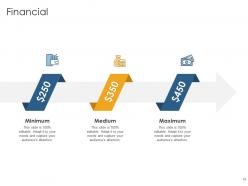
Slide 19: This slide showcases financials.
Slide 20: This slide depicts 30-60-90 days plan for projects.
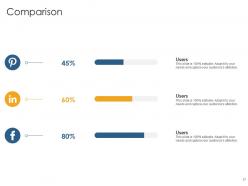
Slide 21: This slide highlights comparison of products based on selects.
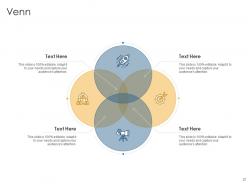
Slide 22: This slide displays Venn.
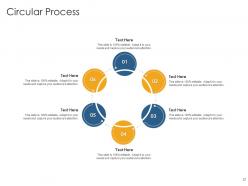
Slide 23: This slide presents circular process.
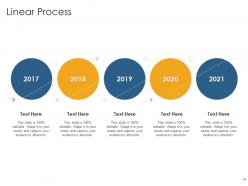
Slide 24: This slide shows linear process.
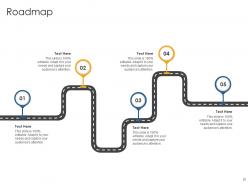
Slide 25: This slide shows roadmap.
Slide 26: This is thank you slide & contains contact details of company like office address, phone no., etc.
Information security risk scorecard powerpoint presentation slides with all 26 slides:
Use our Information Security Risk Scorecard Powerpoint Presentation Slides to effectively help you save your valuable time. They are readymade to fit into any presentation structure.


FAQs for Information security risk scorecard
An effective Information Security Risk Scorecard includes threat assessment metrics, vulnerability management indicators, incident response timelines, compliance status tracking, and asset protection measures. These components work together by providing quantifiable security posture visibility, enabling proactive risk mitigation, and streamlining regulatory reporting, with many organizations finding that comprehensive scorecards ultimately deliver faster threat detection and improved operational security efficiency.
Organizations customize risk scorecards by incorporating industry-specific compliance frameworks, adjusting risk weightings to reflect regulatory priorities, and integrating mandatory control assessments. Financial institutions emphasize Basel III requirements while healthcare organizations focus on HIPAA compliance, with many finding that tailored scorecards streamline audit processes, enhance regulatory reporting accuracy, and deliver competitive advantage through proactive compliance management.
Financial institutions should prioritize metrics including vulnerability exposure rates, incident response times, compliance audit scores, third-party vendor risk assessments, and data breach frequency indicators. These comprehensive metrics enable banks and credit unions to streamline risk management by identifying critical vulnerabilities, accelerating threat response, and ensuring regulatory compliance, ultimately delivering enhanced customer trust and competitive advantage in an increasingly complex financial landscape.
A risk scorecard facilitates communication by translating complex security metrics into executive-friendly visual formats, standardized risk ratings, and business impact assessments that leadership can quickly understand. Through clear dashboards and trend analysis, security teams can demonstrate ROI on security investments, justify budget allocations, and align cybersecurity initiatives with strategic business objectives, ultimately enabling data-driven decision making.
Data classification serves as the foundation for risk assessment metrics by categorizing information assets based on sensitivity levels, regulatory requirements, compliance standards, and business criticality. Through systematic classification frameworks, organizations can assign appropriate risk weights, determine protection priorities, and allocate security resources more effectively, with sectors like healthcare and financial services finding that classified data directly correlates with threat impact scoring and regulatory exposure measurements.
Organizations should update their Information Security Risk Scorecard quarterly at minimum, with monthly updates recommended for high-risk environments, while conducting comprehensive annual reviews to reassess threat landscapes and business changes. This frequency enables timely identification of emerging vulnerabilities, ensures compliance with evolving regulations, and maintains accurate risk prioritization, with many financial services and healthcare organizations finding that regular updates significantly enhance their security posture and regulatory compliance.
**INPUT**: What techniques can be employed to ensure that the risk scorecard remains relevant in an ever-changing threat landscape? **OUTPUT**: Maintaining scorecard relevance requires continuous threat intelligence integration, automated vulnerability scanning, regular framework updates, dynamic risk weighting, and stakeholder feedback loops. These techniques enable organizations to adapt quickly through real-time monitoring, quarterly assessments, and emerging threat incorporation, with many financial services and healthcare institutions finding that proactive scorecard evolution delivers enhanced security posture and competitive advantage.
Organizations can leverage automation tools to enhance risk scorecard accuracy through continuous monitoring systems, automated data collection from security infrastructure, real-time threat intelligence integration, and machine learning algorithms that identify patterns and anomalies. These technologies streamline risk assessment by eliminating manual errors, providing consistent scoring methodologies, and delivering updated threat landscapes, with many financial institutions and healthcare organizations finding that automated scorecards significantly improve response times while reducing operational overhead.
Common pitfalls include inadequate stakeholder buy-in, inconsistent risk measurement criteria, over-reliance on quantitative metrics without qualitative context, and insufficient integration with existing governance frameworks. Organizations often struggle with maintaining current threat intelligence, establishing realistic baseline measurements, and ensuring cross-departmental collaboration, ultimately hindering effective risk visibility and strategic security investment decisions.
A risk scorecard systematically evaluates security vulnerabilities by assessing likelihood, impact severity, current controls, and business criticality, creating quantified risk ratings across systems and processes. This structured approach enables organizations to allocate resources strategically, with many financial institutions and healthcare providers finding that scorecards streamline remediation efforts, enhance compliance reporting, and ultimately deliver faster threat response while reducing overall security exposure.
Cultural awareness significantly impacts risk scorecard effectiveness by fostering employee buy-in, encouraging transparent risk reporting, and ensuring security practices align with organizational values and behaviors. Companies with strong security cultures see improved compliance rates, faster incident reporting, and more accurate risk assessments, while organizations lacking cultural integration often experience resistance to security measures, ultimately delivering more reliable scorecards and enhanced overall security posture.
Organizations measure risk management success using the scorecard by tracking key performance indicators like incident reduction rates, compliance scores, vulnerability remediation times, and security investment ROI across different risk categories. Through regular scorecard assessments, financial institutions, healthcare systems, and retail companies can benchmark progress against industry standards, identify emerging threat patterns, and demonstrate measurable improvements in their security posture to stakeholders, ultimately delivering enhanced operational resilience and competitive advantage.
An Information Security Risk Scorecard supports incident response planning by identifying high-priority vulnerabilities, mapping potential attack vectors, establishing baseline security metrics, and prioritizing resource allocation for critical threats. Through comprehensive risk assessment data, organizations can develop targeted response protocols, streamline threat containment procedures, and enhance recovery strategies, with many financial institutions and healthcare providers finding that scorecards ultimately accelerate incident resolution times.
Best practices for visually presenting risk data include using color-coded heat maps, standardized risk matrices, clear severity indicators, trend arrows, and dashboard-style layouts with key metrics prominently displayed. These visual elements streamline stakeholder comprehension by translating complex security data into intuitive formats, with many organizations finding that executive dashboards combining traffic light systems and quantified risk scores ultimately enhance decision-making speed and strategic risk management effectiveness.
Organizations ensure seamless risk scorecard integration by aligning scoring metrics with established frameworks like NIST, ISO 27001, or COBIT, mapping risk categories to existing policy structures, and automating data feeds from current security tools. This strategic alignment enables consistent risk assessment across all security domains, reduces administrative overhead, and enhances decision-making capabilities, with many enterprises finding that integrated scorecards deliver more comprehensive visibility and streamlined compliance reporting.
-
Great designs, really helpful.
-
Designs have enough space to add content.