


Infrastructure As Code Iac Approaches And Best Practices Complete Deck




Try Before you Buy Download Free Sample Product
 Impress Your
 Audience
 100%
100% Editable
 Save Hours
 of Time


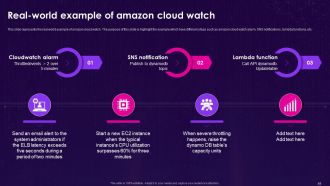
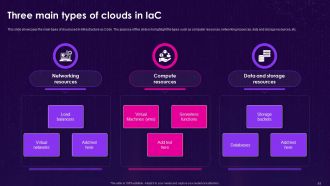
This Infrastructure as Code IaC approach and Best practices ppt includes an introduction, advantages, and features of infrastructure as code. It also discusses the testing in IaC that can be done by different types such as unit tests, style checks, system checks, etc. This Securing the Infrastructure with IaC Best Practices PowerPoint presentation represents different ways of securing the infrastructure in the organization. There are a lot of security models and standards that can be used such as COBIT, ITIL, ISO, etc. In addition, the Measuring and Improving IaC Efficiency and Performance module demonstrates the various steps for monitoring the codes in infrastructure. The monitoring can be done by Amazon Cloud Watch. Furthermore, the Scaling Up with IaC Achieving Efficiency and Consistency deck discusses the three types of clouds present in the world such as compute resources, networking resources, data and storage resources. Moreover, IaC Tools for Performance Analysis and Optimization PPT contains sections about different tools such as Terraform, AWS, and Google Cloud Development Manager. Lastly, this Achieving Peak Performance with IaC deck comprises a roadmap, checklist, dashboard, and awareness training program for implementing infrastructure as code. Download our 100 percent editable and customizable template, which is also compatible with Google Slides.
People who downloaded this PowerPoint presentation also viewed the following :
Content of this Powerpoint Presentation
Slide 1: This slide introduces Infrastructure as Code (IaC) Approaches and Best Practices. State Your Company Name and begin.
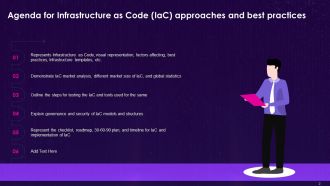
Slide 2: This slide is an Agenda slide. State your agendas here.
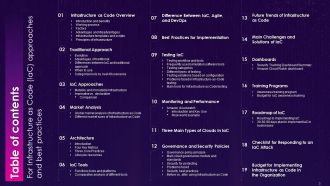
Slide 3: This slide shows a Table of Contents for the presentation.
Slide 4: This slide is an introductory slide.
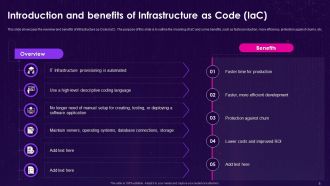
Slide 5: This slide showcases the overview and benefits of Infrastructure as Code (IaC).
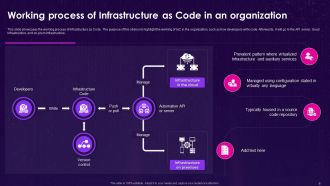
Slide 6: This slide shows the working process of Infrastructure as Code.
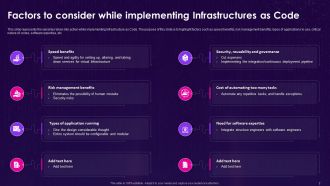
Slide 7: This slide represents the variables taken into action while implementing Infrastructure as Code.
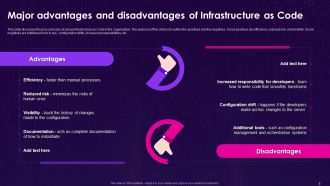
Slide 8: This slide discusses the pros and cons of using Infrastructure as Code in the organization.
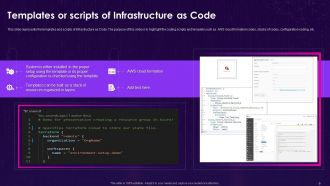
Slide 9: This slide presents the templates and scripts of Infrastructure as Code.
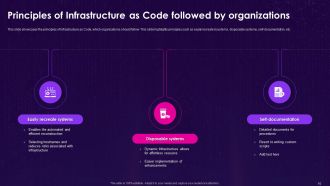
Slide 10: This slide showcases the principles of Infrastructure as Code, which organizations should follow.
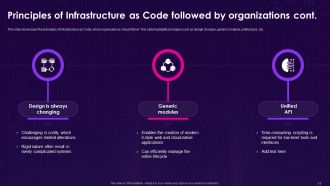
Slide 11: This slide shows the principles of Infrastructure as Code, which organizations should follow.
Slide 12: This slide is an introductory slide.
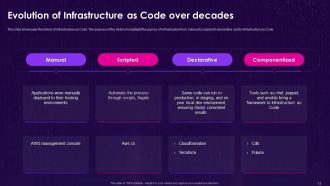
Slide 13: This slide entails the history of Infrastructure as Code.
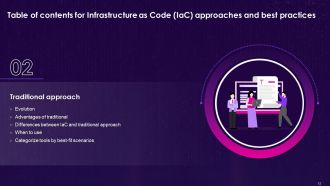
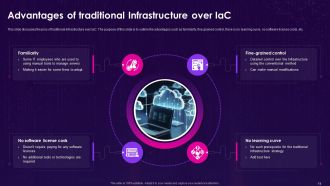
Slide 14: This slide discusses the pros of traditional Infrastructure over IaC.
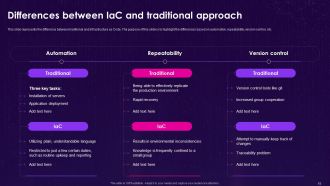
Slide 15: This slide puts the difference between traditional and Infrastructure as Code.
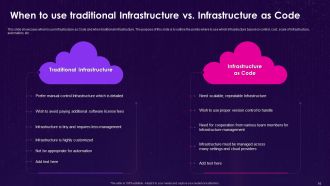
Slide 16: This slide highlights when to use Infrastructure as Code and when traditional Infrastructure.
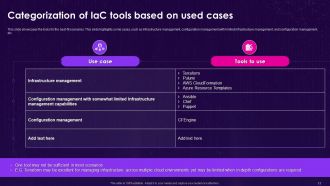
Slide 17: This slide illustrates the tools for the best-fit scenarios.
Slide 18: This slide is an introductory slide.
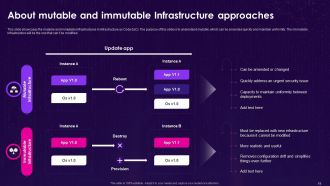
Slide 19: This slide entails the mutable and immutable Infrastructures in Infrastructure as Code (IaC).
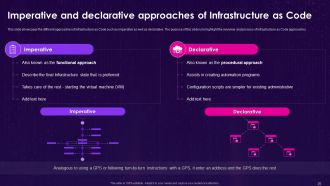
Slide 20: This slide marks the different approaches of Infrastructure as Code such as imperative as well as declarative.
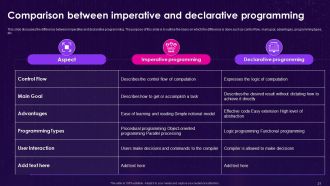
Slide 21: This slide puts the difference between imperative and declarative programming.
Slide 22: This slide is an introductory slide.
Slide 23: This slide depicts the global market analysis of Infrastructure as Code.
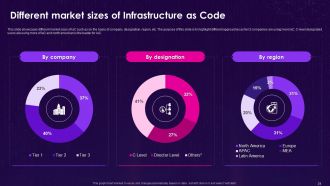
Slide 24: This slide showcases different market sizes of IaC such as on the basis of company, designation, region, etc.
Slide 25: This slide is an introductory slide.
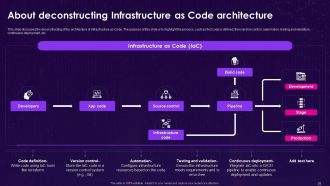
Slide 26: This slide discusses the deconstructing of the architecture of Infrastructure as Code.
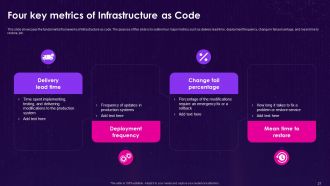
Slide 27: This slide contains the fundamental frameworks of infrastructure as code.
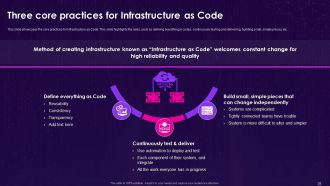
Slide 28: This slide elucidates the core practices for Infrastructure as Code.
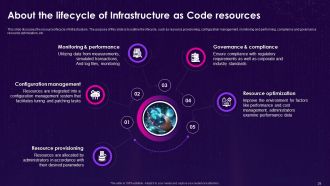
Slide 29: This slide contains the resource lifecycle of Infrastructure.
Slide 30: This slide is an introductory slide.
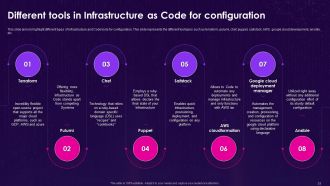
Slide 31: This slide aims to highlight different types of Infrastructure and Code tools for configuration.
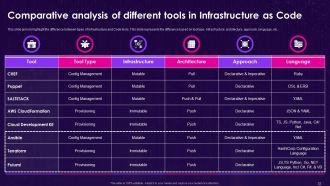
Slide 32: This slide contains the difference between types of Infrastructure and Code tools.
Slide 33: This slide is an introductory slide.
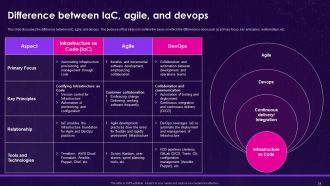
Slide 34: This slide discusses the difference between IaC, agile, and devops.
Slide 35: This slide is an introductory slide.
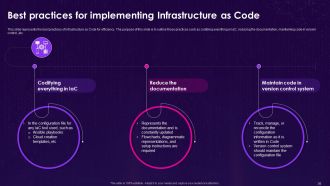
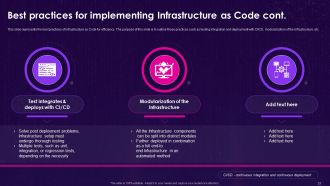
Slide 36: This slide represents the best practices of Infrastructure as Code for efficiency.
Slide 37: This slide presents the best practices of Infrastructure as Code for efficiency.
Slide 38: This slide is an introductory slide.
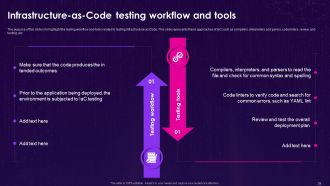
Slide 39: This slide highlights the testing workflow and tools related to testing Infrastructure as Code.
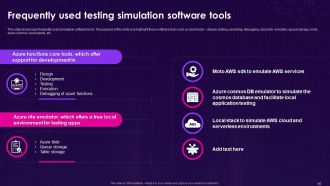
Slide 40: This slide showcases frequently used simulation software tools.
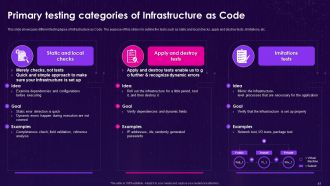
Slide 41: This slide pertains to different testing types of Infrastructure as Code.
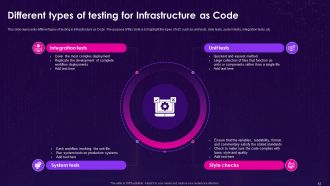
Slide 42: This slide portrays different types of testing in Infrastructure as Code.
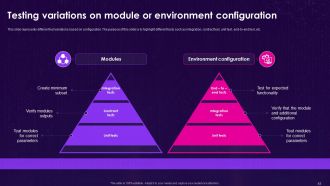
Slide 43: This slide illustrates different test variations based on configuration.
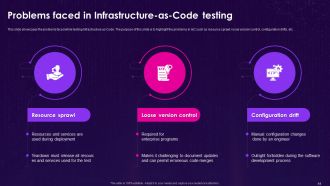
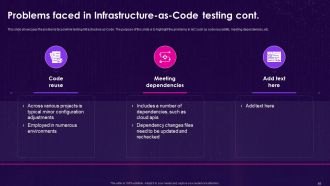
Slide 44: This slide showcases the problems faced while testing Infrastructure as Code.
Slide 45: This slide shows the problems faced while testing Infrastructure as Code.
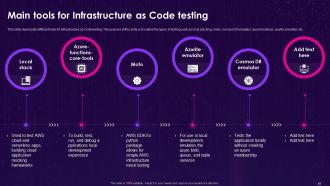
Slide 46: This slide puts different tools for Infrastructure as Code testing.
Slide 47: This slide is an introductory slide.
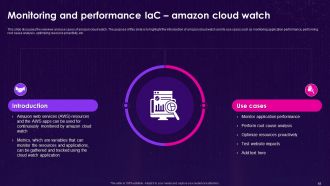
Slide 48: This slide marks the overview and use cases of amazon cloud watch.
Slide 49: This slide represents the real world example of amazon cloud watch.
Slide 50: This slide is an introductory slide.
Slide 51: This slide showcases the main types of cloud used in Infrastructure as Code.
Slide 52: This slide is an introductory slide.
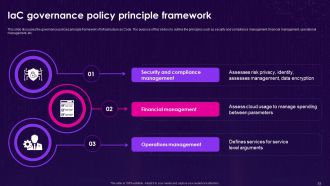
Slide 53: This slide discusses the governance policies principle framework of Infrastructure as Code.
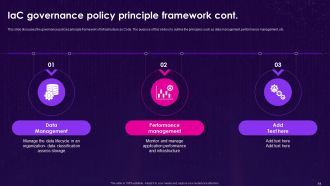
Slide 54: This slide contains the governance policies principle framework of Infrastructure as Code.
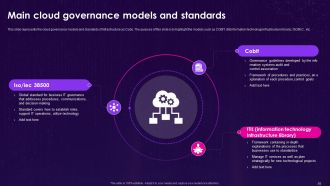
Slide 55: This slide caters to the cloud governance models and standards of Infrastructure as Code.
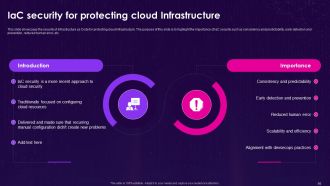
Slide 56: This slide elucidates the security of Infrastructure as Code for protecting cloud Infrastructure.
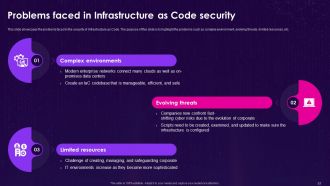
Slide 57: This slide showcases the problems faced in the security of Infrastructure as Code.
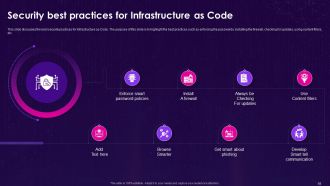
Slide 58: This slide elaborates the best security practices for Infrastructure as Code.
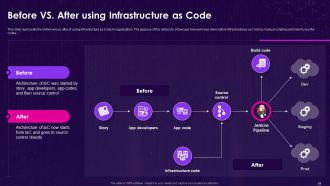
Slide 59: This slide puts the before versus after of using Infrastructure as Code in organization.
Slide 60: This slide is an introductory slide.
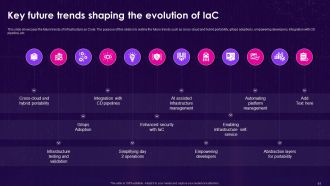
Slide 61: This slide embarks the future trends of Infrastructure as Code.
Slide 62: This slide pertains to the future trends of Infrastructure as Code.
Slide 63: This slide is an introductory slide.
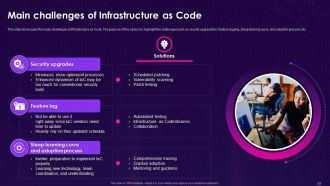
Slide 64: This slide projects the major challenges of Infrastructure as Code.
Slide 65: This slide is an introductory slide.
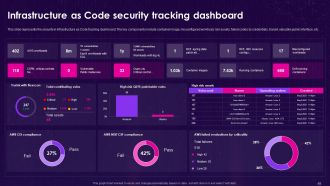
Slide 66: This slide represents the security in Infrastructure as Code tracking dashboard.
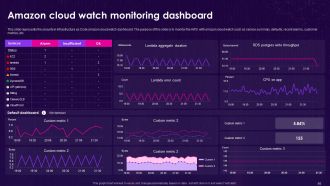
Slide 67: This slide presents the security in Infrastructure as Code amazon cloud watch dashboard.
Slide 68: This slide is an introductory slide.
Slide 69: This slide outlines the training program of Infrastructure as Code awareness which will help organizations.
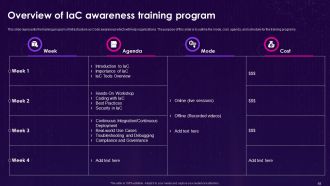
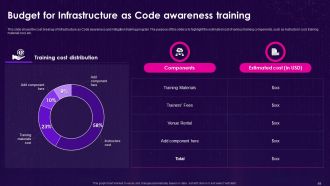
Slide 70: This slide overviews the cost breakup of Infrastructure as Code awareness and mitigation training program.
Slide 71: This slide is an introductory slide.
Slide 66: This slide is an introductory slide.
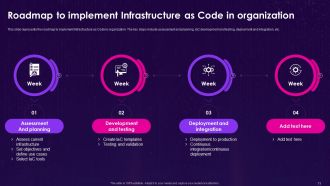
Slide 72: This slide represents the roadmap to implement Infrastructure as Code in organization.
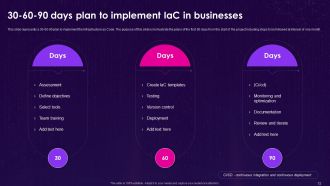
Slide 73: This slide presents a 30-60-90 plan to implement the Infrastructure as Code.
Slide 74: This slide is an introductory slide.
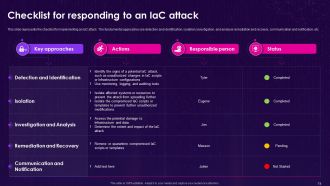
Slide 75: This slide presents the checklist for implementing an IaC attack.
Slide 76: This slide is an introductory slide.
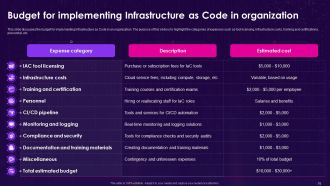
Slide 77: This slide discusses the budget for implementing Infrastructure as Code in an organization.
Slide 78: This slide shows all the icons included in the presentation.
Slide 79: This slide is titled Additional Slides for moving forward.
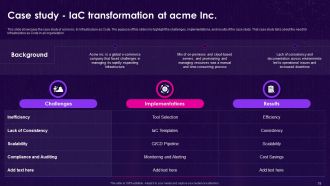
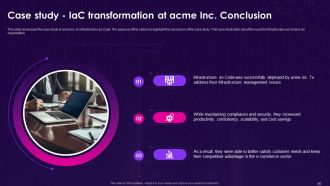
Slide 80: This slide showcases the case study of acme inc. In Infrastructure as Code.
Slide 81: This slide embarks the case study of acme inc. In Infrastructure as Code.
Slide 82: This slide is an About Us slide to show company specifications etc.
Slide 83: This slide is Our Mission slide with related imagery and text.
Slide 84: This is in continuation with the previous slide.
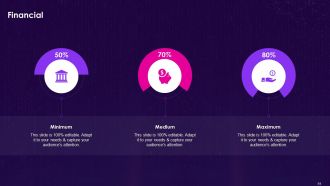
Slide 85: This slide is a financial slide. Show your finance-related stuff here.
Slide 86: This slide is Our Team slide with names and designations.
Slide 87: This slide presents a Roadmap with additional text boxes.
Slide 88: This slide is an Idea Generation slide to state a new idea or highlight information, specifications, etc.
Slide 89: This slide contains a Puzzle with related icons and text.
Slide 90: This slide shows Post-It Notes. Post your important notes here.
Slide 91: This slide is a thank-you slide with address, contact numbers, and email address.
Infrastructure As Code Iac Approaches And Best Practices Complete Deck with all 98 slides:
Use our Infrastructure As Code Iac Approaches And Best Practices Complete Deck to effectively help you save your valuable time. They are readymade to fit into any presentation structure.
















FAQs for Infrastructure As Code Iac Approaches And Best
Honestly, IaC is a total game-changer once you get into it. No more "works on my machine" disasters because everything spins up exactly the same way every time. Your deployments get crazy fast too – I used to spend forever clicking through AWS dashboards manually. Now it's all automated. The version control thing is huge. When someone breaks prod (and they will), you can actually roll back instead of panicking. Everything becomes predictable, which sounds boring but trust me, it's not when you're trying to hit deadlines. Start with just one environment first though. Don't go crazy right away.
So IaC fixes that annoying "works on my machine" mess by putting all your infrastructure into version-controlled code. Both dev and ops can actually read it and make changes together. No more devs tossing stuff over the fence with sketchy deployment notes - everyone's literally working from the same setup. Your infrastructure changes get the same treatment as regular code: pull requests, testing, all that good stuff. Honestly saves so much time on those blame-game meetings when things go sideways. I'd start with your most critical components first, then just build out from there.
So you've got four main options here. Terraform's probably your best bet if you want to work across different cloud providers - the state management is solid. Ansible's more about configuration stuff, but honestly the YAML is so clean anyone can read it. CloudFormation only works with AWS, though if you're already locked into their ecosystem it's pretty seamless. Oh and there's Pulumi - lets you write everything in Python or TypeScript instead of learning weird new syntax, which is nice. I'd go Terraform for flexibility, CloudFormation if you're AWS all the way.
Treat your infrastructure code exactly like regular code - everything goes into Git. Terraform files, CloudFormation templates, whatever you're using. Set up proper branches and use pull requests for reviews (trust me, you'll catch so many mistakes this way). The rollback ability alone is worth it. Create a dedicated repo and build CI/CD pipelines that deploy when you merge to main. Never push infrastructure changes directly to prod without version control - I learned that the hard way on a project last year. Start small with one environment and expand from there.
So basically, config management picks up where your IaC tools leave off. Terraform spins up your servers and networks, but then what? That's where Ansible, Puppet, or Chef come in - they actually install your apps, tweak settings, and keep things updated. IaC builds the infrastructure, config management makes it useful. (That house analogy was pretty bad, wasn't it?) The trick is connecting them so when your infrastructure comes online, it automatically kicks off the right configuration stuff. You'll want them talking to each other, not running in silos.
So basically, IaC lets you treat your infrastructure like actual code - you can version it, test it, whatever. Need to scale? Just tweak your templates and boom, identical environments deploy instantly. Way better than manually setting up servers (seriously, who has time for that headache?). Everything becomes super predictable since the same code always spits out the same result. No more "works on my machine" nightmares. If stuff breaks, you just redeploy from your tested templates - it's like having disaster recovery baked right in. I'd say start with one service and expand from there.
Honestly, the hardest part is getting your team on board with learning new tools. Everyone's comfortable clicking around AWS console, then suddenly they need to write Terraform. State management will bite you - trust me, set up remote backends immediately or you'll hate yourself later. Testing infrastructure changes is weird compared to regular code testing. Also someone will eventually try to destroy prod by accident, so figure out permissions early. Oh and don't go big right away - pick some throwaway resources to mess around with first. Your team needs way more training time than you think they do.
Dude, Infrastructure as Code is a lifesaver for disaster recovery. When everything crashes, you don't have to frantically dig through old notes trying to remember configs. Just run your scripts in another region and you're back online with identical settings. Recovery becomes something you can actually test instead of crossing your fingers and hoping. Honestly, the "what port was that again?" panic moments are the worst part of any outage. You can spin up exact replicas whenever you want to practice. Start getting your current setup into Terraform now - trust me, you'll thank yourself later when things inevitably go sideways.
Look, treat those IaC templates exactly like your regular code - version control, scan for vulns, don't hardcode secrets. Honestly, I've watched so many teams skip the scanning step and then panic when something breaks. Set up least-privilege access and validate your inputs. Throw a security scanner into your CI/CD pipeline (easiest quick win). AWS Secrets Manager or Vault for sensitive stuff, obviously. Oh, and audit your deployed infrastructure against templates regularly - drift happens more than you'd think. Start with that scanner though, seriously.
Honestly, IaC is a game changer for testing and CI/CD. Version control your infrastructure like regular code, so you catch config mistakes before they bite you. Spinning up identical environments becomes trivial - testing, staging, prod, whatever you need. No more of that "works on my machine" nonsense we've all dealt with. Your pipelines can provision everything automatically, deploy apps, then tear it all down when you're done. The consistency alone makes it worth it. Oh, and you don't have to go crazy at first - just pick one simple resource and get it automated through your current pipeline.
Track deployment frequency and lead time first - those are your bread and butter. Infrastructure spin-up time is massive too, especially compared to doing things manually. When stuff breaks (and it will), measure how fast you can recover since IaC makes rollbacks way smoother. Configuration drift is another big one - basically how often your real infrastructure actually matches your code. Oh, and if you're dealing with compliance stuff, track audit time because that can save you tons of headaches later. Don't go crazy measuring everything though. Pick like 2-3 metrics to start with and build from there.
Dude, IaC is such a game changer for multi-cloud stuff. Instead of juggling different consoles for AWS, Azure, GCP - you just write everything in Terraform or Pulumi once. Then deploy it everywhere the same way. Way less headache when you're troubleshooting too since you're not trying to remember how each provider does their weird little quirks. Version control tracks what's running where, which honestly saves my butt constantly. I'd say pick Terraform first - seems like everyone's using it these days. Just get your whole team on the same tool and you'll be golden.
So basically IaC treats your whole infrastructure like code - you can version it, track changes, deploy consistently. No more random 2am disasters from mystery updates! Everything goes through code review now, which is honestly a game changer. Rolling back when stuff breaks? Super easy. The cool part is your infrastructure grows with your app code, so scaling and config updates become totally predictable. I'd start small though - maybe just your dev environment first to get the hang of it.
Honestly, IaC is a game-changer for compliance stuff. Everything gets documented automatically since it's all in version control. You can bake security policies right into your code, so problems get caught before deployment instead of some auditor yelling at you later. Way less stressful. Every change is tracked, so you can actually prove what was running when. I'd start by figuring out which regulations hit your infrastructure - then just build those rules into your templates from the start. Oh, and throw compliance scanning into your CI/CD pipeline too.
Definitely start with hands-on workshops where teams actually write Terraform or CloudFormation together. Pair your experienced people with newcomers on real projects - way better than just reading about it. Online courses help, but honestly? Diving into the documentation is where it clicks for most people. Oh, and set up a proper sandbox environment so they can mess around without taking down production (learned that one the hard way). Code reviews for infrastructure are huge too. It's probably the fastest way to spread knowledge around and catch those weird config issues before they bite you.
-
Like always a great experience with you guys. Always there on the drop of hat to help.
-
The designs are very attractive and easy to edit. Looking forward to downloading more of your PowerPoint Presentations.