

Insurance Broker Business Plan Powerpoint Presentation Slides





Try Before you Buy Download Free Sample Product
 Impress Your
Audience
 100%
Editable
 Save Hours
of Time


The insurance agency business is where different insurance related to health, annuities, automobiles, marine, and other business insurance is sold and reinsured. Check out our efficiently designed Insurance Broker Business Plan PowerPoint presentation. The PowerPoint presentation covers details regarding the company executive summary, the quick pitch providing information about the business, the clothing market, and the opportunities available with the business. It displays the key to success factors, mission, vision, and the start up summary, including all the necessary expenses. The business plan document exhibits the growth potential analysis, including SWOT analysis and Porters five force analysis model, customer analysis, and market sizing, including TAM, SAM, and SOM. The plan also has an offline and online marketing strategy, and sales funnel for customer retention. The financial summary includes the basic assumptions which are used for estimating the future, and scenario analysis showing nominal, optimistic, and pessimistic cases. It also includes a graphical presentation of profit and loss statements, cash flow statements, and balance sheet, and provides a DCF valuation model for the business after five years. Get access now.
People who downloaded this PowerPoint presentation also viewed the following :
Content of this Powerpoint Presentation
Slide 1: This slide displays the title Insurance Broker Business Plan.
Slide 2: This slide presents the agenda of the insurance agency business plan.
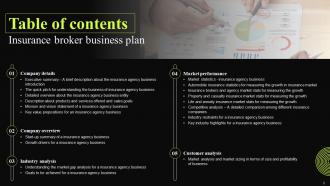
Slide 3: This slide exhibit table of content.
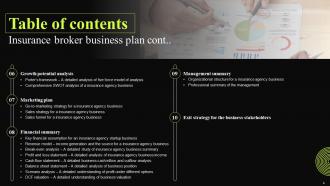
Slide 4: This slide exhibit table of content.
Slide 5: This slide exhibit table of content that is to be discuss further.
Slide 6: This slide covers a brief glimpse of what the business will be offering to the customer with market information.
Slide 7: This slide covers a brief glimpse of what the quick pitch of the business to the customers with market information.
Slide 8: This slide provides a detailed information about the business’s incorporation, location, web-address, target market, and about the business.
Slide 9: This slide provide a gist about the business mission and vision.
Slide 10: This slide provide a brief about the business values.
Slide 11: This slide provides a gist of products and services which the business will offer along with the revenue assumptions for the future growth of the business.
Slide 12: This slide provides a detailed information about the value prepositions which includes one-stop destination, competitive prices, mobile application services etc.
Slide 13: This slide exhibit table of content that is to be discuss further.
Slide 14: This slide provides a gist of company start-up summary.
Slide 15: This slide provides a detailed information about the market opportunity which financially support and share the risk, settlement, claims and lawsuits.
Slide 16: This slide provides a detailed information about the market opportunity which financially support and share the risk, settlement, claims and lawsuits.
Slide 17: This slide exhibit table of content that is to be discuss further.
Slide 18: This slide highlights the market gap which the industry is undergoing which includes Accessibility issues and a financial literacy deficit, low rate of penetration.
Slide 19: This slide highlights the market gap which the industry is undergoing which includes Accessibility issues and a financial literacy deficit, low rate of penetration.
Slide 20: This slide provides a detailed information about the business’s milestone, the business’s five year growth plan and it’s sales assumption to achieve.
Slide 21: This slide exhibit table of content that is to be discuss further.
Slide 22: This slide provides a glimpse of industry overview of the insurance agency.
Slide 23: This slide provides a glimpse of automobile industry overview in the insurance business.
Slide 24: This slide provides a glimpse of insurance broker and agency industry overview in the insurance business.
Slide 25: This slide provides a glimpse of property and casualty insurance overview in the insurance business.
Slide 26: This slide provides a glimpse of property and casualty insurance overview in the insurance business.
Slide 27: This slide provides a competitive framework of insurance brand competitive analysis within the already existing market in the USA.
Slide 28: This slide provides a brief gist of industry restraints of the US insurance market, which includes restraints related to licensure laws and capital requirements.
Slide 29: This slide provides a glimpse of industry highlights of the insurance agency market, which includes impact of new models and customized goods.
Slide 30: This slide provides a glimpse of industry highlights of the insurance agency market.
Slide 31: This slide exhibit table of content that is to be discuss further.
Slide 32: This slide provides a brief gist of customer analysis of the insurance agency business.
Slide 33: This slide exhibit table of content that is to be discuss further.
Slide 34: This slide provides detailed information on porter’s framework, including strong competitive rivalry, strong bargaining power of consumers.
Slide 35: The slide highlights a swot analysis of the clothing business. It includes the strengths, weaknesses, opportunities, and threats of the clothing market.
Slide 36: This slide exhibit table of content that is to be discuss further.
Slide 37: This slide provides a brief of go-to-marketing strategies which the company will follow to capture the market.
Slide 38: This slide provides a brief of salesstrategies which the company will follow to capture the market.
Slide 39: This slide provides a brief of sales funnel which the company will follow to capture the market.
Slide 40: This slide exhibit table of content that is to be discuss further.
Slide 41: This slide represents financial assumptions of the insurance agency business plan.
Slide 42: This slide presents revenue model of insurance agency business.
Slide 43: This slide represents breakeven analysis.
Slide 44: This slide represents breakeven graph.
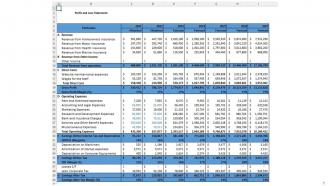
Slide 45: This slide represents profit and loss statement.
Slide 46: This slide represents graphs of gross profit of the business and earnings before interest tax & depreciation.
Slide 47: This slide represents graphs of total revenue from operations and earnings after tax.
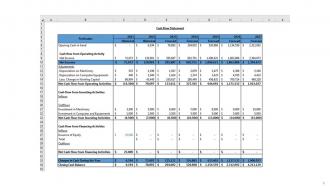
Slide 48: This slide represents the business’s historical and forecasted cash flow results and the amount of cash the business will introduce to starts its operations.
Slide 49: This slide represents a graph on cash flow analysis and total assets.
Slide 50: This slide represents balance sheet statement.
Slide 51: This slide represents a graph on cash flow analysis and total assets.
Slide 52: This slide represents the different scenarios for deriving final annual profit after tax on the basis of realistic case analysis, optimistic case analysis.
Slide 53: This slide presents a scenario analysis of annual revenue break-even, annual profit after tax and break-even analysis.
Slide 54: This slide represents the DCF valuation analysis of a business’s financials based on the free cash flow to firm.
Slide 55: This slide exhibit table of content that is to be discuss further.
Slide 56: This slide represents organizational structure of the business.
Slide 57: The slide highlights the professional summary section of the café.
Slide 58: This slide exhibit table of content that is to be discuss further.
Slide 59: This slide represents exit strategy for stakeholders such as venture capitalists, private offerings and initial public offer.
Slide 60: This is the icons slide.
Slide 61: This slide presents title for additional slides.
Slide 62: This slide showcase Clustered column for different products.
Slide 63: This slide showcase Line chart for different products.
Slide 64: This slide showcase Target.
Slide 65: This slide shows puzzle for displaying elements of company.
Slide 66: This slide showcase Quotes.
Slide 67: This slide exhibit Timeline.
Slide 68: This slide display Venn diagram.
Slide 69: This slide depicts posts for past experiences of clients.
Slide 70: This is thank you slide & contains contact details of company like office address, phone no., etc.
Insurance Broker Business Plan Powerpoint Presentation Slides with all 75 slides:
Use our Insurance Broker Business Plan Powerpoint Presentation Slides to effectively help you save your valuable time. They are readymade to fit into any presentation structure.







































































FAQs for Insurance Broker Business Plan
So you'll want to start with market research - figure out your target clients and scope out the competition. Then nail down what types of insurance you're actually gonna broker. Sales strategy is huge too, like how you'll actually get clients through the door. Financial stuff is obvious but tedious - startup costs, revenue projections, all that fun accounting work. Don't skip the operational boring bits either: licensing, staffing, compliance procedures. Honestly, the trickiest part might be defining what makes you different from every other broker. Oh, and write a killer executive summary first - it's what investors read to decide if they'll bother with the rest.
Look, market research is gonna save your ass from making expensive mistakes. Survey potential clients first - find out what insurance they actually need versus what every other broker is already pushing. Auto insurance? Yeah, that market's oversaturated as hell. But maybe there's a gap in cyber liability or some other niche nobody's touching. The data shows you how to price competitively and which client types make you the most money. Plus you'll figure out what marketing actually works instead of just throwing stuff at the wall. Honestly, skipping this step is how most new brokers end up competing on price alone, which sucks.
So you'll want revenue projections - base those on your commission rates and how many clients you think you can actually land. Operating expenses too: rent, software subscriptions, marketing budget, all that stuff. Cash flow statements are honestly the most crucial part because commissions are so unpredictable (trust me on this one). Break-even analysis showing when you'll turn profitable, plus maybe a 3-5 year P&L. Oh and don't forget startup costs - licensing fees, E&O insurance, tech setup. Just be realistic with your numbers and show how you calculated everything so investors aren't scratching their heads.
Honestly, specialize instead of trying to do everything. Pick one thing - maybe small restaurants or construction - and get really good at their specific problems. Relationships still matter way more than people think. Meet face-to-face when you can, respond fast, and skip the insurance speak - just talk like a normal person. Oh, and having some kind of online portal or app definitely helps you stand out from the old-school agents. I'd say start with whatever industry you already know best and just own that space first.
Start with licensing - that's the biggest headache honestly. Your state insurance commissioner's website usually has checklists that'll save you hours of digging around. Business plan needs to cover E&O insurance, bonding requirements, and compliance stuff that varies by state. Data privacy laws are another thing to think about if you're going digital with client info. Most states want continuing education plans too. Oh, and each broker on your team needs individual licensing - forgot to mention that first. It's a lot of boxes to check but the commissioner's office can point you in the right direction.
Look, you absolutely need this stuff or you'll drown in paperwork. I learned this the hard way watching my buddy try to manually handle 500+ clients - total nightmare. CRM systems and automated quote tools will save your sanity when you're scaling up. Your team can actually focus on building relationships instead of drowning in spreadsheets. Younger clients expect everything digital anyway, so you're kind of behind if you don't adapt. Start with one solid system that plays nice with your carriers, then add more later. Don't try to do everything at once though.
Focus on automated follow-ups before renewals and after claims - that's huge. Your CRM should track client changes like new kids or business growth so you can suggest coverage updates. Honestly, the birthday cards thing sounds corny but clients eat it up. Same with industry newsletters. Different clients want different contact levels though - some need quarterly check-ins, others just want their annual review. I'd segment them by risk and how much they actually want to hear from you. The trick is staying helpful without being annoying, which is trickier than it sounds.
Look at your client data first - which industries and company sizes bring in the most money and stick around longest? Build 2-3 solid personas from that info, including their pain points and where they hang out online. Honestly, most brokers make the mistake of trying to be everything to everyone (I get it, more clients seems better). But you'll crush it way harder if you pick specific niches and become THE person they think of. Then use those personas to shape your messaging and sales pitch. Way more effective than generic outreach that falls flat.
Look, most successful brokers I know built their whole client base through networking - it really is that important. You'll get tons of referrals from accountants, lawyers, real estate people who deal with your same clients. Chamber of commerce is probably your best starting point. Industry associations too. I'd say shoot for at least one event per month, even though yeah, some of it feels like schmoozing. But those relationships actually turn into real business. Plus you'll pick up on industry trends and hear about new carriers. Honestly beats cold calling by a mile.
LinkedIn's your best bet - that's where business owners actually scroll when they're thinking about coverage. Post quick tips, industry news, maybe some client wins if they're cool with it. Facebook's solid for local stuff and connecting with smaller businesses in your area. Honestly? Skip TikTok unless you're going after the younger crowd. Instagram could work for some behind-the-scenes content though. Don't stress about making everything perfect. Better to post consistently, even if it's just sharing an article with your thoughts. Pick one platform first, figure out your voice, then branch out from there.
Honestly, referrals are where it's at - happy clients basically become your sales team. I'd also hit up chamber of commerce stuff since you're meeting actual business owners who need coverage. LinkedIn content about insurance trends works well too, plus Google Ads for local targeting. Oh, and don't overlook accountants and attorneys - they refer clients constantly. Digital marketing takes forever to build momentum though, so maybe start there while you're doing the networking thing? Partner relationships are clutch. Just pick one approach and get good at it first instead of spreading yourself too thin.
Hey! So for your business plan, weave the risk stuff right into your ops and financials. Think about what could go wrong - E&O claims, losing a big client, new regulations, key people quitting. Then map out how you'll handle each one: good insurance, not putting all your eggs in one client basket, solid compliance systems. Oh and definitely work risk assessment into how you onboard new clients - saves headaches later. Your financial projections should factor in insurance costs and what happens if you get hit with a claim. Honestly, showing investors you've thought this through beats just talking about growth targets.
Honestly, you need three main types of partnerships. Carrier relationships are obvious - gotta have those for good rates. But here's what most people miss: CPAs, attorneys, and financial advisors are absolute goldmines for referrals since their clients always need insurance. I'd also partner with other brokers for cross-referrals when you can't handle certain coverage or areas. One thing though - don't do handshake deals that fall apart later. Set up actual referral agreements with clear terms so everyone knows what they're getting.
Okay so first thing - get your claims process mapped out step by step. Walk clients through filing, stay on top of insurers with regular follow-ups, and document literally everything. Seriously, that paperwork becomes gold when things go sideways later. Communication-wise, commit to response times like 24-48 hours and pick your preferred contact methods. Regular check-ins during active claims are huge. Templates help for common stuff, just don't make them sound robotic. Here's the thing though - you've gotta stay ahead of it. Clients shouldn't be left wondering or chasing you down for updates.
Dude, three things you gotta nail: licensing stuff first (obviously), then product knowledge, and sales training. Get everyone licensed and compliant - that's like table stakes. Monthly sessions work great for keeping up with new products and carrier changes since that stuff shifts all the time. Oh and don't sleep on the soft skills part. Communication and relationship building matter way more than people think. The brokers killing it right now? They're constantly learning new stuff. Maybe team up with carriers for workshops or push certifications. I'd make it part of how you operate, not some annual thing you check off.
-
Stunning collection! With a wide variety of options available, I was able to find a perfect slide for my presentation. Thank you, SlideTeam!
-
I am not the best at presentations but using SlideTeam’s PPT template made it easier for me. Thank you SlideTeam!