


Integrated planning framework powerpoint slides templates




Try Before you Buy Download Free Sample Product
 Impress Your
 Audience
 100%
100% Editable
 Save Hours
 of Time


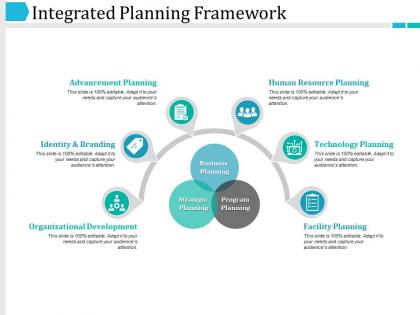
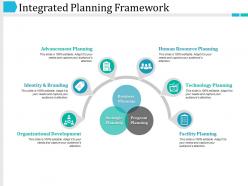
Construct an impressive presentation on integrated planning framework concept using our predesigned integrated planning framework PowerPoint slides templates. This integrated business framework PowerPoint template has been designed utilizing an impactful icon of advancement, advertising, development, facility, technology, and HR planning. This integrated strategy model template slide highlights a process of six steps such as organizational development, identity and branding, advancement planning, human resource planning, and technology planning. This concentric circles template design highlights three concepts such as business planning, strategic planning, and program planning. Apply this business integrated strategy model PPT slide layout in your PPT to describe the idea of sales forecasting and budgeting, supply chain planning, and strategic & commercial planning, integrated planning and reporting, integrated planning system, strategic planning, integrated architecture framework, integrated design, enterprise planning system, integrated business planning, functions & business processes, finance & operations, sales and operations planning. Use this integrated business process PPT design beneficial and understandable to the audience by inserting the valuable information about each concept. Win the heart of the audience and achieve the end goals. Cash in on it with our Integrated Planning Framework Powerpoint Slides Templates. The audience will be eager to fund you.
People who downloaded this PowerPoint presentation also viewed the following :
Integrated planning framework powerpoint slides templates with all 5 slides:
The job is bound to grab their interest due to our Integrated Planning Framework Powerpoint Slides Templates. Folks will itch to do it.


FAQs for Integrated planning framework
Key components of an integrated planning framework include strategic alignment, cross-functional coordination, data integration, performance metrics, and continuous feedback loops. These elements work together by connecting departmental objectives, streamlining resource allocation, and enabling real-time adjustments, with many organizations finding that this comprehensive approach ultimately delivers enhanced operational efficiency and competitive advantage.
Organizations ensure stakeholder alignment by establishing clear communication channels, defining shared objectives and success metrics, implementing regular cross-functional review sessions, and creating transparent reporting mechanisms. Through collaborative planning platforms and structured feedback loops, teams achieve consistent understanding of priorities, resource allocation, and strategic direction, while maintaining accountability across departments, ultimately delivering enhanced coordination and faster decision-making.
Data analytics enhances integrated planning strategies by providing predictive insights, identifying operational bottlenecks, optimizing resource allocation, and enabling real-time performance monitoring across departments. Through advanced analytics platforms, organizations streamline decision-making processes, improve forecast accuracy, and align cross-functional objectives more effectively, ultimately delivering enhanced operational efficiency and strategic competitive advantage.
An integrated planning framework supports long-term sustainability by aligning financial, operational, and strategic planning processes, enabling organizations to anticipate market changes, optimize resource allocation, and maintain competitive positioning. Through coordinated scenario planning and risk assessment, companies across manufacturing, healthcare, and financial services streamline decision-making, reduce operational inefficiencies, and ultimately deliver sustained growth while adapting to evolving business environments.
Technology facilitates integrated planning frameworks through cloud-based collaboration platforms, real-time data analytics, automated workflow systems, predictive modeling tools, and centralized dashboards. These technologies streamline cross-departmental coordination, enable data-driven decision making, and enhance resource allocation, with organizations across manufacturing and financial services finding that integrated systems ultimately deliver improved operational efficiency and strategic alignment.
Common challenges include data silos across departments, resistance to cross-functional collaboration, legacy system incompatibilities, inadequate technology infrastructure, and insufficient change management processes. These obstacles can significantly impact implementation timelines, with many organizations finding that successful adoption requires strategic leadership alignment, comprehensive staff training, and phased integration approaches, ultimately delivering enhanced operational efficiency and competitive advantage.
An integrated planning framework improves resource allocation efficiency by connecting strategic objectives, operational requirements, and financial constraints into unified decision-making processes, eliminating departmental silos and redundant investments. Through real-time data integration and cross-functional visibility, organizations can optimize budget distribution, minimize waste, and accelerate project timelines, with many enterprises finding 20-30% improvements in resource utilization.
Key metrics include plan accuracy rates, cross-functional alignment scores, resource utilization efficiency, cycle time reduction, forecast variance, and stakeholder satisfaction levels. These measurements enable organizations to assess planning effectiveness by tracking decision speed, cost optimization, and strategic goal achievement, with many enterprises finding that integrated frameworks deliver 20-30% faster planning cycles and improved organizational agility.
An integrated planning framework incorporates risk management by embedding risk assessment into strategic planning, aligning risk tolerance with business objectives, and establishing continuous monitoring systems across all organizational levels. Through automated risk analytics and cross-functional collaboration, companies streamline decision-making, enhance operational resilience, and optimize resource allocation, ultimately delivering competitive advantage in increasingly volatile markets.
Organizations can adopt regular cross-functional reviews, real-time data integration, scenario planning exercises, stakeholder feedback loops, and performance metric standardization for continuous improvement. These practices enhance integrated planning by identifying bottlenecks early, adapting to market changes swiftly, and aligning departmental objectives, with many enterprises finding that systematic review cycles ultimately deliver enhanced operational efficiency and strategic agility.
**INPUT**: How does an integrated planning framework differ across various industries? **OUTPUT**: Integrated planning frameworks vary significantly across industries based on regulatory requirements, operational complexity, and strategic priorities, with manufacturing emphasizing supply chain coordination, financial services focusing on risk management integration, and healthcare prioritizing patient flow optimization. These industry-specific adaptations enable organizations to streamline sector-relevant processes, enhance compliance management, and deliver targeted operational efficiency, ultimately providing competitive advantage within their specific market landscapes. [Word count: 60]
A poorly executed integrated planning framework results in fragmented communication, resource misallocation, missed deadlines, budget overruns, and conflicting objectives across departments. These breakdowns create cascading delays throughout project lifecycles, with many organizations finding that inadequate integration ultimately delivers reduced ROI, compromised quality standards, and diminished competitive positioning in increasingly complex market environments.
An integrated planning framework enhances cross-functional collaboration by establishing shared objectives, standardized communication protocols, and centralized data visibility across departments. This strategic approach enables teams from finance, operations, marketing, and supply chain to coordinate decisions seamlessly, ultimately reducing silos and accelerating project timelines while delivering improved resource allocation and competitive advantage.
Leadership and culture are foundational to integrated planning success, driving cross-functional collaboration, strategic alignment, and organizational buy-in across departments. Strong leaders champion the framework by breaking down silos, fostering transparent communication, and modeling collaborative behaviors, while a supportive culture ensures sustained adoption and continuous improvement throughout the organization.
Organizations leverage integrated planning for better financial forecasting by connecting budgeting, workforce planning, sales projections, and operational data into unified models that eliminate silos and improve accuracy. This strategic approach enables finance teams to create dynamic forecasts that automatically adjust across departments, with companies in manufacturing and retail finding that integrated frameworks reduce forecasting errors by 20-30% while accelerating planning cycles.
-
Enough space for editing and adding your own content.
-
Awesome use of colors and designs in product templates.