


Integrated planning process ppt summary






Try Before you Buy Download Free Sample Product
 Impress Your
 Audience
 100%
100% Editable
 Save Hours
 of Time


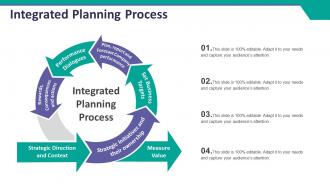
Check our predesigned integrated planning process PPT template to showcase a procedure for translating wanted business results into monetary and operational asset prerequisites. Graphics of multiple arrows in the circular process have been used to craft this integrated business planning PPT slide. While keeping the customer needs on top priority, our research team has researched this template design. Using this IBP business process planning PowerPoint template, you can highlight four different ways to reduce the risk and maximize the profits or cash flow. This integrated planning management template design reflects light on various vital targets such as performance dialogues, set business targets, measure value, strategic direction, and context, rewards consequences and actions, plan report and forecast company performance, strategic initiatives and ownership, and integrated planning process. Employ this slide design to design a PPT presentation on business planning, supply chain management, customer demands, strategic model, customer portfolios, sales, and operations planning, capital expenditure, product profitability, business process modeling, and business intelligence. So, ease your PPT work by downloading this integrated planning process presentation template. Ensure demands continue to increase exponentially with our Integrated Planning Process Ppt Summary. Enlarge your existing customer base
People who downloaded this PowerPoint presentation also viewed the following :
Integrated planning process ppt summary with all 5 slides:
Cure the hiccups with our Integrated Planning Process Ppt Summary. Gain control over any instability that arises.
FAQs for Integrated planning
Honestly, it comes down to getting everyone on the same page first - finance, ops, marketing, HR, the whole crew. Stop letting teams work in silos with their own little spreadsheets (seriously, we've all seen that disaster). Get your data talking to each other so there's no more "well MY numbers say..." arguments. Strategic alignment and cross-functional collaboration are huge, but don't forget the boring stuff like regular check-ins. Plans never survive reality anyway. Start by figuring out who you need at the table and what data they're bringing. Oh, and continuous monitoring isn't optional - things change fast.
Dude, seriously - get stakeholders involved from day one. They'll spot issues you'd never think of and actually know what works in their departments. Plus people are way more cooperative when they help build the plan instead of having it dumped on them later. The insights you get are so much better too since they're the ones dealing with this stuff daily. I learned this the hard way on a project last year - tried to skip ahead and it backfired completely. Map out who you need early. Don't make my mistake and treat it like some box to check later.
So here's the thing - data analytics is what makes integrated planning actually work instead of being a total mess. Without it, you're basically guessing and hoping for the best (which never ends well). It shows you patterns across different departments and helps predict what'll really happen. You can catch bottlenecks early and see how one team's decisions mess with another team's plans. The key is connecting sales forecasts with resource needs and what you can actually pull off operationally. I'd start by figuring out which metrics really matter across your main planning areas, then build up from there. Makes your plans way more realistic.
Honestly, tech is a game-changer for this stuff. Cloud platforms let you sync data across departments instantly - no more endless email chains with random spreadsheets flying around. AI spots patterns and runs forecasts way quicker than doing it manually (which is mind-numbing anyway). I've watched teams shrink their planning cycles from like 3 months down to a few weeks just by adding collaborative dashboards and auto-reporting. The trick? Pick tools that actually play nice together instead of creating more headaches. Map out your current process first and find where things get stuck - that's where you'll see the biggest impact.
Honestly, the worst part is dealing with departments that guard their data like it's state secrets. Finance locks down budgets while operations is still scrambling to figure out capacity - total nightmare. Plus everyone wants to use their own tools and metrics instead of standardizing. Data gets messy when you're pulling from like 5 different systems too. Oh, and good luck getting people to actually coordinate timelines between teams. I'd say pick maybe 2 departments first, show them it works, then slowly bring others in. Way less painful that way.
So basically, integrated planning gets all your departments talking to each other instead of doing their own thing. You know how finance makes their budget, then ops does theirs, then sales does whatever? Yeah, that's a recipe for chaos when you actually try to run the business. Instead, you get everyone in the same room (figuratively - or literally I guess) so your sales targets actually line up with what you can produce and afford. Way more work upfront but you won't be scrambling later when nothing matches up. Honestly, if doing everything at once sounds insane, just pick two departments and start there.
Track both the doing and the results, you know? Process-wise: are stakeholders actually engaged, are you hitting milestones, is collaboration real (not just people sitting in meetings scrolling their phones). Results matter too - goal achievement, how well you're using resources, adaptation speed when things change. Decision-making speed is huge - honestly, slow decisions kill more projects than bad ones sometimes. Start with 3-4 metrics that actually matter to your team. You can always add more later once you've got a rhythm going and aren't drowning in data.
Okay so basically integrated planning stops all your departments from working in their own little bubbles. Marketing, ops, finance - they're all looking at the big picture together instead of fighting over budget scraps. You get to see where resources actually need to go based on what matters most for company goals. Way better than those awkward moments where you're like "seriously, we blew how much on that random project?" Honestly, just start by looking at where your planning processes already overlap - I bet you'll spot some quick wins. It saves so much headache down the road.
You gotta map out how your big-picture goals actually connect to what people do every day - most companies are terrible at this part, honestly. Start with one major goal and trace it down to specific team tasks. Set up regular check-ins to see if daily work is actually moving you toward those bigger objectives. Dashboards help, but don't go overboard with them. Build in ways for your teams to push back when strategic goals don't make sense from their perspective. The feedback loop thing is huge because strategy looks different from the ground level.
Check out Singapore's urban planning - they absolutely nailed the coordination between housing, transit, and jobs over like 50 years. Copenhagen's another solid example, though mainly for bikes. Both cities got everyone on the same page early and somehow kept that vision intact despite political turnover (which is honestly impressive). The thing that blows my mind is how organized they are compared to most places. Start with Singapore's "concept plan" approach - it's a really good framework for thinking about how to get different sectors working together. Should give you some solid ideas for your projects.
You want your planning to bend without breaking, right? Build in regular review cycles and scenario planning upfront. Create multiple "what if" models so you can pivot fast when stuff changes. Quarterly reviews work for most teams, but honestly? Some industries need monthly check-ins these days - everything moves so damn fast. Get your sales, finance, and ops people working from the same data model. That way when you adjust forecasts or move resources around, everyone sees how it affects everything else instantly. Set up those cross-team meetings now, trust me.
Oh man, integrated planning is such a headache but here's what actually works. Start with Miro or Mural - they're lifesavers for getting everyone on the same page visually. Microsoft Project handles timelines pretty well, or Smartsheet if you want something cleaner. Honestly the hardest part is just herding cats and getting people to use the same tools! For dashboards, Tableau's solid but Power BI works too if you're already in the Microsoft world. Most teams I know love Asana or Monday for day-to-day stuff. Just don't go crazy with too many platforms - pick like 2-3 max or you'll create chaos.
Look, integrated planning breaks down those annoying department silos so everyone's actually working toward the same sustainability goals. Finance, operations, and sustainability teams stop doing their own random things and start aligning budgets and metrics around environmental targets. Think of it like getting everyone on the same spreadsheet instead of that chaos where twelve people have different versions (we've all been there). You'll spot real cost savings from energy efficiency and waste reduction when sustainability gets baked into planning from the start. The trick? Build those green metrics into your regular planning cycles. Don't just tack them on later.
Think of scenario planning as your safety net - you're basically preparing for multiple futures instead of putting all your eggs in one basket. Create different "what if" situations (best case, worst case, most likely) and see how your plans would survive each one. Sounds a bit paranoid, but honestly? It's brilliant. You'll spot weak points in your strategy way earlier than you would otherwise. Plus it shows you exactly where you need wiggle room. My advice is start with your biggest uncertainties first and build scenarios around those.
Honestly, it makes planning way better when you handle it right. Different backgrounds bring wild creative solutions - like, people just think about problems totally differently based on their culture. Communication gets messy though. Some cultures are super direct, others beat around the bush forever. Decision-making styles are all over the place too. But once your team gets past that awkward figuring-out phase? The whole process becomes so much stronger. Just give everyone room to contribute how they're comfortable and nail down some basic communication rules upfront. Trust me, it's worth the initial confusion.
-
It saves your time and decrease your efforts in half.
-
Informative presentations that are easily editable.