

Integrated management system powerpoint ppt template bundles





Try Before you Buy Download Free Sample Product
 Impress Your
Audience
 100%
Editable
 Save Hours
of Time


Our Integrated Management System Powerpoint PPT Template Bundles are topically designed to provide an attractive backdrop to any subject. Use them to look like a presentation pro.
People who downloaded this PowerPoint presentation also viewed the following :
Integrated management system powerpoint ppt template bundles with all 33 slides:
Use our Integrated Management System Powerpoint PPT Template Bundles to effectively help you save your valuable time. They are readymade to fit into any presentation structure.







FAQs for Integrated management system powerpoint
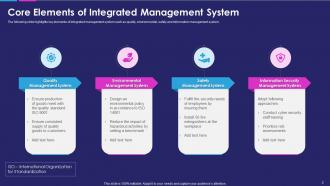
So you've got three main pieces - quality management (ISO 9001), environmental (ISO 14001), and health & safety (ISO 45001). Some companies toss in info security or risk stuff too, depends what they're dealing with. Instead of running separate systems that don't talk to each other, you merge everything into one setup. Way less paperwork, trust me on that one. You'll have shared docs, combined audits, unified policies - the whole thing just flows better. My advice? Map what you've already got first, then pick the easiest overlapping processes to combine. Start small and build from there.
Dude, you know all that duplicate paperwork you're drowning in? An IMS cuts through that mess by combining your quality, safety, and environmental stuff into one system. No more separate audits for everything - honestly, I wish more places would figure this out sooner. You'll have way fewer redundant meetings and can actually share resources between departments. The best part? When problems pop up, you see the whole picture instead of just your little corner. I'd start by looking at where your current systems overlap the most. That's where you'll feel the difference right away.
Dude, you're gonna love how much easier life gets. No more juggling three different sets of documentation - everything rolls into one system. Your team stops running around trying to follow different procedures for quality vs safety stuff, which honestly is a game changer. Compliance gets way better when it's all coordinated too. Management finally sees the big picture instead of getting bits and pieces from each department. Oh, and the cost savings are real once you cut out all that duplicate work. I'd map where your systems overlap first - that's where you'll find the quick wins.
So basically an IMS just combines all your compliance stuff into one system instead of dealing with separate headaches for ISO 9001, 14001, 45001, whatever you need. No more three different audit trails and document sets - trust me, that gets messy fast. You'll have unified procedures covering multiple standards at once. Documentation overlaps naturally, internal audits hit everything together, and management reviews actually make sense. The big win? You're not doing the same work twice while still checking all the boxes. Oh, and start by figuring out where your standards overlap - that's honestly where you'll save the most time.
Honestly, the department pushback is gonna be brutal - everyone's attached to their current setup and nobody wants extra work. ISO standards are a mess to align too, like trying to make 9001 and 14001 play nice when they have totally different priorities. You'll end up with duplicate docs everywhere and training becomes this whole thing. People get weirdly territorial about processes, I've seen it before. Start with just two systems max, get the key people on board early (buy them coffee, whatever it takes), and map out what actually overlaps first. Don't try to boil the ocean right away.
Honestly, automation tools are your best friend here. Start by mapping out what's driving you crazy right now - those manual approval processes, scattered documents, all that stuff. Workflow automation can handle approvals automatically, and good document management systems sync everything across ISO 9001, 14001, 45001, whatever standards you're dealing with. Cloud solutions are seriously worth it because they centralize everything in one place. Makes audits so much less stressful. AI's getting pretty decent at risk assessment too, though that might be overkill depending on your setup. Focus on fixing your biggest headaches first.
So basically, an IMS pulls all your data into one place instead of having quality, safety, and environmental teams doing their own thing separately. You'll start seeing patterns you missed before - honestly, it's wild how fixing something in one area often helps somewhere else too. The whole setup forces you to review everything against multiple standards at once, which pushes you toward better practices without even trying. Reporting gets way cleaner and you can fix problems faster. My advice? Look at where your current systems already overlap - that's where you'll probably see the biggest wins right away.
Honestly, training is where IMS projects live or die. Most people don't get how quality, environmental, and safety systems actually connect in real work - they just see separate boxes. Your team needs to understand their role in the bigger picture and how their daily stuff affects multiple standards at once. I'd start with leadership first, then work your way down. That cascading approach actually works. Without good training, everyone just goes back to doing things the old siloed way. It's like trying to run a relay race where nobody knows they're supposed to pass the baton.
So basically, an IMS lets you see all your risks in one place - quality, environmental, safety, the whole deal. Instead of each department doing their own thing, everyone follows the same process for spotting and handling risks. The cool part? You'll catch connections between risks that would totally fly under the radar otherwise. Better data means smarter decisions too since it's all flowing into one system. Honestly, I'd start by just mapping out what each team does now for risk management. You'll be shocked at the gaps - we found some pretty wild blind spots when we did this exercise last year.
Track metrics across all your systems - compliance rates, audit findings, incident frequency, that stuff. Customer satisfaction and employee engagement matter way more than people think since they show if everything's actually working together. Don't get stuck measuring individual ISO requirements like most companies do. Focus on integration instead - how fast can you respond to issues? Are your documentation processes less of a nightmare now? Pick maybe 5-7 KPIs that show real business impact, not just boxes you can check off.
Look, you absolutely need people on board or your IMS is toast. Get employees, customers, suppliers - basically anyone who touches your processes - involved from the start. They'll actually use the system if they helped build it, you know? Plus they catch stuff you'd totally miss sitting in your office bubble. I learned this the hard way on a project last year - skipped the stakeholder meetings and ended up with documentation nobody wanted to follow. Map out who matters early and check in with them regularly. Trust me, their buy-in makes or breaks the whole thing.
Honestly, just keep it simple and use the same format across quality, environmental, and safety. Flowcharts are your best friend - nobody wants to read walls of text. Map out which requirements each process hits (ISO 9001, 14001, 45001) so auditors don't give you grief later. Most companies mess this up by creating separate docs for everything when one integrated process would work way better. Don't forget roles and responsibilities, plus build in review cycles. Oh, and start with your riskiest or most-used processes first. The boring stuff can wait.
Dude, IMS is a game-changer for small businesses. Instead of juggling three different standards, everything gets rolled into one system. Your documentation becomes so much simpler, and audits? Way less painful. Employees actually know what they're doing instead of getting confused by different procedures everywhere. Honestly, the training alone makes it worth it - I've seen companies waste months just trying to coordinate separate systems. Cost-wise, you're maintaining one thing instead of three. Customers dig the integrated approach too. My advice? Don't go crazy at first. Pick two standards and see how it goes.
So an IMS basically takes your sustainability stuff and makes it actually work. It pulls together quality, environmental, and safety systems so you're not just randomly doing green things that fall apart later. You get real structure for tracking environmental goals and hitting regulations. Way better than the usual scattered approach most companies do (which is honestly a mess). It builds sustainability right into daily operations instead of treating it like some side project. Start by looking at what you're already doing versus what your management systems cover - that'll show you where the gaps are.
Skip the corporate speak - nobody buys that stuff anyway. Show them concrete wins instead. Like how they'll deal with one audit rather than juggling three separate ones, or how the streamlined processes actually cut down their daily headaches. Success stories from other teams work great too. Get your team leads on board first since people trust their peers way more than executives. Focus on the real benefits they'll feel - less paperwork, clearer job responsibilities, no more conflicting procedures driving them nuts. Make it about solving their actual problems, not some abstract management goal.
-
Innovative and attractive designs.
-
Great designs, Easily Editable.