


Integration Maturity Model For Continuous Improvement




Try Before you Buy Download Free Sample Product
 Impress Your
 Audience
 100%
100% Editable
 Save Hours
 of Time


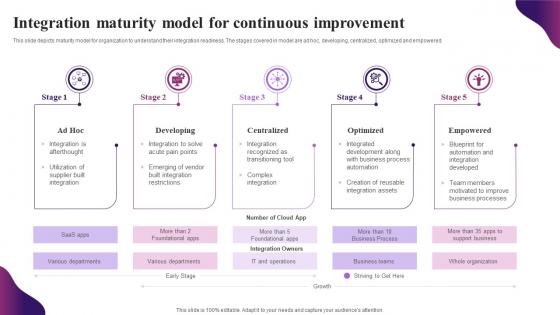
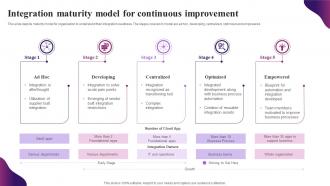
This slide depicts maturity model for organization to understand their integration readiness. The stages covered in model are ad hoc, developing, centralized, optimized and empowered.
People who downloaded this PowerPoint presentation also viewed the following :
Integration Maturity Model For Continuous Improvement with all 6 slides:
Use our Integration Maturity Model For Continuous Improvement to effectively help you save your valuable time. They are readymade to fit into any presentation structure.
-
Integration Maturity Model For Continuous Improvement
-

Integration Maturity Model For Continuous Improvement
-

Integration Maturity Model For Continuous Improvement
-

Integration Maturity Model For Continuous Improvement
-

Integration Maturity Model For Continuous Improvement
-

Integration Maturity Model For Continuous Improvement
FAQs for Integration Maturity Model
The Integration Maturity Model typically includes five key stages: initial/ad-hoc integration, managed integration processes, defined integration standards, optimized integration architecture, and innovative integration capabilities. These stages help organizations systematically evaluate their current integration maturity, identify gaps in connectivity and data flow, and develop strategic roadmaps for advancing their integration capabilities, ultimately delivering improved operational efficiency and competitive advantage.
Organizations identify their Integration Maturity Model position through comprehensive assessments evaluating current integration capabilities, data flow efficiency, system connectivity, and automation levels across departments. Through strategic auditing of existing processes, technology infrastructure, and operational workflows, companies can benchmark against maturity frameworks, with many finding that honest evaluation of integration gaps and manual processes reveals opportunities for streamlined operations and enhanced competitive advantage.
Advancing through Integration Maturity Model stages delivers enhanced operational efficiency, reduced system complexity, improved data consistency, faster decision-making capabilities, and stronger competitive positioning. Organizations progressing from basic connectivity to strategic integration find that streamlined workflows, automated processes, and real-time data synchronization ultimately enable faster customer service, lower operational costs, and more agile responses to market changes.
The Integration Maturity Model serves as a foundational framework for digital transformation, enabling organizations to assess their current integration capabilities, identify gaps, and develop strategic roadmaps for advancement. Through structured evaluation of data connectivity, process automation, and system interoperability, companies can prioritize transformation initiatives that deliver maximum impact, with many enterprises finding that higher integration maturity significantly accelerates their digital transformation outcomes and competitive positioning.
Technology evolves from basic point-to-point connections in initial stages to sophisticated API management, cloud-native platforms, and AI-driven orchestration in advanced phases. Through enterprise service buses, microservices architectures, and intelligent automation tools, organizations streamline data flow, enhance real-time processing, and enable seamless cross-platform integration, ultimately delivering operational efficiency and competitive advantage.
Organizations measure integration success through key performance indicators like system uptime, data accuracy, processing speed, and user satisfaction scores across different maturity stages. At basic levels, success focuses on connectivity and error reduction, while advanced levels emphasize real-time analytics, automated workflows, and business agility, with many enterprises finding that mature integration delivers measurable competitive advantages.
Organizations commonly face resource constraints, legacy system compatibility issues, skill gaps, change management resistance, and inadequate governance frameworks when advancing through integration maturity stages. These challenges often compound as companies struggle with siloed data architectures and insufficient stakeholder buy-in, with many finding that strategic planning and phased implementation approaches help overcome these obstacles while delivering enhanced operational efficiency.
The Integration Maturity Model facilitates better cross-departmental collaboration by establishing standardized communication protocols, shared data governance frameworks, and unified workflow processes across organizational silos. Through progressive maturity stages, organizations streamline information exchange, eliminate redundant systems, and create transparent accountability structures, with many enterprises finding that higher integration maturity levels significantly reduce interdepartmental friction while accelerating decision-making processes.
Organizations should track metrics including system connectivity rates, data synchronization accuracy, process automation levels, integration response times, and cross-platform error frequencies. These measurements enable businesses to assess operational efficiency, identify bottlenecks across departments, and optimize resource allocation, with many enterprises finding that comprehensive metric tracking ultimately delivers faster decision-making and enhanced competitive advantage.
Organizational culture significantly impacts Integration Maturity Model progression by influencing collaboration levels, change acceptance, and cross-functional communication patterns. Companies with open, adaptive cultures typically advance faster through maturity stages, while siloed organizations face barriers in achieving seamless integration, with many enterprises finding that cultural transformation often precedes successful technical integration initiatives.
Organizations can improve integration maturity by establishing standardized API governance, implementing robust data quality frameworks, adopting cloud-native integration platforms, creating comprehensive monitoring dashboards, and developing cross-functional integration teams. These practices streamline operations across departments while reducing system silos, with many enterprises finding that strategic integration investments ultimately deliver faster deployment cycles, enhanced operational efficiency, and improved customer experiences.
The Integration Maturity Model can be customized by adjusting assessment criteria, metrics, and integration priorities to align with industry-specific regulations, operational requirements, and technology landscapes. Organizations in healthcare, financial services, and manufacturing often modify maturity levels to reflect sector-unique compliance needs, data sensitivity requirements, and process workflows, ultimately delivering more relevant roadmaps for strategic integration advancement.
**INPUT**: What tools and technologies are most effective for supporting each stage of the Integration Maturity Model? **OUTPUT**: Effective tools include API management platforms, enterprise service buses, cloud integration platforms, data mapping software, and monitoring dashboards tailored to each maturity stage. These technologies streamline operations by automating workflows, enhancing data visibility, and enabling real-time connectivity, with many organizations finding that strategic tool selection accelerates their progression through maturity levels while delivering competitive advantage.
External factors significantly influence integration maturity by driving compliance requirements, competitive pressures, and operational adaptations that demand more sophisticated integration capabilities. Regulatory changes in banking and healthcare often accelerate integration investments, while market dynamics push organizations toward real-time data sharing, API-first architectures, and seamless customer experiences, ultimately delivering competitive advantage and operational resilience.
Smaller organizations can effectively leverage the Integration Maturity Model by adapting its frameworks to their scale, focusing on foundational connectivity, cloud-based solutions, and gradual automation implementation. While larger enterprises may pursue comprehensive multi-system integration, smaller businesses find that targeted integration approaches deliver significant operational efficiency and competitive advantages within their resource constraints.
-
I was mind-blown by the services that SlideTeam provided me. Thanks a ton!
-
Superb! The innovative and inspiring template designs provide an edge to the presentation.