


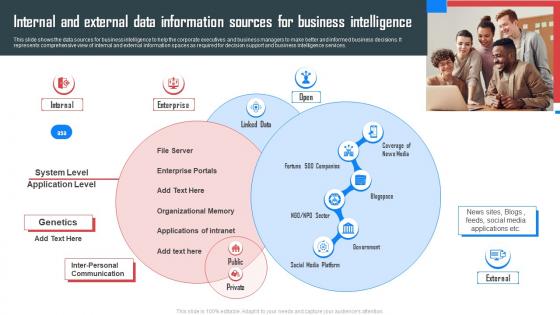
Internal And External Data Information Sources For Business Intelligence




Try Before you Buy Download Free Sample Product
 Impress Your
 Audience
 100%
100% Editable
 Save Hours
 of Time


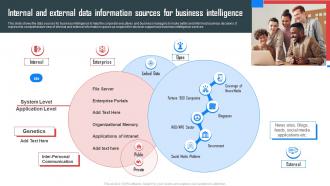
This slide shows the data sources for business intelligence to help the corporate executives and business managers to make better and informed business decisions. It represents comprehensive view of internal and external information spaces as required for decision support and business intelligence services.
People who downloaded this PowerPoint presentation also viewed the following :
Internal And External Data Information Sources For Business Intelligence with all 6 slides:
Use our Internal And External Data Information Sources For Business Intelligence to effectively help you save your valuable time. They are readymade to fit into any presentation structure.





FAQs for Internal And External Data Information Sources
Primary business intelligence data sources include internal transactional systems, external market data, social media platforms, IoT sensors, and third-party databases. These sources enable organizations to streamline decision-making by combining operational insights, customer behavior patterns, and market intelligence, with many companies finding that this strategic combination delivers enhanced forecasting accuracy and competitive advantage.
Structured data sources like databases and spreadsheets enable direct analysis and reporting through organized formats, while unstructured data from emails, social media, and documents requires preprocessing but offers richer insights. Through advanced analytics platforms, organizations leverage structured data for operational dashboards and financial reporting, while mining unstructured sources for customer sentiment and market trends, ultimately delivering comprehensive business intelligence.
Real-time data enables immediate decision-making in business intelligence by providing current insights into operations, customer behavior, and market conditions as they unfold. This capability allows organizations to respond instantly to emerging trends, detect anomalies quickly, and optimize processes continuously, with many financial services and retail companies finding significant competitive advantages through faster responses.
Organizations ensure data quality and accuracy through comprehensive data governance frameworks, automated validation protocols, standardized integration processes, and regular auditing mechanisms. These approaches streamline data collection by implementing real-time monitoring, establishing clear data lineage tracking, and creating consistent formatting standards, with many enterprises finding that strategic data quality investments ultimately deliver enhanced decision-making capabilities and competitive advantage.
Cloud-based data sources for business intelligence offer scalability, cost-effectiveness, real-time accessibility, enhanced security, and seamless integration capabilities. These technologies streamline operations by eliminating infrastructure maintenance, enabling automatic scaling, and facilitating remote collaboration, with many organizations finding that cloud solutions deliver faster insights, reduced IT overhead, and improved competitive advantage in increasingly data-driven markets.
Social media platforms serve as effective data sources by providing real-time customer sentiment, behavioral patterns, demographic insights, and competitive intelligence through user interactions, comments, and engagement metrics. These platforms enable businesses to track brand perception, identify emerging trends, and enhance customer targeting strategies, with retailers and hospitality companies finding that social analytics significantly improve marketing ROI and customer experience personalization.
Data integration techniques include ETL (Extract, Transform, Load) processes, API connections, data virtualization, master data management, and real-time streaming protocols. These approaches enable organizations to consolidate information from CRM systems, financial databases, and operational platforms, ultimately delivering unified analytics dashboards and comprehensive business insights for strategic decision-making.
IoT devices contribute to business intelligence by capturing real-time operational data, customer behavior patterns, equipment performance metrics, and environmental conditions directly from physical touchpoints. These sensors enable organizations to monitor supply chains, optimize energy usage, and predict maintenance needs, with retailers and manufacturers finding that continuous data streams deliver enhanced operational efficiency and competitive advantage.
Ethical considerations include data consent and privacy compliance, transparency in collection methods, accuracy verification, bias mitigation, and responsible data retention practices. Organizations must balance competitive intelligence needs with respect for individual privacy rights and regulatory requirements, with many companies finding that ethical data sourcing ultimately enhances stakeholder trust and long-term business sustainability.
Third-party data vendors enhance internal insights by providing market benchmarks, competitive intelligence, demographic trends, and industry-specific analytics that complement existing organizational data. Through strategic combination of external datasets with internal sources, companies streamline decision-making, identify new market opportunities, and validate internal assumptions, ultimately delivering comprehensive business intelligence and competitive advantage.
Organizations face data quality inconsistencies, format incompatibilities, integration complexities, security concerns, and timing synchronization issues when harmonizing diverse sources. These challenges require strategic data governance, standardized protocols, and robust integration platforms, with many enterprises finding that investing in automated data management tools and cross-functional teams ultimately delivers improved accuracy, faster insights, and enhanced operational efficiency.
Historical data sources serve as the foundation for predictive analytics in business intelligence by providing patterns, trends, and baseline metrics that algorithms use to forecast future outcomes. Through machine learning models trained on years of sales, customer behavior, and operational data, organizations can anticipate market shifts, optimize inventory levels, and reduce forecasting errors by up to 30%, ultimately delivering competitive advantage in strategic planning.
Machine learning enhances business intelligence data sources by automating data cleaning, enabling predictive analytics, identifying hidden patterns, and providing real-time anomaly detection. These capabilities streamline data processing, deliver faster insights, and enable proactive decision-making, with many organizations finding that predictive models significantly improve forecasting accuracy and operational efficiency.
Data privacy regulations like GDPR and CCPA create both compliance challenges and opportunities for strategic data governance, requiring organizations to implement stricter consent management, data anonymization, and audit trails. While these regulations initially increase operational complexity, they ultimately drive better data quality, enhanced customer trust, and competitive advantage, with many financial services and healthcare organizations finding that robust privacy frameworks actually streamline their analytics processes.
Open data initiatives enrich business intelligence by providing external context, market benchmarks, demographic insights, regulatory data, and economic indicators that complement internal datasets. Organizations leverage government databases, census information, and industry reports to enhance customer segmentation, identify market opportunities, and validate strategic decisions, ultimately delivering more comprehensive analyses and competitive advantage.
-
The quality of the templates is as fine as it could get. It was a purchase well made!
-
“Excellent service from the customer support team when I wanted a slide that was a bit different from those on their standard menu. Super helpful.”