

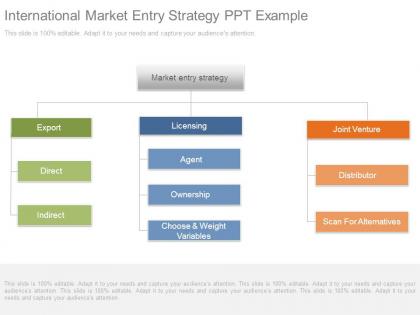
International market entry strategy ppt example




Try Before you Buy Download Free Sample Product
 Impress Your
 Audience
 100%
100% Editable
 Save Hours
 of Time


You are seen as the elder statesman. Our International Market Entry Strategy Ppt Example will strenghten your renown.
People who downloaded this PowerPoint presentation also viewed the following :
International market entry strategy ppt example with all 7 slides:
Ease the change with our International Market Entry Strategy Ppt Example. Make the new easier to digest.
FAQs for International market entry
Key factors include market size and growth potential, competitive landscape, regulatory environment, cultural differences, and available resources. These considerations enable companies to select optimal entry modes like joint ventures, licensing, or direct investment, with many organizations finding that strategic combinations of local partnerships and gradual expansion ultimately deliver sustainable competitive advantage.
Market analysis influences entry strategy selection by evaluating competitive landscapes, regulatory environments, consumer preferences, distribution channels, and local market dynamics. Through comprehensive analysis, companies identify optimal approaches like joint ventures in regulated markets, direct investment in stable economies, or franchising in culturally distinct regions, ultimately enabling strategic decisions that minimize risks while maximizing market penetration opportunities.
Cultural differences significantly influence market entry strategies through consumer behavior patterns, communication preferences, business relationship norms, regulatory expectations, and local partnership requirements. These cultural factors determine product adaptation needs, marketing message resonance, and operational approaches, with companies like McDonald's and Netflix finding that localized strategies respecting cultural nuances ultimately deliver stronger market penetration and sustainable competitive advantage.
Businesses can evaluate international market entry risks through comprehensive market research, political and economic stability assessments, regulatory compliance analysis, currency fluctuation studies, and competitive landscape evaluation. Through due diligence frameworks, companies can identify potential challenges like cultural barriers, legal complexities, and operational costs, while developing risk mitigation strategies that enable confident market expansion and sustainable growth.
Direct investment offers complete control, higher profit potential, and strategic flexibility, while franchising provides faster market entry, lower capital requirements, and reduced operational risks. While direct investment enables companies to fully capture market opportunities and maintain brand standards, franchising allows businesses to leverage local expertise and minimize financial exposure, with many multinational corporations finding that franchising accelerates expansion in unfamiliar markets.
Entry strategy selection varies significantly by industry based on regulatory complexity, capital requirements, local expertise needs, and competitive dynamics. Manufacturing companies often prefer joint ventures or direct investment for production control, while service industries like consulting frequently use licensing or franchising models, and technology firms increasingly adopt digital-first approaches, ultimately enabling faster market penetration with reduced operational risks.
Companies should anticipate challenges including foreign investment restrictions, complex tax obligations, employment law compliance, intellectual property protection, data privacy regulations, and industry-specific licensing requirements. These regulatory frameworks vary significantly across jurisdictions, with many multinational organizations finding that early legal consultation and local partnerships streamline compliance processes while minimizing costly delays and operational risks.
Partnerships and joint ventures enhance entry strategies by providing local market expertise, established distribution networks, regulatory knowledge, and shared financial risks. Through strategic alliances, companies accelerate market penetration while minimizing operational complexities, with many organizations finding that collaborative approaches deliver faster customer acquisition, reduced entry costs, and stronger competitive positioning than solo expansion efforts.
Companies should measure international market entry success through market share growth, revenue targets, customer acquisition costs, local brand recognition, regulatory compliance rates, and operational efficiency metrics. These indicators help organizations track penetration in banking, retail, and manufacturing sectors, with many finding that combining financial performance with market adaptation metrics ultimately delivers comprehensive insights into competitive positioning and long-term viability.
Localization proves critical for international success, encompassing product adaptation, cultural messaging, regulatory compliance, pricing strategies, and distribution channels tailored to local markets. Companies entering markets like Japan, Germany, or Brazil find that comprehensive localization enhances customer acceptance, reduces barriers to adoption, and delivers competitive advantage, ultimately enabling faster market penetration and sustainable growth.
Companies can minimize competition through first-mover advantage, strategic partnerships with local firms, niche market targeting, exclusive distribution agreements, and regulatory compliance expertise. These approaches enable organizations to establish market presence by securing prime retail locations, building customer loyalty early, and creating barriers to entry, with many international retailers finding that combining local partnerships with specialized market positioning ultimately delivers sustainable competitive advantages.
The current economic climate affects international market entry decisions by creating heightened emphasis on risk assessment, market timing considerations, and resource allocation strategies. Organizations increasingly prioritize markets with stable currencies and favorable trade policies, while many companies find that economic uncertainties present opportunities for strategic acquisitions and partnerships, ultimately delivering competitive advantages through calculated expansion timing.
Digital marketing tactics support international market entry through localized content creation, targeted social media campaigns, search engine optimization for regional markets, influencer partnerships, and data-driven audience analysis. These strategies enable businesses to build brand awareness cost-effectively, test market responsiveness before major investments, and establish customer relationships across cultural boundaries, with many companies finding that digital-first approaches significantly reduce traditional entry barriers while delivering measurable engagement and conversion metrics.
Technology streamlines international market entry through digital marketing platforms, e-commerce infrastructure, data analytics tools, communication systems, and automated compliance solutions. These technologies enable businesses to conduct market research, establish online presence, manage cross-border operations, and connect with local customers remotely, while reducing traditional barriers like physical infrastructure requirements, ultimately delivering faster market penetration and lower entry costs.
Companies leverage social media for international market entry through targeted audience research, cultural preference analysis, competitor monitoring, and localized content testing across platforms like Facebook, Instagram, and regional networks. These digital insights enable businesses to understand consumer behavior, validate product-market fit, and build brand awareness cost-effectively, while many organizations finding that social listening delivers crucial market intelligence before significant investment commitments.
-
Great designs, Easily Editable.
-
Amazing product with appealing content and design.