


Internet and media usage stats powerpoint graphics





Try Before you Buy Download Free Sample Product
 Impress Your
 Audience
 100%
100% Editable
 Save Hours
 of Time


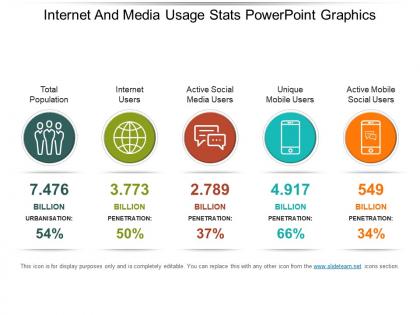
The social media usage stat PowerPoint slide is useful to describe the total population, number of users using social media platform, active internet user, and many more. A user can go for social media platform slide for PowerPoint presentation to highlight the stat of social sharing buttons, internet geolocation, devices, tech visualization, etc. The social media marketing report presentation slide design is perfect for displaying number of users of social media platforms such as Facebook, Instagram, Twitter, Google + as well as other social network platforms. The internet stat PPT template is suitable for a user who wants to share social media marketing objectives, along with that he can share progress of the social campaign, analysis of key performance indicators or KPIs, social demographics, fan engagement, and the overall traffic and return on investment or ROI. The internet user stat PowerPoint template basically helps in delivering the important campaign statistics as well as geo-targeting in the simplest way so that the viewers can understand it easily. A presenter can take help of this internet and media user stat slide to convey the social marketing concepts. Impress folks with your calm demeanor due to our Internet And Media Usage Stats Powerpoint Graphics. It helps handle a cliff hanger.
People who downloaded this PowerPoint presentation also viewed the following :
Internet and media usage stats powerpoint graphics with all 5 slides:
Dish out a few intelligent inputs with our Internet And Media Usage Stats Powerpoint Graphics. It generates intense discussions.

FAQs for Internet and media usage
So global internet access is around 64% right now, but it's all over the place depending where you look. Europe and North America are crushing it at 85-90%. Africa's only at 43% but honestly their growth is absolutely wild lately. Asia has the most users overall - like 2.8 billion people - but their percentage is lower just because there's so many people there. Middle East sits around 70%, Latin America's about 75%. You should probably check ITU or We Are Social for the newest numbers since this stuff changes pretty fast with all the infrastructure money being thrown around.
So Instagram and TikTok are killing it with younger crowds - super high engagement rates. Facebook's got more of the older demographic but honestly, the reach is still massive. LinkedIn's the obvious choice for professional stuff, and Twitter (or X now, whatever we're calling it) pulls in news people and thought leaders, though that whole platform's been kind of a mess lately. TikTok wins for keeping people glued to their screens the longest. Instagram's your go-to for visual content that actually gets interaction. Facebook still has the biggest user base overall. I'd check out platform analytics or recent Pew Research studies for current numbers since this stuff changes constantly.
Yeah so mobile totally won the internet war - like 60-65% of people browse on their phones now vs maybe 35-40% on desktop. The switch happened around 2016 and it's just kept growing since then. Honestly blows my mind how fast phones took over everything. Desktop's basically just for work hours now while mobile is 24/7. Different analytics tools show slightly different numbers but they all point the same direction. If you're building anything web-related, start with mobile first - that's where your actual users are gonna be.
Dude, seniors (65+) have had the biggest internet usage jump - like 40% over five years. Makes total sense though. Younger people were already hitting 95%+ usage, so where could they even go from there? Meanwhile older adults finally got into smartphones and video calls. COVID definitely pushed that along when everyone needed to stay connected with family. Oh, and they're all over social media now too. If you're doing anything digital marketing-wise, don't ignore them - they've got money and they're way more tech-savvy than people assume.
Dude, video is everywhere now - like 80% of social media compared to maybe half that two years back. TikTok and Reels basically run the show at this point. People watch hours of this stuff daily, which honestly feels insane when I think about it. Here's the weird part though: most folks scroll with sound off on their phones, so captions aren't optional anymore. If you're making content, just assume it's gotta work silently. Short-form is king, and mobile-first isn't really a choice - it's just how people consume everything now.
So here's the deal with shopping by age - younger people (Gen Z/Millennials) do like 60-70% of their buying on phones. Makes sense honestly. Gen X splits between desktop and mobile pretty evenly, and Boomers still love desktop but they're slowly getting into mobile shopping. The under-40 crowd also goes crazy for those Instagram and TikTok ads - total impulse buy territory. Oh, and if you're running campaigns? Mobile-first is crucial for younger demographics. Don't forget to keep desktop smooth for older shoppers though.
So it's all over the place honestly - Japan and Germany are around 3-4 hours daily, but places like the Philippines and Brazil hit 10+ hours. Developing countries actually use it more, which sounds weird but makes sense since they went straight to mobile. Most European countries sit somewhere in the 5-7 hour range. The US is about 7 hours daily. Where your audience is based should totally change when and how you're reaching them online - I learned this the hard way with a campaign last year.
Yeah, the pandemic totally changed how we use the internet. Streaming and social media jumped like 25-50% when everyone got locked down - makes sense since we were all doom-scrolling and binge-watching constantly. What's wild though is that usage never really dropped back down. People kept their Netflix habits, remote work became normal (hello, endless Zoom calls), and we just got used to doing everything online. Oh, and if you're planning anything digital, don't expect those numbers to go back to 2019 levels. We're basically living in a higher-usage world now.
Okay so millennials are still big on Facebook and Instagram for posting stuff. Gen Z though? They've completely jumped ship to TikTok, Instagram Stories, and Snapchat. YouTube's weird because both groups use it but totally differently - millennials share longer videos while Gen Z's all about quick clips and reaction content. Honestly, Facebook feels like it's just millennials now. Gen Z only goes on there when their parents make them lol. For content strategy, you gotta match the vibe: polished, longer posts work for millennial platforms. Quick, authentic, trendy stuff kills it in Gen Z spaces. Just figure out where your audience actually hangs out first.
Yeah so here's the thing - live streaming only gets like 10-15% of total video views compared to pre-recorded stuff which dominates at 85-90%. Most people just want to watch whenever they feel like it, you know? Can't blame them honestly. The pandemic did boost live numbers though, which is interesting. When people DO tune into live streams, they're way more engaged - commenting in real time and all that. But your audience will be smaller. I'd say focus mostly on pre-recorded content but throw in some live sessions too. Those deeper connections are worth it.
Yeah, podcasts are absolutely blowing up right now. Gen Z and millennials are basically fueling the whole thing. People aren't waiting for weekly episodes anymore - they're binge-listening entire series in one go, which is wild. Video podcasts are crushing it on YouTube and Spotify too, so you've gotta think visual now. Oh, and here's something interesting - niche shows are actually doing way better than those broad, general interest ones. They're just getting lost in the noise. If you're planning to advertise or make content, definitely do batch releases instead of the old weekly thing.
So cities get like 80-85% internet adoption, but rural areas are stuck around 65-70%. Infrastructure's the big issue - lots of rural spots just don't have decent broadband, or what they do have is painfully slow. Plus rural internet costs way more, which is honestly pretty unfair. Mobile usage is surprisingly similar between both though. Oh, and rural folks end up using satellite internet more, but that goes to shit whenever there's bad weather. Just something to think about if you're doing anything digital that targets rural markets - the connectivity really isn't the same.
Honestly, the biggest thing is how much data these companies grab without you even realizing it. Privacy invasion is huge - they're collecting way more than what you think you agreed to. Then they use all that info to manipulate what you see and buy, which feels pretty gross to me. Data security is sketchy too, plus there's tons of algorithmic bias baked in. Most people don't actually understand what they're signing up for when they click "accept." Oh, and the whole surveillance capitalism angle is basically dystopian at this point. My two cents? Actually read those privacy policies (I know, boring) and check your data settings regularly.
Okay so basically, your digital skills totally change how you consume media. Higher literacy means you're fact-checking stuff and actually thinking about what you see instead of just mindlessly scrolling. People without those skills? They stick to the same platforms and fall for fake news way more often. It's crazy how this affects literally everything - politics, what you buy, all of it. Oh and here's something useful: when you're analyzing data, always break it down by digital literacy levels. Raw demographics won't show you the real patterns, but that will.
Dude, 5G totally spoiled everyone. Now people lose their minds if a video buffers for like 2 seconds - they want 4K streaming instantly and games that download in minutes. It's wild how fast we got used to these crazy speeds. People are doing way more data-heavy stuff too, like AR shopping and constant live streaming, since their connection won't die anymore. Honestly thought it'd take longer for everyone to adjust, but nope! If you're building anything digital now, you've gotta plan for these ridiculously high expectations.
-
Easy to edit slides with easy to understand instructions.
-
The content is very helpful from business point of view.
-
Illustrative design with editable content. Exceptional value for money. Highly pleased with the product.
-
Designs have enough space to add content.