


Introducing devops tools for in time product release it powerpoint presentation slides




Try Before you Buy Download Free Sample Product
 Impress Your
 Audience
 100%
100% Editable
 Save Hours
 of Time


Devops is a software engineering culture and set of practices that emphasize agile software development, collaboration between software developers and other IT professionals, and the use of automation to reduce manual tasks. The goal of devops is to improve the quality and speed of product releases while preserving the stability and security of production systems. devops is a software engineering culture and set of practices that emphasize agile software development, collaboration between software developers and other IT professionals, and the use of automation to reduce manual tasks. The goal of devops is to improve the quality and speed of product releases while preserving the stability and security of production systems. With SlideTeam’s devops presentation templates, you can get insights about introducing devops tools for in time product release. Download our devOps powerpoint presentations now and learn how to speed up your product releases while maintaining quality control. Our templates are easy to use and will help you get the most out of your devops initiatives.
People who downloaded this PowerPoint presentation also viewed the following :
Content of this Powerpoint Presentation
Slide 1: This slide shows title Introducing DevOps Tools for In-time Product Release. State Your Company Name and begin.
Slide 2: This slide shows Agenda for Introducing DevOps Tools for In-time Product Release (IT).
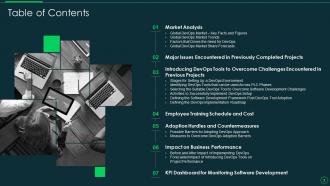
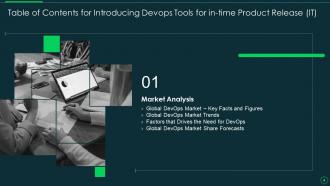
Slide 3: This slide presents Table of Content for the presentation.
Slide 4: This slide shows title for topics that are to be covered next in the template.
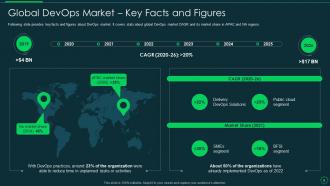
Slide 5: This slide displays global DevOps market CAGR and its market share in APAC and NA regions.
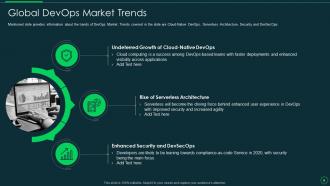
Slide 6: This slide represents trends of DevOps Market. Trends covered in the slide are Cloud-Native DevOps, Serverless Architecture, Security and DevSecOps
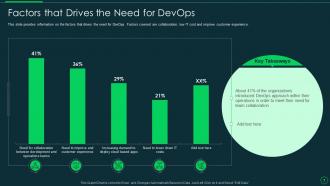
Slide 7: This slide shows Factors that Drives the Need for DevOps.
Slide 8: This slide presents details about DevOps market growth estimation during 2019-2024.
Slide 9: This slide shows Table of Contents for DevOps Tools to Bridge the Gap between Software Development and Operations Teams.
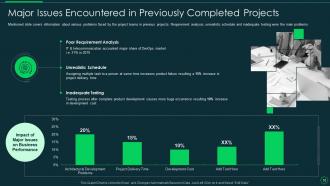
Slide 10: This slide displays Major Issues Encountered in Previously Completed Projects.
Slide 11: This slide represents Table of Contents for DevOps Tools to Bridge the Gap between Software Development and Operations Teams.
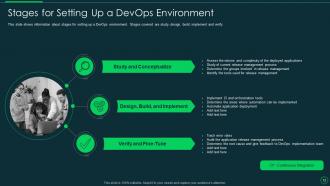
Slide 12: This slide shows Stages for Setting Up a DevOps Environment.
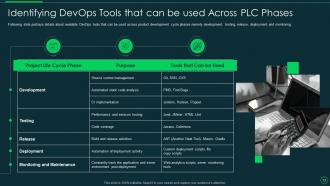
Slide 13: This slide presents Identifying DevOps Tools that can be used Across PLC Phases.
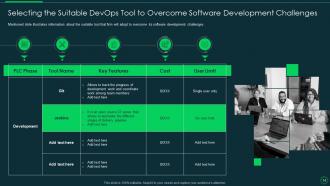
Slide 14: This slide shows Selecting the Suitable DevOps Tool to Overcome Software Development Challenges.
Slide 15: This slide displays Table of Contents for DevOps Tools to Bridge the Gap between Software Development and Operations Teams.
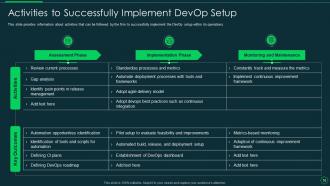
Slide 16: This slide represents Activities to Successfully Implement Devop Setup.
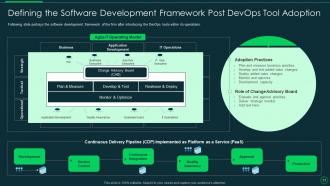
Slide 17: This slide shows Defining the Software Development Framework Post DevOps Tool Adoption.
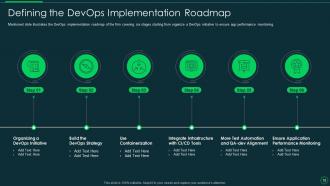
Slide 18: This slide presents Defining the DevOps Implementation Roadmap.
Slide 19: This slide shows Table of Contents for DevOps Tools to Bridge the Gap between Software Development and Operations Teams.
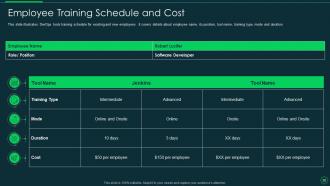
Slide 20: This slide displays DevOps tools training schedule for existing and new employees.
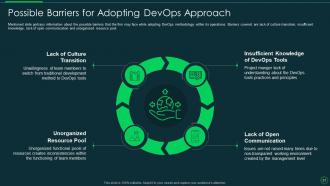
Slide 21: This slide represents possible barriers that the firm may face while adopting DevOps methodology within its operations.
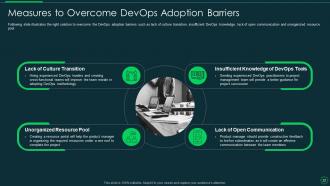
Slide 22: This slide shows Measures to Overcome DevOps Adoption Barriers.
Slide 23: This slide presents Table of Contents for DevOps Tools to Bridge the Gap between Software Development and Operations Teams.
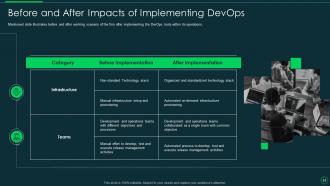
Slide 24: This slide shows Before and After Impacts of Implementing DevOps.
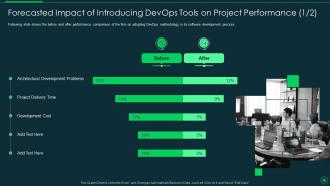
Slide 25: This slide displays Forecasted Impact of Introducing DevOps Tools on Project Performance.
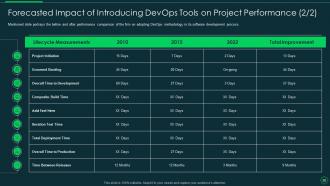
Slide 26: This is another slide showing Forecasted Impact of Introducing DevOps Tools on Project Performance.
Slide 27: This slide shows Table of Content highlighting KPI Dashboard for Monitoring Software Development.
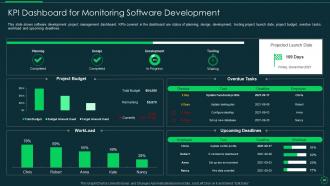
Slide 28: This slide presents KPI Dashboard for Monitoring Software Development.
Slide 29: This slide displays Icons for Introducing DevOps Tools for In-time Product Release (IT).
Slide 30: This slide is titled as Additional Slides for moving forward.
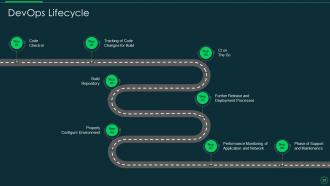
Slide 31: This slide showcases DevOps Lifecycle with related icons and text.
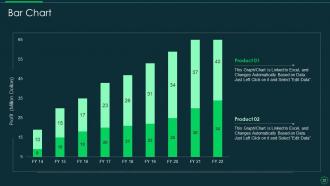
Slide 32: This slide presents Bar chart with two products comparison.
Slide 33: This is About Us slide to show company specifications etc.
Slide 34: This is an Idea Generation slide to state a new idea or highlight information, specifications etc.
Slide 35: This slide showcases Magnifying Glass to highlight information, specifications etc
Slide 36: This is a Timeline slide. Show data related to time intervals here.
Slide 37: This is a Thank You slide with address, contact numbers and email address.
Introducing devops tools for in time product release it powerpoint presentation slides with all 45 slides:
Use our Introducing DevOps Tools For In Time Product Release IT Powerpoint Presentation Slides to effectively help you save your valuable time. They are readymade to fit into any presentation structure.












FAQs for Introducing devops tools for in time product release it
DevOps tools are designed to support core principles including continuous integration, continuous delivery, automation, collaboration, monitoring, and infrastructure as code. These principles streamline development cycles by eliminating silos between teams, accelerating deployment processes, and enhancing system reliability, with many organizations finding that strategic tool implementation ultimately delivers faster time-to-market and improved operational efficiency.
CI/CD tools accelerate software delivery by automating code integration, testing, and deployment processes, eliminating manual bottlenecks and reducing human error. These platforms enable development teams to deploy updates multiple times daily rather than weekly or monthly, with many organizations finding that automated pipelines deliver faster time-to-market and enhanced competitive advantage.
Automation serves as the foundation of DevOps effectiveness by streamlining code integration, testing, deployment, and infrastructure management processes. Through automated pipelines, organizations eliminate manual bottlenecks, reduce human error, and accelerate delivery cycles, with many companies finding that automation ultimately delivers faster time-to-market and enhanced operational efficiency.
Monitoring tools enhance application performance and reliability by providing real-time visibility into system health, automatically detecting anomalies, and enabling proactive issue resolution before user impact occurs. These platforms streamline troubleshooting through centralized dashboards, predictive analytics, and automated alerting, with many organizations finding that comprehensive monitoring reduces downtime significantly while accelerating deployment cycles.
Best practices for integrating version control systems into DevOps workflows include implementing branching strategies like GitFlow, enforcing code reviews through pull requests, automating CI/CD triggers on commits, maintaining comprehensive commit messages, and establishing clear merge policies. These practices streamline development by enabling parallel work, reducing integration conflicts, and ensuring code quality, with many organizations finding that proper version control integration accelerates deployment cycles while maintaining stability.
Collaboration tools facilitate communication between development and operations teams by providing centralized platforms for real-time messaging, shared dashboards, and integrated project management workflows. Through platforms like Slack, Microsoft Teams, and Jira, teams streamline issue resolution, coordinate deployments, and maintain transparency across the entire software lifecycle, ultimately delivering faster releases and enhanced operational efficiency.
Popular container orchestration tools include Kubernetes, Docker Swarm, Apache Mesos, Amazon ECS, and OpenShift. These platforms streamline deployment automation, resource scaling, and service management across development environments, with many organizations finding that they significantly reduce operational overhead while enhancing application reliability and deployment speed.
Security tools integrate into DevOps pipelines through automated vulnerability scanning, code analysis, compliance checks, configuration management, and continuous monitoring at every development stage. These integrations enable organizations to identify threats early, automate security policies, and maintain compliance standards, while development teams deliver faster, more secure applications with reduced manual oversight, ultimately creating competitive advantage through both speed and security.
When selecting DevOps tools, consider project complexity, team size, existing infrastructure, budget constraints, scalability requirements, and integration capabilities with current systems. Organizations should evaluate tools based on deployment frequency needs, security requirements, and maintenance overhead, with many enterprises finding that strategic tool alignment with business objectives, rather than feature abundance, ultimately delivers better operational efficiency and faster time-to-market.
Cloud infrastructure management tools revolutionize DevOps practices by automating provisioning, enabling infrastructure as code, and facilitating seamless scaling across environments. These platforms streamline deployment pipelines, enhance collaboration between development and operations teams, and significantly reduce manual configuration errors, with many organizations finding that automated infrastructure management accelerates release cycles while improving system reliability and operational efficiency.
Configuration management tools are essential for ensuring consistent deployments, standardized configurations, automated provisioning, and reliable infrastructure across development, testing, and production environments. These tools streamline operations by eliminating configuration drift, reducing deployment errors, and accelerating release cycles, with many organizations finding that automated configuration management ultimately delivers faster time-to-market and enhanced operational efficiency.
Teams leverage testing tools to enhance quality assurance by implementing automated unit testing, integration testing, performance monitoring, code quality analysis, and continuous security scanning throughout the DevOps pipeline. These tools enable faster feedback loops, earlier defect detection, and consistent quality standards, with organizations like Netflix and Amazon finding that automated testing reduces deployment risks while accelerating release cycles.
Organizations should monitor AI-powered automation, GitOps adoption, platform engineering solutions, security-first DevOps integration, and cloud-native observability tools as key emerging trends. These advancements streamline deployment pipelines, enhance security protocols, and improve system reliability, with many enterprises finding that early adoption delivers significant competitive advantages through faster delivery cycles and reduced operational costs.
Analytics tools provide insights into the DevOps process through performance metrics, deployment frequency tracking, failure rate analysis, lead time measurement, and recovery time monitoring. These platforms enable organizations to identify bottlenecks, optimize resource allocation, and enhance collaboration between development and operations teams, with many enterprises finding that data-driven insights ultimately streamline workflows and accelerate delivery cycles.
DevOps tools facilitate compliance by automating audit trails, enforcing security policies, and maintaining consistent documentation throughout development lifecycles. Through automated testing, code scanning, and deployment controls, organizations streamline regulatory adherence while reducing manual oversight, with financial services and healthcare sectors finding that integrated compliance workflows significantly minimize risk exposure and accelerate certification processes.
-
Good research work and creative work done on every template.
-
Designs have enough space to add content.
-
Best way of representation of the topic.
-
Presentation Design is very nice, good work with the content as well.