


Introduction To Application Of Total Quality Management In Education




Try Before you Buy Download Free Sample Product
 Impress Your
 Audience
 100%
100% Editable
 Save Hours
 of Time


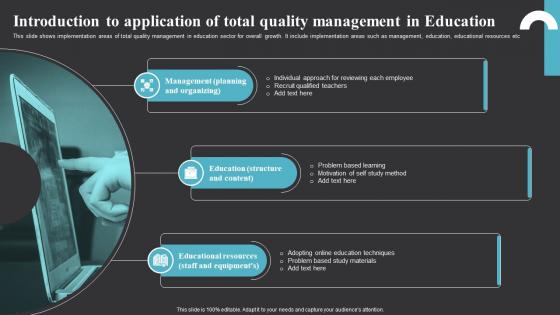
This slide shows implementation areas of total quality management in education sector for overall growth. It include implementation areas such as management, education, educational resources etc
People who downloaded this PowerPoint presentation also viewed the following :
Introduction To Application Of Total Quality Management In Education with all 6 slides:
Use our Introduction To Application Of Total Quality Management In Education to effectively help you save your valuable time. They are readymade to fit into any presentation structure.






FAQs for Introduction To Application Of Total Quality
Key principles of Total Quality Management in educational institutions include continuous improvement, student-focused outcomes, faculty and staff empowerment, data-driven decision making, and systematic process enhancement. These principles streamline academic operations by fostering collaborative learning environments, enhancing curriculum delivery, and improving administrative efficiency, with many universities and schools finding that strategic TQM implementation ultimately delivers better student experiences and institutional performance.
TQM improves student satisfaction and learning outcomes by streamlining curriculum delivery, enhancing faculty-student interactions, and implementing continuous feedback mechanisms that identify learning gaps early. Through systematic quality processes, educational institutions deliver more personalized instruction, faster response to student needs, and consistently improved academic services, with many universities finding that structured quality management ultimately increases retention rates and graduate employment success.
Staff training and development serve as foundational pillars for TQM implementation in educational institutions, encompassing continuous improvement methodologies, quality assessment techniques, student-centered approaches, and collaborative problem-solving skills. These comprehensive programs enable educators and administrators to streamline academic processes, enhance student learning outcomes, and deliver superior educational experiences, with many schools finding that well-trained staff ultimately drive sustainable quality improvements and institutional excellence.
Educational leaders can foster continuous improvement by implementing systematic feedback mechanisms, establishing cross-functional improvement teams, promoting data-driven decision making, and creating transparent communication channels throughout their institutions. Through regular stakeholder engagement and performance monitoring, schools and universities streamline operations, enhance student outcomes, and build collaborative environments, with many educational institutions finding that this strategic approach ultimately delivers improved learning experiences and operational excellence.
Key metrics for measuring TQM success in schools include student achievement scores, graduation rates, teacher retention, parent satisfaction surveys, and operational efficiency indicators like reduced administrative processing times. These measurements enable educational institutions to track improvements in academic outcomes, staff engagement, and resource utilization, while many schools finding that regular assessment of these metrics ultimately delivers enhanced learning environments and stronger competitive positioning within their districts.
Stakeholder feedback drives TQM processes by identifying improvement areas, validating curriculum effectiveness, and ensuring educational services meet diverse needs through systematic data collection and analysis. Schools leverage student satisfaction surveys, parent engagement metrics, and educator performance insights to refine teaching methods, enhance resource allocation, and streamline administrative processes, ultimately delivering improved learning outcomes and institutional excellence.
Technology supports TQM practices in education through learning management systems, data analytics platforms, automated assessment tools, digital feedback systems, and performance tracking software. These technologies streamline quality monitoring by enabling real-time student progress analysis, standardizing curriculum delivery, and facilitating continuous improvement processes, with many educational institutions finding that integrated digital solutions ultimately enhance learning outcomes while reducing administrative overhead.
TQM addresses educational disparities by standardizing quality processes, implementing data-driven resource allocation, and establishing consistent performance metrics across all demographic groups. Through systematic monitoring and continuous improvement cycles, schools can identify achievement gaps early, redistribute resources strategically, and ensure equitable learning outcomes, with many districts finding that standardized quality frameworks significantly reduce performance variations between different student populations.
Schools face challenges including resistance to cultural change, limited financial resources, inadequate staff training, difficulty measuring educational outcomes, and integrating TQM with existing bureaucratic structures. While these obstacles require careful navigation, many educational institutions find that strategic implementation through phased approaches, stakeholder engagement, and continuous professional development ultimately delivers improved student outcomes, enhanced operational efficiency, and stronger competitive positioning in an increasingly performance-driven educational landscape.
Collaborative decision-making enhances TQM implementation by incorporating diverse perspectives from faculty, administrators, students, and staff, ensuring comprehensive quality standards that address all stakeholder needs. This inclusive approach streamlines consensus-building, accelerates policy implementation, and fosters shared accountability, with many educational institutions finding that collaborative frameworks ultimately deliver improved student outcomes and operational efficiency.
TQM revolutionizes curriculum development by emphasizing continuous improvement, stakeholder feedback integration, and outcome-based design aligned with industry standards and student needs. Educational institutions implementing TQM approaches create more responsive curricula through systematic data collection, regular assessment cycles, and collaborative design processes, ultimately delivering enhanced learning experiences and better graduate preparedness for competitive job markets.
TQM principles effectively enhance online education through continuous improvement of digital platforms, standardized content delivery, student feedback integration, and data-driven performance monitoring. Educational institutions leverage these approaches by streamlining virtual classroom experiences, automating assessment processes, and personalizing learning pathways, with many universities finding that systematic quality management significantly improves student engagement and completion rates.
Accreditation and compliance serve as external validation mechanisms that drive systematic quality improvements, establish measurable standards, and ensure educational institutions meet rigorous academic and operational benchmarks. These frameworks enable schools and universities to streamline their TQM processes through continuous assessment, stakeholder feedback integration, and standardized quality metrics, ultimately delivering enhanced educational outcomes and competitive positioning in an increasingly accountability-focused landscape.
Successful TQM implementations include Arizona State University's student retention programs, Singapore's education system standardization, Toyota's partnership with universities for lean processes, and Malcolm Baldrige Award-winning schools like Pearl River School District. These institutions enhanced graduation rates, streamlined administrative processes, and improved student satisfaction through continuous improvement methodologies, ultimately delivering measurable academic outcomes and operational efficiency.
TQM enhances resource management in education by streamlining budget allocation, optimizing facility utilization, and reducing administrative redundancies through systematic process analysis. Educational institutions implementing TQM principles find improved coordination between departments, better tracking of material resources, and more efficient staff deployment, ultimately delivering cost savings while maintaining high-quality educational outcomes and operational efficiency.
-
Thanks to SlideTeam, we have an ideal template to present all the info we need to cover. Their slides give our numbers and projections a more clear and enchanting look.
-
The PPT layout is great and it has an effective design that helps in presenting corporate presentations. It's easy to edit and the stunning visuals make it an absolute steal!