

Introduction to digital marketing ppt examples





Try Before you Buy Download Free Sample Product
 Impress Your
 Audience
 100%
100% Editable
 Save Hours
 of Time


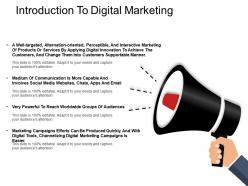
The introduction to digital marketing PPT example is an illustration with the use of large size blowhorn graphic which is a metaphor to the core function or goal of digital marketing. Digital marketing speaks aloud the needed market information so that it is heard in every corner, and blowhorn technically performs exactly the same function. Because of its illustration, the blowhorn PowerPoint graphic can be used to decipher on topics other than digital marketing. Therefore, this blowhorn PowerPoint infographic is an ideal marketing and advertising tool to convey an open message to people. The blowhorn PPT model is also commonly used for the speaking trumpet to amplify a person’s voice. Therefore, this blowhorn trumpet PPT presentation template is helpful for demonstrating the announcements of any type. The given PPT visual demonstrates the idea that when operations are producing effective outcomes, they make a loud sound. This bullhorn PowerPoint diagram is an effective communication management presentation basis too. This blowhorn template can be used as a tool to display a variety of situations where loudly delivering a message is required. Increase the flow of ideas with our Introduction To Digital Marketing Ppt Examples. Bring about a greater influx.
People who downloaded this PowerPoint presentation also viewed the following :
Introduction to digital marketing ppt examples with all 5 slides:
Build up the adrenaline with our Introduction To Digital Marketing Ppt Examples. Inject the desire for immediate action.



FAQs for Introduction to digital
Key components of an effective digital marketing strategy include content marketing, search engine optimization, social media engagement, email campaigns, and data analytics. These approaches work together by building brand awareness, driving targeted traffic, and nurturing customer relationships, with many organizations finding that integrated strategies deliver higher conversion rates and stronger competitive positioning.
Businesses can leverage social media platforms for brand awareness through consistent content creation, targeted advertising campaigns, influencer partnerships, community engagement, and strategic hashtag usage. These approaches enable organizations to reach broader audiences, build authentic customer relationships, and showcase brand personality, with many companies finding that regular social media presence significantly enhances visibility and customer loyalty.
SEO optimizes websites for search engines through keyword research, content optimization, technical improvements, and link building to increase visibility in search results. These strategies enhance website rankings, attract qualified visitors, and reduce marketing costs, with many businesses finding that strong SEO delivers sustained traffic growth and competitive advantage.
Email marketing nurtures customer relationships by delivering personalized content, targeted offers, and timely communications based on customer behavior and preferences. Through automated drip campaigns and segmented messaging, businesses across retail, healthcare, and financial services enhance customer engagement, increase repeat purchases, and build long-term loyalty, ultimately driving higher lifetime value.
Influencer marketing benefits for small businesses include increased brand awareness, targeted audience reach, cost-effective advertising, authentic customer engagement, and enhanced credibility through trusted recommendations. Through strategic partnerships with micro-influencers, small retailers, local restaurants, and service providers can access niche markets, generate higher engagement rates than traditional advertising, and build lasting customer relationships, ultimately delivering measurable ROI.
Different digital marketing channels complement each other by creating integrated touchpoints that reinforce messaging, broaden reach, and optimize conversion paths across customer journeys. Social media drives awareness while email nurtures leads, search engines capture intent while content builds authority, and retargeting closes gaps between channels, ultimately delivering cohesive brand experiences and maximizing ROI.
Key digital marketing metrics include conversion rates, cost per acquisition, return on ad spend, click-through rates, and customer lifetime value. Through analytics platforms, businesses track engagement across social media, email open rates, and website traffic patterns, with many organizations finding that combining multiple metrics delivers comprehensive campaign insights and enables strategic budget optimization for competitive advantage.
User-generated content enhances brand presence by building authentic social proof, increasing engagement rates, expanding organic reach, and reducing content creation costs. Through customer reviews, social media posts, and testimonials, brands like Nike and Starbucks amplify their messaging while fostering community trust, ultimately delivering higher conversion rates and stronger customer loyalty.
Key 2023 digital marketing trends include AI-powered personalization, voice search optimization, interactive content formats, privacy-focused marketing strategies, and omnichannel customer experiences. These approaches enhance engagement by delivering targeted messaging, streamlining customer journeys, and building trust through transparent data practices, with many organizations finding that strategic integration ultimately delivers higher conversion rates and competitive advantage.
Data analytics enhances marketing efforts by identifying customer behavior patterns, optimizing campaign performance, personalizing content delivery, and measuring ROI across channels. Through predictive modeling and real-time insights, businesses streamline targeting strategies, reduce acquisition costs, and deliver more relevant customer experiences, with many organizations finding significantly improved conversion rates and marketing efficiency.
**INPUT**: What are the ethical considerations in digital advertising? **OUTPUT**: Ethical considerations in digital advertising include data privacy protection, transparent targeting practices, honest content representation, consumer consent management, and vulnerable population safeguards. These principles streamline trust-building by ensuring regulatory compliance, enhancing brand reputation, and delivering sustainable customer relationships, with many organizations finding that ethical approaches ultimately provide competitive advantage in increasingly privacy-conscious markets.
Businesses can optimize their websites for mobile users by implementing responsive design, accelerating page load speeds, simplifying navigation menus, optimizing touch-friendly buttons, and ensuring readable font sizes. These enhancements streamline user experiences by reducing bounce rates, improving search rankings, and increasing conversion rates, with many e-commerce and service companies finding that mobile optimization delivers significantly higher customer engagement and revenue growth.
Newsletters significantly enhance customer engagement and retention by delivering personalized content, maintaining regular touchpoints, building brand loyalty, and driving repeat purchases. Through strategic email campaigns, businesses across retail, hospitality, and financial services see improved customer lifetime value, reduced churn rates, and stronger relationships, with many organizations finding that consistent newsletter communication increases retention by 25-30%.
Companies can effectively use video content through product demonstrations, customer testimonials, behind-the-scenes content, educational tutorials, and social media stories. These approaches enhance brand engagement by building trust, simplifying complex concepts, and creating emotional connections, with many organizations finding that video marketing delivers higher conversion rates, improved customer retention, and significantly greater reach across digital platforms.
Best practices for compelling paid ad campaigns include precise audience targeting, A/B testing creative variations, optimizing landing page alignment, utilizing compelling headlines with clear value propositions, and implementing strategic bidding approaches. These methods enhance campaign performance by maximizing click-through rates, improving conversion metrics, and reducing cost-per-acquisition, with many businesses finding that strategic creative testing and audience segmentation ultimately delivers significantly higher ROI.
-
Appreciate the research and its presentable format.
-
Topic best represented with attractive design.