


Introduction To Digital Twin Technology Digital Twin Technology IT




Try Before you Buy Download Free Sample Product
 Impress Your
 Audience
 100%
100% Editable
 Save Hours
 of Time


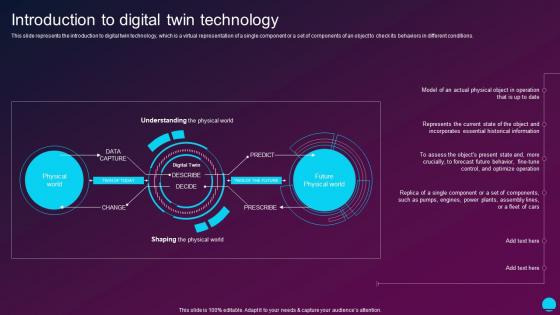
This slide represents the introduction to digital twin technology, which is a virtual representation of a single component or a set of components of an object to check its behaviors in different conditions.
People who downloaded this PowerPoint presentation also viewed the following :
Introduction To Digital Twin Technology Digital Twin Technology IT with all 6 slides:
Use our Introduction To Digital Twin Technology Digital Twin Technology IT to effectively help you save your valuable time. They are readymade to fit into any presentation structure.





FAQs for Introduction To Digital Twin Technology Digital
Manufacturing and aerospace are crushing it right now. Companies track their production lines and catch equipment failures before they happen. Boeing and Airbus build virtual planes to test stuff without the risk - pretty smart honestly. Healthcare's doing virtual organs for surgery prep, though that's still figuring itself out. Cities use them for traffic and energy management too. Oh, and if you're thinking about trying this? Look at whatever breaks down and costs you the most money. That's where you'll see the biggest payoff. Start there and you won't go wrong.
So basically, digital twins give you real-time monitoring of your equipment plus you can run these "what if" scenarios. Pretty neat actually. AI models analyze all that continuous data and catch patterns we'd totally miss - way better than just waiting for stuff to break or doing maintenance on some random schedule. Honestly, the surprise breakdowns are the absolute worst. You can actually predict failures before they happen and schedule repairs right when needed. Cuts downtime and saves money on maintenance costs. I'd start with your most critical equipment first - build twins for those and see how it goes.
So digital twins are basically live copies of your physical stuff - factories, equipment, whatever. The cool part? You can run "what if" tests without breaking anything real. Like, what happens if we ramp up production by 30%? Hook up some IoT sensors and boom, you've got real-time data feeding your model. I swear the predictions are scary accurate sometimes. You can catch equipment failures before they happen, test dangerous changes safely, and just optimize everything. Honestly, pick your biggest headache process first - that's where you'll see the most impact right away.
Honestly, data integration is going to be your biggest headache - trying to get IoT sensors, old legacy systems, and random databases to actually communicate is brutal. Plus you'll need people who get both the technical side and your actual operations, which is harder to find than you'd think. The upfront costs are pretty intense too. Oh, and don't even get me started on how much good infrastructure runs these days. My take? Pick one small thing to digitize first instead of going all-in. You'll figure out what works without burning through your budget or losing your mind in the process.
Think of digital twins as your IoT data's smart sidekick. All those sensors you've got - temperature, pressure, whatever - they're constantly feeding info into this virtual copy of your system. The twin crunches all that data and spots patterns you'd never catch. Pretty cool how it can actually predict when stuff's about to break, then automatically fix things before you even know there's a problem. It's basically like having a crystal ball that never takes a coffee break. I'd start by checking what sensors you already have running. You're probably sitting on tons of unused data that could be way more valuable than you think.
Okay so AI is what makes your digital twin actually smart instead of just a fancy 3D model. It crunches all that sensor data coming in and uses machine learning to predict stuff - like when your equipment's about to crap out or how to boost performance. The cool part? It keeps learning from both your real asset and the simulation, tweaking settings and running scenarios you wouldn't think of. Your twin gets more accurate over time and starts suggesting real improvements. Oh, and focus on your most data-heavy processes first - that's where you'll see the biggest wins.
Yeah totally! Digital twins let you test different production scenarios without wasting actual materials - honestly it's pretty brilliant. Map out your most energy-heavy processes first, that's where the money is. They catch equipment issues before stuff breaks down (saves you from those nightmare emergency repairs), and you get live data on your environmental footprint. Real companies are cutting energy use by 20-30% from this. The whole thing basically simulates your production line so you can optimize without the trial-and-error mess. Worth starting small though - pick one process and see how it goes.
So digital twins are basically a live virtual copy of whatever you're building that updates in real-time as the actual product changes. Pretty cool stuff, honestly. You can predict when things'll break, test design tweaks before manufacturing, and see how people actually use your product (not how you think they will). The amount of data you get is insane - everything from factory hiccups to customer behavior patterns. Best part? You're making decisions off real info instead of educated guesses. Just make sure you start collecting that data early in design phase or you'll be playing catch-up later.
Honestly, the scariest part is that hackers could mess with your actual equipment through the digital twin - since it syncs in real-time with physical stuff. Data breaches are obviously a big concern too. Plus you've got tons of data moving between systems, which creates way too many attack points. I'd start by figuring out what data your twin actually needs (probably less than you think) and lock that down first. End-to-end encryption is non-negotiable. Also set up proper access controls and segment your networks. It's wild how connected everything is these days.
So digital twins let your whole team work on the same virtual model in real-time, which is pretty cool. Everyone sees updates instantly from actual sensor data, plus you can run simulations together and catch problems early. Way better than passing files back and forth honestly. The annotation feature is clutch – you can mark up the model directly instead of drowning in feedback emails. Think of it like everyone's looking at the same prototype, but it's all digital and updates automatically. I'd start with whatever project needs the most collaboration right now.
Look, your digital twin is basically useless if you're feeding it crap data. Garbage in, garbage out - always been true. Bad sensor readings or old info will have your twin making predictions that could seriously mess things up. It's like using a broken GPS and ending up in the middle of nowhere, you know? Quality sensors are worth the money upfront. You'll also want to check your data regularly and make sure those pipelines stay clean. Trust me, fixing data problems later is way more painful than getting it right from the start.
Honestly, focus on the hard numbers first - downtime reduction, maintenance savings, fewer defects. That stuff's easy to track and sells itself. Time-to-market improvements too. The soft benefits like better decisions are actually huge but way harder to prove with dollars (annoying but true). My advice? Pick a pilot project where you can clearly measure before/after - somewhere high-impact. Set your baselines upfront, then check progress every quarter. Those concrete wins make it so much easier to get buy-in for rolling it out everywhere else. Trust me on this one.
Honestly, AI-powered predictive analytics is where you'll see the biggest payoff. Edge computing is making digital twins way more responsive too - game changer for real-time decisions. The metaverse stuff actually isn't total BS when it comes to twins. Those 3D visualizations are getting practical for training teams and collaboration. Sustainability modeling is blowing up, especially if you're dealing with environmental regs. My advice? Don't go crazy trying to digitize everything at once - that's how projects die. Pick one solid use case and nail it first. Way less headache that way.
So basically you build a virtual copy of your whole supply chain and run "what if" tests without breaking anything real. Like what happens when your main supplier crashes or ports get backed up - you know, all those disasters that make us panic at 2am. The system pulls live data from sensors and logistics feeds, so bottlenecks show up before they actually hit you. Pretty neat, right? Routes get optimized, inventory adjusts automatically, and it'll even flag when equipment's about to fail. I'd start with just one piece of your chain first though.
GE's got the best example - they digital twinned their jet engines and caught failures before they actually happened, saving crazy money on maintenance. Rolls-Royce pulled off something similar with aircraft engines. Singapore went nuts and made a digital twin of their whole city for traffic optimization, which honestly sounds like something out of a sci-fi movie. Tesla's doing it for manufacturing too. My advice? Pick one specific thing to focus on first instead of trying to twin your entire operation. You'll get better results that way and won't overwhelm yourself with data you can't actually use yet.
-
“There is so much choice. At first, it seems like there isn't but you have to just keep looking, there are endless amounts to explore.”
-
Easy to edit slides with easy to understand instructions.