

Investment Advice Proposal Powerpoint Presentation Slides





Try Before you Buy Download Free Sample Product
 Impress Your
 Audience
 100%
100% Editable
 Save Hours
 of Time


Investment advisors provide the best financial services to their clients that help them in improving their economic performance. An organization needs to take care of their financial stability and functions. To deal with all the monetary projections, financial advisors are needed. Investment advice is the solution provided by the advisor to their clients to manage their financial goals and aspects. The readymade proposals are made so that the client can choose the best investment advisor for their company. Win the deal with your clients by using our content ready Investment Advice Proposal PowerPoint Presentation Slides. With the aid of this eye-catching financial advice proposal PPT layout, you can provide a variety of wealth services to your potential clients. Use our visually-attractive wealth advisory proposal presentation template, you can describe how you will plan the financial strategies that assist in achieving the objectives of your clients. You can outline the services you provide like strategic investment advice, realistic budget plan, and creative. The investment advice proposal PowerPoint theme provides you plenty of space where you can tweak your content as per your requirements. Employ this professionally designed wealth advisory proposal PPT slide to give a brief overview of your company to your clients that build their confidence even more. Take advantage of our outwardly engaging financial advice proposal PowerPoint theme and explain how your highly-professional advisors can fulfill the requirements given by your clients. You can also talk about your investment strategies like moderate growth strategy, growth strategy, and aggressive growth strategy. Create a financial portfolio and summarize your upcoming goals and targets. You can also portray the holdings summary of an investment portfolio, shares, price per share, market value, and the overall percentage of allocation. Monitor the investment securities of your clients by downloading our ready-to-use investment ppt templates.
People who downloaded this PowerPoint presentation also viewed the following :
Content of this Powerpoint Presentation
Slide 1: This slide introduces Investment Advice Proposal. State your Company name and begin.
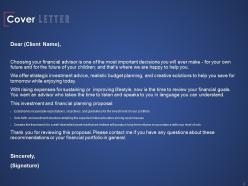
Slide 2: This slide displays Cover Letter.
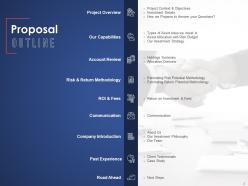
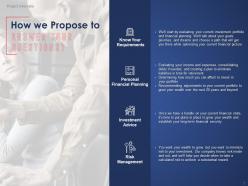
Slide 3: This slide shows Proposal Outline.
Slide 4: This slide showcases Project Overview.
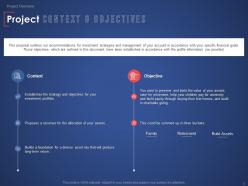
Slide 5: This slide represents Project Context & Objectives.
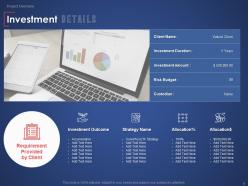
Slide 6: This slide showcases Investment Details.
Slide 7: This slide depicts Project Overview.
Slide 8: This slide shows Our Capabilities.
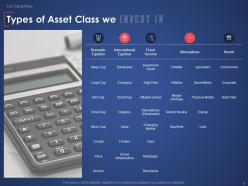
Slide 9: This slide showcases Types of Asset Class we Invest In.
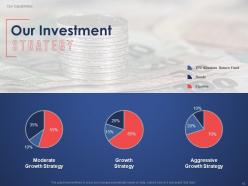
Slide 10: This slide depicts Our Investment Strategy.
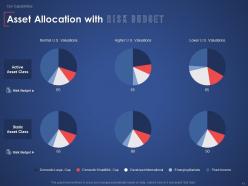
Slide 11: This slide represents Asset Allocation with Risk Budget.
Slide 12: This slide showcases Account Review.
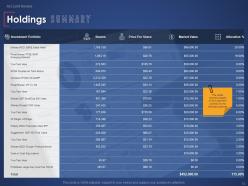
Slide 13: This slide showcases Holdings Summary. This slides mentions details of all investment portfolio for the existing customer
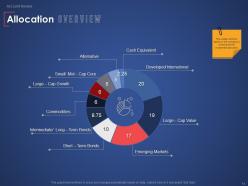
Slide 14: This slide describes Allocation Overview. This slides mentions details of the company’s overall portfolio investment allocation
Slide 15: This slide shows Risk & Return Methodology.
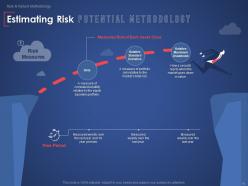
Slide 16: This slide showcases Estimating Risk Potential Methodology.
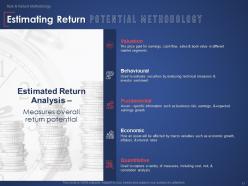
Slide 17: This slide represents Estimating Return Potential Methodology.
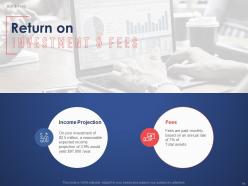
Slide 18: This slide shows Return on investment & fees.
Slide 19: This slide showcases Return on Investment & Fees.
Slide 20: This slide showcases Communication
Slide 21: This slide depicts Communication.
Slide 22: This slide displays Company Introduction displaying- About us, Our investment philosophy, Our team.
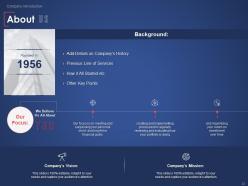
Slide 23: This is About Us slide to showcase Company specifications.
Slide 24: This slide depicts Our Investment Philosophy.
Slide 25: This is Our Team slide with Names and Designations.
Slide 26: This is Our Team slide with Names and Designation.
Slide 27: This slide shows Past Experience with- Client testimonials, Case study.
Slide 28: This slide displays Client Testimonials.
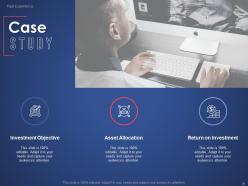
Slide 29: This slide depicts Past Experience with- Case Study, Return on Investment.
Slide 30: This slide shows Next steps.
Slide 31: This slide depicts Next Steps.
Slide 32: This is Contact Us slide with Address, Email address and Contact number.
Slide 33: This slide is titled as Additional Slides for moving forward.
Slide 34: This is About Us slide to showcase Company specifications.
Slide 35: This is Our Mission slide with Mission, Our Target, Vision.
Slide 36: This slide shows Roadmap process.
Slide 37: This slide depicts Roadmap process.
Slide 38: This slide also shows Roadmap process.
Slide 39: This slide shows Roadmap process.
Slide 40: This slide shows Roadmap process.
Slide 41: This is 30 60 90 Day Plan slide.
Investment Advice Proposal Powerpoint Presentation Slides with all 41 slides:
Use our Investment Advice Proposal Powerpoint Presentation Slides to effectively help you save your valuable time. They are readymade to fit into any presentation structure.















FAQs for Investment Advice Proposal
Okay so you'll definitely need an executive summary - that's what they read first so make it good. Then hit them with market analysis, financial projections, and how much funding you actually need. Business model and competitive stuff too, obviously. Management team bios are huge - investors bet on people more than ideas honestly. Risk assessment is clutch because it shows you're not totally naive about what could tank this thing. Oh and break down exactly where the money's going, plus your exit strategy and ROI timeline. Pro tip: make a solid template then tweak it for each pitch instead of reinventing the wheel every time.
Dude, good design makes investors take you way more seriously. They figure if you can't put together clean slides, how are you gonna handle their cash? I've literally watched solid ideas tank because the presentation looked like garbage. Keep your fonts consistent, make charts that don't hurt people's eyes, and for the love of god don't use comic sans (kidding but you get it). Complex financial stuff becomes way easier to follow when it's presented right. Trust me - either learn some basic design skills or pay someone who knows what they're doing. It's honestly one of the best investments you'll make.
Honestly, focus on three things that actually matter to investors: revenue growth, customer acquisition cost vs lifetime value, and your margins. Show consistent month-over-month growth - doesn't have to be crazy hockey stick stuff yet. Prove you can get customers without burning through cash. Market size is whatever, investors can smell BS TAM numbers from a mile away anyway. Your retention rates and traction metrics? That's where the real story is. Those numbers show you've got something people actually want. Just make sure you're not padding with vanity metrics that look pretty but don't mean anything for your business.
Honestly, visual stuff works way better than walls of text for risk sections. Nobody's reading through dense paragraphs about what might go wrong. Charts or those simple red/yellow/green indicators catch people's attention fast. Break it down into clean categories: what's the risk, how likely is it, what's the damage, and how you'll handle it. Tables or bullet points beat paragraphs every time. Mix hard numbers with your gut feelings on the softer risks - both matter. The whole point is helping stakeholders scan quickly without drowning in corporate speak. Oh, and always show your action plan right next to each big risk.
Dude, storytelling is everything in investor pitches. Makes your data stick instead of just throwing numbers at them. I've watched pitches with great financials completely bomb because there was zero story. Boring as hell. You want them picturing your customers' actual problems and how you fix it. Structure it like any good story - problem, solution, opportunity. Don't just rattle off market size projections. Paint the whole picture so they remember you weeks later and feel invested in your journey. Trust me, the narrative is what separates memorable pitches from forgettable ones.
Don't be vague with your numbers - investors hate that. Your financials need to actually make sense, and honestly, don't overpromise returns you can't back up. These people have seen every pitch imaginable. Keep it short too; nobody's reading a 40-page novel about your startup. Be upfront about what could go wrong (there's always something). Include clear exit strategies. Oh, and get someone to look it over first - you'd be surprised what obvious stuff you miss when you've been staring at it forever. Crisp executive summary is key.
Don't just throw all your market research into one boring section - sprinkle it throughout the whole thing. Open with market size stuff to grab attention, then back up your business model with real customer data. Competitive analysis shows you actually know what you're doing. Here's the thing though: random stats make you look like a rookie. Every number needs to directly support why they should invest and what returns they'll see. Oh, and make sure your sources aren't sketchy or from like 2019. Use research to prove every big claim, especially around revenue.
Look, you basically need three things: revenue projections, cash flow statements, and break-even analysis. Start with your revenue forecasts - but please, base them on actual market data and your pipeline, not some fantasy numbers. Cash flow is honestly the most important because it shows when you'll need money and when you can finally breathe. Break-even tells investors when they'll see profits. Oh, and do yourself a favor - create best case, worst case, and realistic scenarios for everything. I'd go conservative with your assumptions first, then work up from there. Trust me on this one.
Dude, the executive summary is EVERYTHING. Investors get slammed with hundreds of these things, so they're literally skimming for like 30 seconds max before deciding if you're worth their time. Boring summary = straight to the trash (I've watched this happen to decent companies, honestly heartbreaking). You need to grab them immediately with your value prop and what makes you different from everyone else. It's basically your elevator pitch but on paper. Those first few paragraphs better be fire because if you don't hook them there, you're done.
Do your research first - figure out what these investors actually care about. Tech VCs? Talk disruption and scale. Conservative funds? Focus on steady returns and how you're managing risk. Honestly, showing you understand their headaches is huge. I've seen people blow meetings because they gave the same generic pitch to everyone. Match your numbers to what they typically invest - don't ask a $50K angel for $5M, you know? Use examples they'll actually get, and structure everything around their main concerns instead of your usual deck. Oh, and ditch the standard format if it doesn't fit. Make it about fixing their problems, not just promoting your thing.
Dude, visuals are a game-changer for financial stuff. Your brain just gets pictures way faster than scanning through endless spreadsheet rows. Bar charts work great for comparisons, line graphs show trends over time, and pie charts break down portfolios nicely. When you're pitching investments, people can instantly see what's going on with performance and risk - nobody has patience for deciphering raw numbers for 20 minutes. Honestly, I've seen presentations tank just because everything was text and tables. You'll get way better engagement and quicker decisions with good charts.
Start with the basics - ROI, NPV, IRR, payback period. Don't assume people know this stuff. Same goes for market terms like TAM, SAM, customer acquisition cost. I've watched too many solid proposals crash because of unexplained jargon (honestly, it's painful to see). Technical concepts specific to your industry? Define those too. Toss a mini-glossary in your executive summary or use footnotes. Short version: if there's even a slim chance someone won't get it, spell it out right away. Better to over-explain than lose them completely.
Dude, stop being vague with your ask. Instead of "let's discuss next steps," be direct: "I need your $2M commitment by Friday to close this round." Most founders are way too soft here, honestly. Create some urgency - what happens if they wait? Limited spots in the round? Competition heating up? Then give them one super clear action: "Sign this term sheet today, legal docs ready Monday." I see this mistake constantly. You've got to make it dead simple for them to say yes right now.
Honestly, I'd hit up the big consulting firms first - McKinsey, Deloitte, PwC all put out solid industry reports. Bloomberg and Reuters are your best bet for financial stuff and competitor data. SEC filings are boring but investors eat that credible government data up. Trade associations have some surprisingly good niche info you won't find anywhere else. Oh, and if there's a university nearby, their academic databases can fill in random gaps. I learned that one the hard way lol. Start with maybe 2-3 sources though - otherwise you'll just get overwhelmed trying to sort through everything.
Figure out what problem you solve that literally no one else can touch. Then beat that drum hard with real proof. Check out your competition and spot the holes - faster delivery? Better price? Serving some weird niche they totally miss? Honestly, most pitches I see try being everything to everyone and just end up being... nothing memorable. Pick your one badass advantage instead. Back it with actual data, customer stories, or a demo that shows results. Oh, and don't just mention it once - make it the backbone of your whole deck. Write down why someone would pick you over those other five companies they're considering.
-
Innovative and Colorful designs.
-
Great quality product.
-
Understandable and informative presentation.