


Iot Enabled Fleet Management System Architecture Asset Tracking And Management IoT SS




Try Before you Buy Download Free Sample Product
 Impress Your
 Audience
 100%
100% Editable
 Save Hours
 of Time


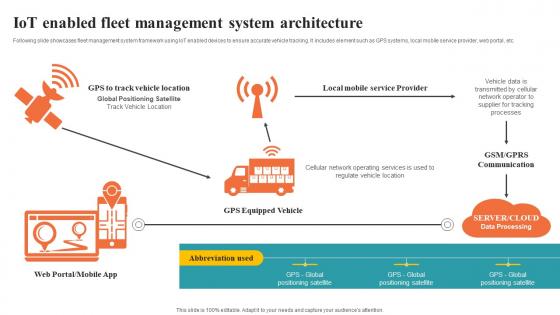
Following slide showcases fleet management system framework using IoT enabled devices to ensure accurate vehicle tracking. It includes element such as GPS systems, local mobile service provider, web portal, etc.
People who downloaded this PowerPoint presentation also viewed the following :
Iot Enabled Fleet Management System Architecture Asset Tracking And Management IoT SS with all 9 slides:
Use our Iot Enabled Fleet Management System Architecture Asset Tracking And Management IoT SS to effectively help you save your valuable time. They are readymade to fit into any presentation structure.








FAQs for Iot Enabled Fleet Management System Architecture Asset Tracking And
IoT integration in fleet management delivers real-time vehicle tracking, predictive maintenance alerts, fuel consumption optimization, driver behavior monitoring, and automated compliance reporting. These technologies streamline operations by reducing maintenance costs, improving route efficiency, and enhancing safety protocols, with many logistics companies finding that IoT-enabled fleets achieve 15-25% operational cost reductions while delivering superior customer service.
Real-time IoT vehicle tracking enhances operational efficiency by optimizing routes, reducing fuel consumption, and enabling predictive maintenance scheduling. Through connected sensors and GPS technology, logistics companies monitor driver behavior, minimize vehicle downtime, and streamline dispatch operations, with many transportation firms finding that these systems deliver faster deliveries and significantly lower operational costs.
Data analytics transforms raw IoT fleet data into actionable insights by identifying patterns in vehicle performance, driver behavior, fuel consumption, and maintenance needs. Through predictive analytics and machine learning algorithms, fleet managers can optimize route planning, reduce operational costs, prevent breakdowns before they occur, and enhance driver safety, ultimately delivering improved efficiency and competitive advantage in logistics operations.
IoT devices enable predictive maintenance by continuously monitoring engine performance, tire pressure, brake conditions, and transmission health through real-time sensors and data analytics. These systems identify potential failures before they occur, allowing fleet operators in logistics, delivery services, and transportation companies to schedule proactive repairs, ultimately reducing unexpected breakdowns and minimizing costly operational downtime.
IoT fleet management faces security challenges including device vulnerabilities, data transmission risks, unauthorized access, inadequate authentication protocols, and cyber attack threats targeting connected vehicles. These risks can be mitigated through end-to-end encryption, regular firmware updates, and multi-factor authentication, with many fleet operators finding that comprehensive security frameworks ultimately deliver enhanced operational protection and competitive advantage.
IoT-enabled sensors enhance driver safety and regulatory compliance by monitoring driver behavior, vehicle conditions, fatigue levels, speed violations, and hours-of-service requirements in real-time. Through continuous data collection and automated alerts, fleet operators can prevent accidents, ensure DOT compliance, and reduce liability risks, while drivers receive immediate feedback that promotes safer driving habits and regulatory adherence.
Essential IoT devices for fleet management include GPS trackers, telematics units, dash cameras, tire pressure monitoring systems, and fuel sensors. These technologies streamline operations by enabling real-time vehicle tracking, driver behavior analysis, and predictive maintenance scheduling, with many logistics companies finding that this strategic combination ultimately delivers reduced operational costs and enhanced customer service efficiency.
IoT integration enhances inventory management by providing real-time tracking, automated stock monitoring, predictive analytics, and seamless data synchronization across supply chain networks. Through connected sensors and smart devices, organizations streamline warehouse operations, reduce stockouts, and optimize resource allocation, with many retail and manufacturing companies finding that automated inventory systems deliver significantly faster order fulfillment and lower operational costs.
Yes, IoT technology significantly reduces fuel consumption through real-time vehicle monitoring, route optimization algorithms, driver behavior analytics, and predictive maintenance systems. Through connected sensors and telematics platforms, fleet operators can minimize idle time, optimize delivery routes, and identify fuel-wasting behaviors, with many transportation companies achieving 10-15% fuel savings while enhancing operational efficiency.
IoT fleet management adoption involves upfront costs for sensors, connectivity, and software platforms, typically offset by significant operational savings within 12-18 months. These systems reduce fuel consumption through route optimization, minimize maintenance costs via predictive analytics, and lower insurance premiums through improved safety monitoring, with many transportation companies finding that comprehensive IoT implementations deliver 15-25% cost reductions annually.
IoT data enables fleets to optimize route planning through real-time traffic analysis, weather monitoring, fuel consumption tracking, and vehicle performance metrics. By analyzing this comprehensive data, transportation companies can reduce fuel costs by 15-20%, minimize delivery times, and enhance operational efficiency, while predictive maintenance insights help prevent costly breakdowns and extend vehicle lifecycles.
IoT significantly enhances sustainability initiatives in fleet operations by enabling real-time emissions monitoring, optimizing fuel consumption through route planning, and facilitating predictive maintenance that extends vehicle lifecycles. Through connected sensors and analytics, companies reduce carbon footprints by 15-25%, while many transportation and logistics firms find that IoT-driven efficiency improvements ultimately deliver both environmental benefits and substantial cost savings.
IoT enables fleet managers to monitor driver behavior through telematics devices, dashcams, accelerometers, and GPS tracking systems that capture real-time data on speeding, harsh braking, acceleration patterns, and route adherence. This comprehensive data streamlines training programs by identifying specific improvement areas, creating personalized coaching modules, and delivering measurable safety improvements, ultimately reducing accidents and operational costs.
Future trends in IoT fleet management include autonomous vehicle integration, predictive maintenance through machine learning, real-time cargo monitoring, advanced telematics analytics, and sustainability tracking systems. These technologies streamline operations by reducing downtime, optimizing routes, and enhancing driver safety, with logistics companies finding that early adoption delivers significant competitive advantages and operational cost reductions.
IoT facilitates enhanced customer service and transparency by providing real-time shipment tracking, automated delivery notifications, proactive issue alerts, and precise estimated arrival times. Through connected sensors and GPS tracking, logistics companies deliver immediate visibility into package locations, temperature conditions, and potential delays, while customers receive seamless updates, ultimately strengthening trust and competitive advantage.
-
Excellent products for quick understanding.
-
Designs have enough space to add content.
-
Superb! The innovative and inspiring template designs provide an edge to the presentation.
-
Excellent template with unique design.