

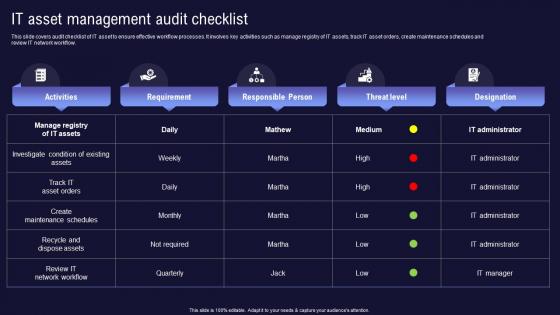
It Asset Management Audit Checklist Inventory And Asset Management




Try Before you Buy Download Free Sample Product
 Impress Your
 Audience
 100%
100% Editable
 Save Hours
 of Time


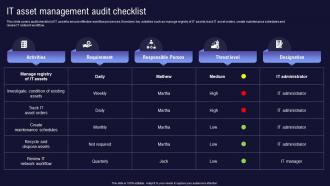
This slide covers audit checklist of IT asset to ensure effective workflow processes. It involves key activities such as manage registry of IT assets, track IT asset orders, create maintenance schedules and review IT network workflow.
People who downloaded this PowerPoint presentation also viewed the following :
It Asset Management Audit Checklist Inventory And Asset Management with all 9 slides:
Use our It Asset Management Audit Checklist Inventory And Asset Management to effectively help you save your valuable time. They are readymade to fit into any presentation structure.








FAQs for It Asset Management Audit Checklist Inventory
**INPUT**: What are the key components of an effective IT Asset Management (ITAM) strategy? **OUTPUT**: Key components include asset discovery and inventory, lifecycle management, compliance monitoring, cost optimization, and risk assessment frameworks. These strategic elements streamline operations by enhancing visibility across hardware and software assets, ensuring regulatory compliance, and minimizing unnecessary expenditures, with many organizations finding that comprehensive ITAM delivers significant cost reductions and operational efficiency.
Organizations ensure compliance through ITAM by implementing automated license tracking, conducting regular software audits, maintaining centralized asset inventories, and establishing approval workflows for software procurement. These systems streamline compliance monitoring by providing real-time visibility into license usage, identifying unauthorized installations, and generating compliance reports, ultimately reducing audit risks and costly penalties while enhancing operational efficiency.
Automation revolutionizes IT Asset Management by streamlining discovery, tracking, compliance monitoring, and lifecycle management processes. Through automated tools, organizations minimize manual errors, accelerate asset provisioning, and enhance visibility across their entire IT infrastructure, with many enterprises finding that automated workflows reduce operational costs while delivering faster service delivery and improved regulatory compliance.
Organizations leverage ITAM to optimize software costs by conducting comprehensive license audits, identifying unused applications, negotiating volume discounts, and eliminating duplicate functionalities across departments. Through centralized tracking and automated discovery tools, companies streamline procurement processes, reduce compliance risks, and reallocate resources more strategically, with many enterprises finding that proper ITAM delivers 15-30% cost reductions annually.
Common IT Asset Management implementation challenges include data accuracy issues, integration complexities with existing systems, employee resistance to new processes, budget constraints, and lack of executive support. Organizations often struggle with incomplete asset inventories, disparate data sources, and workflow disruptions, though successful implementations ultimately deliver improved compliance, cost optimization, and operational efficiency across IT operations.
IT Asset Management strengthens cybersecurity by maintaining comprehensive asset inventories, tracking software versions and vulnerabilities, and ensuring timely security updates across all systems. Through automated monitoring and lifecycle management, organizations can identify unauthorized devices, patch critical vulnerabilities faster, and maintain compliance standards, ultimately reducing security risks while enabling proactive threat prevention.
Key ITAM metrics include asset utilization rates, compliance scores, cost per asset, license optimization ratios, and inventory accuracy percentages. These measurements enable organizations to demonstrate ROI through reduced software spending, improved compliance postures, and enhanced operational efficiency, with many enterprises finding that comprehensive tracking delivers 15-30% cost savings while minimizing audit risks.
ITAM supports sustainable practices by optimizing hardware lifecycles, reducing energy consumption through efficient resource allocation, minimizing electronic waste, and enabling strategic retirement of underutilized assets. Through comprehensive asset tracking and performance monitoring, organizations streamline operations while reducing their environmental footprint, with many companies finding that effective ITAM delivers both cost savings and meaningful sustainability outcomes.
Organizations can integrate ITAM with existing ITSM tools through API connections, shared databases, automated workflows, and unified dashboards that synchronize asset data across platforms. This strategic combination enables IT teams to streamline incident management, change requests, and service delivery by providing real-time asset visibility, ultimately delivering faster problem resolution and enhanced operational efficiency.
Hardware asset management focuses on physical devices like servers, laptops, and network equipment, tracking their lifecycle from procurement through disposal, while software asset management monitors licenses, usage rights, and compliance requirements. These complementary approaches enable organizations to optimize costs, ensure regulatory compliance, and maintain operational efficiency, with many enterprises finding that integrated management delivers better visibility and strategic control over their entire technology infrastructure.
Effective ITAM enhances technology investment decisions by providing comprehensive asset visibility, utilization analytics, lifecycle tracking, and cost optimization insights across all IT resources. Through detailed performance data and usage patterns, organizations can identify underutilized assets, predict replacement needs, and allocate budgets strategically, ultimately enabling data-driven investments that maximize ROI and competitive advantage.
Accurate asset tracking requires implementing automated discovery tools, standardized naming conventions, regular audit cycles, centralized database management, and real-time monitoring systems. These practices enable organizations to maintain comprehensive visibility across their IT infrastructure, reduce compliance risks, and optimize resource allocation, with many enterprises finding that systematic tracking approaches ultimately deliver significant cost savings and operational efficiency gains.
Cloud computing and virtualization revolutionize traditional IT Asset Management by shifting focus from physical hardware tracking to software licensing, virtual resource allocation, and service-level monitoring. These technologies enable organizations to streamline asset visibility, automate compliance reporting, and optimize resource utilization across distributed environments, ultimately delivering enhanced operational efficiency and reduced infrastructure costs.
Emerging technologies transforming IT Asset Management include artificial intelligence for predictive analytics, blockchain for asset authenticity, IoT sensors for real-time monitoring, machine learning for optimization algorithms, and cloud-based platforms for centralized visibility. These technologies streamline asset tracking, enhance lifecycle management, and automate compliance reporting, with many organizations finding that integrated solutions deliver significant cost reductions and operational efficiency.
Training and awareness improve IT Asset Management effectiveness by ensuring employees understand asset policies, proper procurement procedures, and lifecycle responsibilities across departments. Through comprehensive education programs, organizations achieve better compliance, reduced shadow IT, and more accurate asset tracking, with many companies finding that well-trained staff significantly minimize unauthorized purchases and enhance overall asset visibility.
-
Amazing slides! Unique, attractive, and easy to understand.
-
Requested a complete pitch deck. Delivered immediately and with high quality well researched content.