


It Security Gap Analysis With Risk Level




Try Before you Buy Download Free Sample Product
 Impress Your
 Audience
 100%
100% Editable
 Save Hours
 of Time


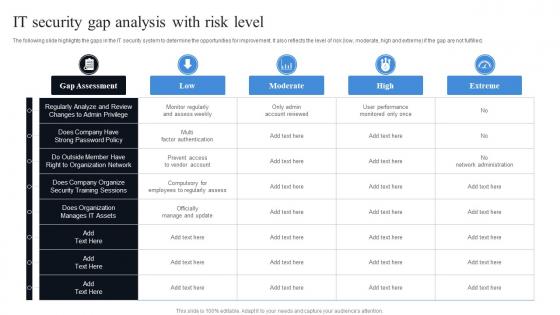
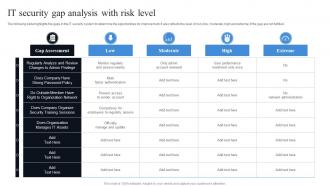
The following slide highlights the gaps in the IT security system to determine the opportunities for improvement. It also reflects the level of risk low, moderate, high and extreme if the gap are not fulfilled.
People who downloaded this PowerPoint presentation also viewed the following :
It Security Gap Analysis With Risk Level with all 6 slides:
Use our It Security Gap Analysis With Risk Level to effectively help you save your valuable time. They are readymade to fit into any presentation structure.





FAQs for It Security Gap Analysis
Honestly, just start with documenting what you've got right now - all your security stuff, policies, tools, whatever. Figure out where you actually need to be (compliance rules, industry benchmarks, your company's risk appetite). Gap analysis comes next, which sounds fancy but it's just "what are we missing?" Then - and this is key - don't try fixing everything at once. Rank those gaps by how much they'd hurt if something went wrong. I'd throw it all in a basic spreadsheet first. You can get all sophisticated with fancy tools later, but honestly? Start simple until you know what mess you're dealing with.
First thing - audit everything you've got right now. Map your network, document all the security tools and policies, check who has access to what. Oh, and don't forget those random SaaS apps people are probably using without telling IT! Once that's done, compare it against something like NIST or ISO 27001 to see how you stack up. Be honest about the gaps - sugarcoating won't help anyone. Then just prioritize fixes based on what'll hurt most if it breaks and what you can actually afford to tackle first.
Honestly, most places I've seen have the same issues over and over. Outdated software is huge - like probably 80% of vulnerabilities come from that and missing patches. Password policies are usually trash too. Firewalls get misconfigured all the time, and everyone has way more access than they need. Users love installing random apps behind IT's back, which drives me nuts. Then there's the basics - crappy backups, no encryption on sensitive stuff, zero security training for employees. My take? Hit the patch management and password stuff first. Those are easy fixes that'll cover your biggest risks right away.
So compliance actually gives you a roadmap instead of just wandering around looking for random security issues. You'll be measuring against real requirements - SOX, HIPAA, PCI-DSS, whatever fits your situation. Honestly makes the whole process less overwhelming since you're not guessing what matters most. Map your current controls against those compliance rules and you'll see the gaps pretty clearly. I'd start by figuring out which regulations actually apply to you first (some companies think they need everything when they don't), then structure your whole assessment around meeting those specific requirements.
Pick a framework first - NIST, ISO 27001, or CIS Controls work well depending on your industry. Nessus and Qualys are solid for vulnerability scans. OpenVAS too if budget's tight. Don't sleep on spreadsheets though, I know it sounds old school but they're still clutch for tracking everything. Rapid7 and ServiceNow can automate the compliance stuff which saves tons of time. You'll need to interview people and dig through existing policies anyway. Honestly the framework choice matters most - everything else builds from there. Start simple and add layers.
Honestly, most places I know do them every 6-12 months. Annual is kinda the bare minimum tbh. If you're constantly adding new tech or growing fast, maybe quarterly makes sense. Had a security incident recently? Definitely don't wait a whole year. The trick is breaking it into smaller chunks throughout the year instead of one giant review that takes forever. Nobody wants to deal with a massive annual project that just sits on a shelf afterward. Way better to do focused mini-reviews so you can actually fix stuff as you find it. Makes the whole process less painful too.
Look, training is huge for fixing security gaps. Most breaches happen because someone clicked a sketchy email or used "password123" - not because of fancy hacking. Your firewalls can be bulletproof, but if Janet from accounting falls for a phishing scam, you're toast. I've seen it happen way too often. Map out what training you need based on your specific gaps first. Then tackle the riskiest stuff. People are usually the weakest link, but they're also the most fixable with decent training.
So a gap analysis shows you exactly where your security is weakest and helps you prioritize what's actually dangerous vs just annoying. Think of it like triage for your budget - you don't want to waste money on random fixes when something critical could tank your whole operation. The analysis ranks everything by risk and cost, so you get a clear roadmap. Honestly, I'd start with high-risk stuff that's cheap to fix first. Those quick wins make you look good while buying time for the expensive problems. Way better than just buying whatever security tool has the flashiest marketing.
Honestly, skipping security gap analysis is like driving with your eyes closed. Hackers will spot your weak points way before you do - and trust me, that's when the real problems start. Data breaches, ransomware, compliance fines... all that expensive nightmare stuff. Your systems could already be compromised right now and you'd have no clue. Without these assessments, you can't figure out where to actually spend your security budget. You'll either waste money on useless stuff or leave huge holes wide open. I'd say run these checks quarterly at minimum.
Start by connecting your security gaps to what actually matters - business impact. Don't just list technical vulnerabilities. Think about what would really screw over the company: data breaches killing customer trust, downtime destroying revenue, compliance failures bringing fines. Talk to people from different departments first so you know what they're worried about. I've honestly seen way too many gap analyses that look like IT wish lists instead of real business docs. When you present findings, speak their language - dollars and risk, not technical jargon. Then build your roadmap around gaps that threaten your company's main goals.
Honestly, start with remediation velocity - basically how fast you're actually fixing the gaps you find. Risk reduction scores show if your security's getting better overall. Gap recurrence is huge too because having the same vulnerabilities keep showing up is just embarrassing. Coverage metrics tell you what percentage of your stuff you've even looked at yet. And don't sleep on stakeholder engagement - I've seen amazing analysis just sit there collecting dust because nobody upstairs cared. These'll give you a solid foundation, then you can get fancier with tracking later.
Honestly, the biggest thing is knowing your audience. Executives just want to see business impact and risk levels - they don't care about technical stuff. IT folks are the opposite. I always make those red/yellow/green dashboards because people love visuals. But here's what really works: tell them a story about what could go wrong instead of just listing vulnerabilities. Nobody remembers a boring list anyway. Hit them with your top 3-5 critical findings first, don't dump everything on them at once. And seriously, ditch the security jargon - you'll lose them in 30 seconds. Always include remediation timelines with actual costs attached.
Honestly, budget's gonna be your biggest headache - executives want those gap analysis reports until they see what it costs lol. People hate change too, so expect pushback when you're asking them to learn new processes. Plus there's always some "urgent" project that'll bump your security stuff down the priority list. Legacy systems make everything 10x harder, especially when you need to integrate multiple platforms. Start with the quick wins that don't cost much. Build some momentum there, then use those wins to get buy-in for the expensive stuff later.
So gap analysis used to be this once-a-year thing that'd get stale fast. Now with continuous monitoring, you're basically getting live updates on your security health. Pretty much like having a dashboard running 24/7 (minus the sleep deprivation for you). New vulnerabilities pop up? You'll know right away instead of finding out months later when hackers already had their fun. Set up automated scans and alerts so you don't go crazy checking manually. Honestly, I'd focus on your most critical stuff first - you can always expand from there.
Look, start with the scariest stuff first - like critical patches and wonky access controls. Those are your quick wins that actually matter. Don't try fixing everything at once though, that's how teams burn out and get nowhere. Make a timeline with real names attached to each problem, not just "the security team will handle it." Check in regularly so nothing falls through the cracks. I swear, half the battle is just staying on top of things instead of letting gaps pile up again. Write it all down too - you'll need proof later when auditors come knocking.
-
Editable, diversified, compatible with MS PPT and Google Slides, and on top of that finest graphics!! I mean in the words of the famous Ross Geller, “What more do you want!”
-
They guys always go the extra mile to meet the expectations of their customers. Almost a year has been associated with them.