


It Security Risk Management Action Plan




Try Before you Buy Download Free Sample Product
 Impress Your
 Audience
 100%
100% Editable
 Save Hours
 of Time


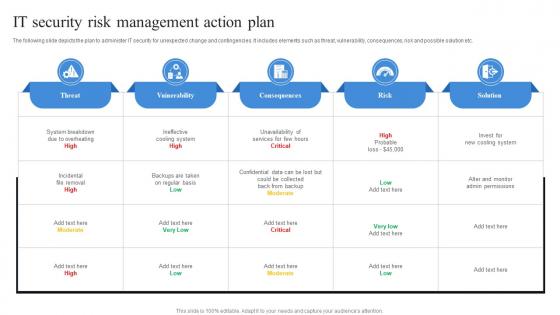
The following slide depicts the plan to administer IT security for unexpected change and contingencies. It includes elements such as threat, vulnerability, consequences, risk and possible solution etc.
People who downloaded this PowerPoint presentation also viewed the following :
It Security Risk Management Action Plan with all 6 slides:
Use our It Security Risk Management Action Plan to effectively help you save your valuable time. They are readymade to fit into any presentation structure.





FAQs for It Security Risk
Effective IT security risk management plans include asset inventory, threat assessment, vulnerability analysis, risk evaluation, and incident response protocols. These components work together by identifying critical systems, evaluating potential threats, implementing protective controls, and establishing recovery procedures, with many organizations finding that this comprehensive approach significantly reduces security breaches while enhancing operational resilience.
Organizations identify critical IT security vulnerabilities through comprehensive vulnerability scanning, penetration testing, risk assessments, threat modeling, and continuous monitoring systems. These approaches enable security teams to prioritize risks by analyzing potential business impact, exploit likelihood, and asset criticality, with many enterprises finding that automated scanning combined with expert analysis delivers faster threat detection and more strategic resource allocation.
Employee training serves as a critical defense mechanism against IT security risks by educating staff on phishing recognition, password management, social engineering tactics, and proper data handling procedures. Through comprehensive cybersecurity awareness programs, organizations significantly reduce human error incidents, enhance incident response capabilities, and strengthen their overall security posture, with many companies finding that well-trained employees become their most effective first line of defense.
Organizations should conduct comprehensive IT security risk assessments annually, with quarterly reviews for critical systems and monthly assessments for high-risk environments like financial services or healthcare. This strategic approach enables companies to identify emerging threats, evaluate new vulnerabilities, and adapt security controls proactively, ultimately delivering stronger protection and regulatory compliance in an increasingly complex digital landscape.
**INPUT**: What methods can be employed to prioritize IT security risks? **OUTPUT**: Risk prioritization methods include threat modeling, vulnerability assessments, business impact analysis, likelihood scoring matrices, and asset valuation frameworks. These approaches enable organizations to systematically evaluate potential threats by analyzing severity, probability, and business consequences, with many enterprises finding that strategic risk ranking ultimately delivers optimized resource allocation and enhanced security posture. [Word count: 54]
Emerging technologies significantly transform IT security risk management by introducing both advanced protective capabilities and new vulnerability surfaces that require adaptive strategies. While AI enhances threat detection and automated response systems, technologies like IoT and cloud computing expand attack vectors, with many organizations finding that successful risk management now demands continuous strategy evolution and real-time threat intelligence integration.
Common pitfalls include inadequate stakeholder buy-in, insufficient resource allocation, overly complex processes, poor communication across departments, and lack of regular framework updates. Organizations often struggle with balancing comprehensive security measures with operational efficiency, with many finding that successful implementation requires continuous training, clear governance structures, and regular assessment cycles to maintain effectiveness.
Compliance requirements like GDPR and HIPAA significantly influence IT security risk management by mandating specific data protection controls, regular vulnerability assessments, incident response procedures, and comprehensive audit trails. These frameworks drive organizations to implement strategic security measures that not only ensure regulatory adherence but also enhance overall cybersecurity posture, with many finding that compliance-driven security investments ultimately deliver stronger customer trust and competitive advantage.
Key metrics for evaluating IT security risk management effectiveness include mean time to detection and response, number of security incidents, vulnerability remediation rates, compliance audit scores, and security awareness training completion rates. These metrics enable organizations to assess their security posture comprehensively, with many financial services and healthcare institutions finding that tracking these indicators helps minimize breach costs, enhance regulatory compliance, and ultimately deliver stronger operational resilience and customer trust.
Organizations effectively communicate IT security risks through clear business impact assessments, regular executive briefings, visual dashboards, and tailored reporting for different stakeholder levels. By translating technical vulnerabilities into financial implications, compliance risks, and operational disruptions, companies enable informed decision-making across departments, ultimately strengthening security posture and stakeholder buy-in.
Best practices for integrating third-party vendors include conducting comprehensive security assessments, establishing clear contractual security requirements, implementing continuous monitoring protocols, and maintaining detailed vendor risk inventories. These approaches streamline risk oversight by standardizing evaluation criteria, automating compliance tracking, and ensuring ongoing security validation, with many organizations finding that structured vendor integration ultimately delivers enhanced operational security and reduced exposure across their extended business ecosystem.
Incident response planning serves as a critical operational component of IT security risk management by providing structured protocols for threat detection, containment, and recovery processes. This strategic integration enables organizations to minimize business disruption, reduce financial losses, and maintain regulatory compliance during security events, while continuously improving their overall risk posture through lessons learned and enhanced defensive capabilities.
Continuous monitoring enables organizations to detect threats in real-time, assess vulnerabilities continuously, and respond to security incidents before they escalate into major breaches. Through automated scanning tools and threat intelligence platforms, businesses in banking, healthcare, and retail can identify suspicious activities, track compliance deviations, and maintain security posture visibility, ultimately reducing response times and minimizing potential damage costs.
Organizations can leverage automation to enhance IT security risk management through continuous monitoring systems, automated threat detection algorithms, real-time vulnerability assessments, compliance reporting tools, and incident response orchestration. These technologies streamline security operations by reducing manual oversight, accelerating threat identification, and enabling faster remediation responses, with many financial institutions and healthcare organizations finding that automated frameworks ultimately deliver improved security postures and operational efficiency.
Remote work significantly expands attack surfaces, increases endpoint vulnerabilities, complicates network monitoring, and challenges traditional perimeter-based security models. Organizations are adapting by implementing zero-trust architectures, enhanced endpoint detection systems, and cloud-based security platforms, with many companies finding that distributed security frameworks ultimately deliver greater resilience and flexibility.
-
I was mind-blown by the services that SlideTeam provided me. Thanks a ton!
-
Stunning collection! With a wide variety of options available, I was able to find a perfect slide for my presentation. Thank you, SlideTeam!