


Iterative Change Management Powerpoint Presentation Slides CM CD V




Try Before you Buy Download Free Sample Product
 Impress Your
 Audience
 100%
100% Editable
 Save Hours
 of Time


Our Iterative Change Management Powerpoint Presentation Slides CM CD V are topically designed to provide an attractive backdrop to any subject. Use them to look like a presentation pro.
People who downloaded this PowerPoint presentation also viewed the following :
Content of this Powerpoint Presentation
Slide 1: This slide introduces Iterative Change Management. State your company name and begin.
Slide 2: This is an Agenda slide. State your agendas here.
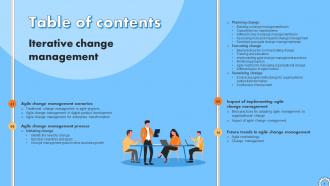
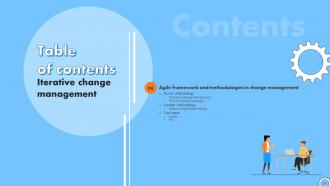
Slide 3: This slide shows Table of Content for the presentation.
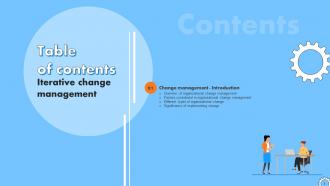
Slide 4: This slide continues showing Table of Content for the presentation.
Slide 5: This slide shows title for topics that are to be covered next in the template.
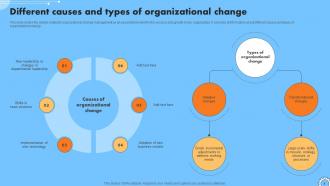
Slide 6: This slide defines organizational change management as an essential element for the success and growth of any organization.
Slide 7: This slide also defines organizational change management as an essential element for the success and growth of any organization.
Slide 8: This slide covers the details related to organizational change management as an essential element for the success and growth of any organization.
Slide 9: This slide defines why organizational change management is important. It consists of details related to organizational change management.
Slide 10: This slide shows title for topics that are to be covered next in the template.
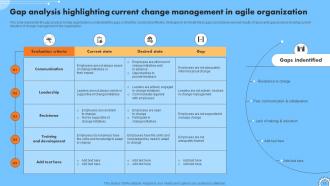
Slide 11: This slide represents the gap analysis to help organizations understand the gaps so that they could build effective strategies to eliminate these gaps.
Slide 12: This slide covers details related to different challenges in agile implementation.
Slide 13: This slide shows title for topics that are to be covered next in the template.
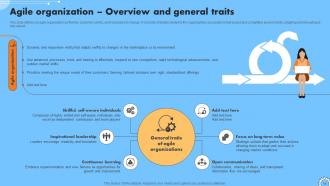
Slide 14: This slide defines an agile organization as flexible, customer-centric, and responsive to change.
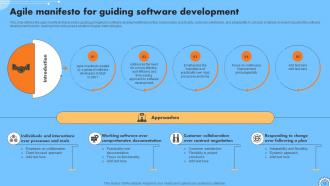
Slide 15: This slide also defines the agile manifesto that provides guiding principles for software development that prioritize collaboration, practicality etc.
Slide 16: This slide displays the four values of the Agile Manifesto and provides a foundational framework for guiding software development practices toward greater efficiency etc.
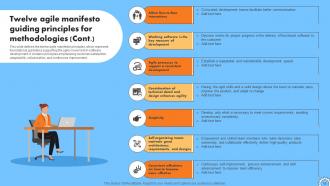
Slide 17: This slide presents the twelve agile manifesto principles, which represent foundational guidelines supporting the agile movement in software development.
Slide 18: This slide defines the twelve agile manifesto principles, which represent foundational guidelines supporting the agile movement in software development.
Slide 19: This slide provides an overview of agile project management and its core components, emphasizing the iterative and collaborative nature of the approach.
Slide 20: This slide defines an overview of agile project management and its core components, emphasizing the iterative and collaborative nature of the approach.
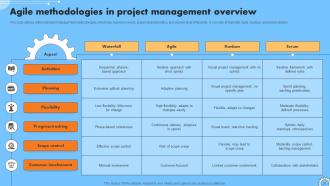
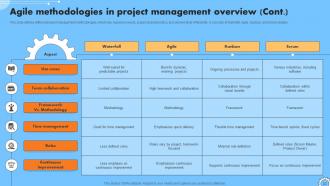
Slide 21: This slide presents a different project management methodologies, which vary based on needs, project characteristics, and desired level of flexibility.
Slide 22: This slide defines different project management methodologies, which vary based on needs, project characteristics, and desired level of flexibility.
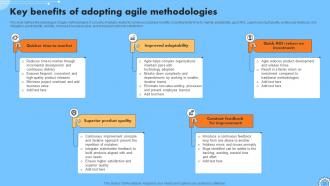
Slide 23: This slide displays the advantages of agile methodologies. It consists of details related to numerous business benefits, including faster time-to-market, adaptability etc.
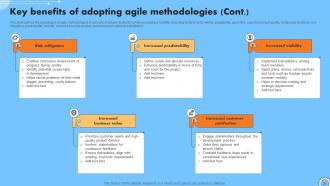
Slide 24: This slide presents the advantages of agile methodologies. It consists of details related to numerous business benefits, including faster time-to-market, adaptability etc.
Slide 25: This slide covers details related to a case study on a company implementing changes in its IT (Information technology) department.
Slide 26: This slide shows title for topics that are to be covered next in the template.
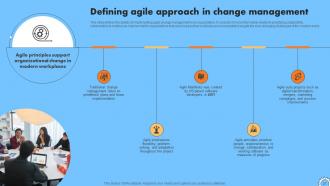
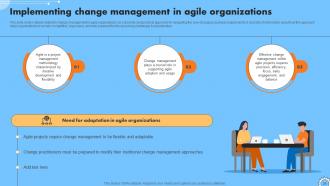
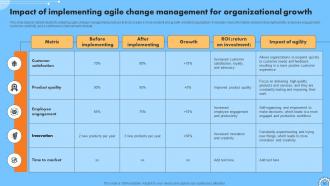
Slide 27: This slide defines the details of implementing agile change management in an organization. It consists of more information related to prioritizing adaptability etc.
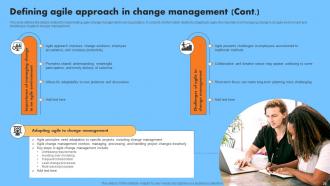
Slide 28: This slide presents the details related to implementing agile change management in an organization.
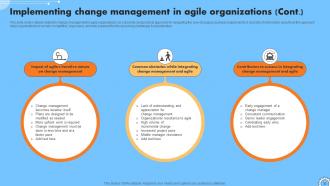
Slide 29: This slide covers details related to change management in agile organizations as a dynamic and practical approach for navigating the ever-changing business requirements.
Slide 30: This slide displays details related to change management in agile organizations as a dynamic and practical approach for navigating the ever-changing business requirements.
Slide 31: This slide covers details related to change management in agile organizations as a dynamic and practical approach for navigating the ever-changing business requirements.
Slide 32: This slide presents details related to integrating change management and agile.
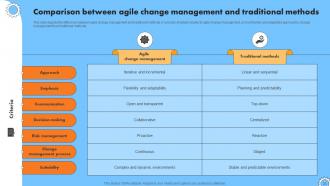
Slide 33: This slide depicts the difference between agile change management and traditional methods. It consists of details related to agile change management etc.
Slide 34: This slide shows title for topics that are to be covered next in the template.
Slide 35: This slide defines that agile change management promotes an organization-wide mindset of adaptability, customer-centricity, and collaboration.
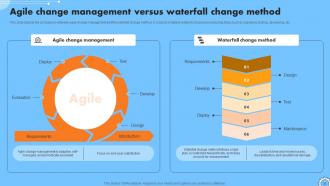
Slide 36: This slide presents the comparison between agile change management and the waterfall change method.
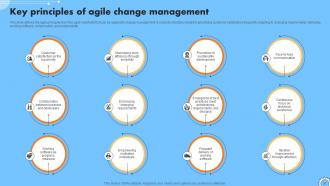
Slide 37: This slide defines the agile principles from the agile manifesto that can be applied to change management.
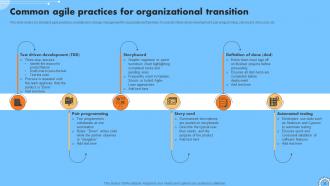
Slide 38: This slide covers six standard agile practices considered in change management for organizational transition.
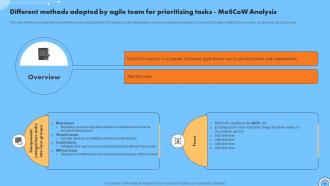
Slide 39: This slide defines how agile teams prioritize their work using techniques like MoSCoW and Kano analysis to categorize tasks based on importance and customer preferences.
Slide 40: This slide presents how agile teams prioritize their work using the MoSCoW analysis to prioritize features based on necessity and values.
Slide 41: This slide defines how agile teams prioritize their work using the Kano analysis focusing on customer preferences, categorizing features as delighters, satisfiers etc.
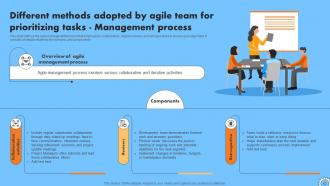
Slide 42: This slide presents the agile management process that emphasizes collaboration, regular reviews, and retrospectives to ensure goal alignment.
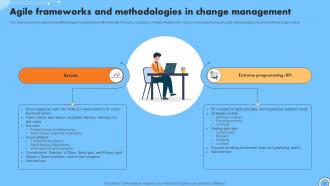
Slide 43: This slide covers information about different agile frameworks that offer flexibility for teams.
Slide 44: This slide displays information about different agile frameworks that offer flexibility for teams.
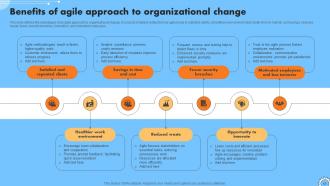
Slide 45: This slide presents the advantages of an agile approach to organizational change. It consists of details related to how agile leads to satisfied clients etc.
Slide 46: This slide defines the disadvantages of agile approaches. It highlights potential challenges such as organizational confusion, documentation concerns etc.
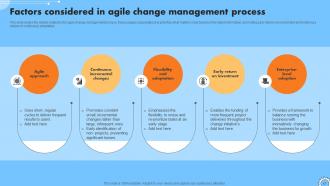
Slide 47: This slide covers the details related to the agile change management process. It encourages organizations to prioritize what matters most based on the latest information etc.
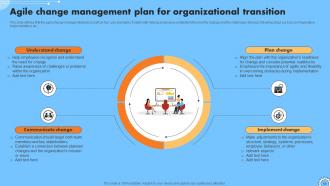
Slide 48: This slide defines that the agile change management plan is built on four core principles.
Slide 49: This slide presents the challenges of implementing agile change management in an organization.
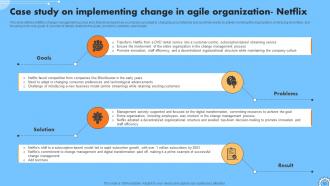
Slide 50: This slide defines Netflix's change management success story that showcases how a company can adapt to changing circumstances and customer needs.
Slide 51: This slide shows title for topics that are to be covered next in the template.
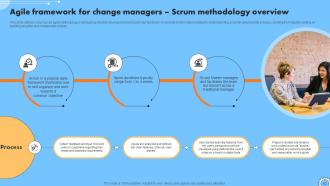
Slide 52: This slide defines scrum as an agile methodology emphasizing iterative development and customer feedback.
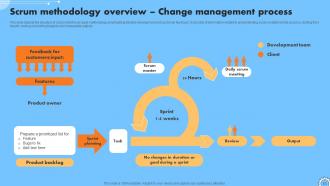
Slide 53: This slide depicts the structure of scrum which is an agile methodology emphasizing iterative development and customer feedback.
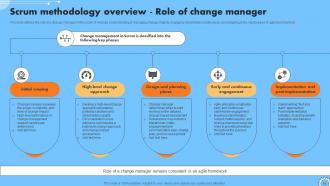
Slide 54: This slide presents the role of a change manager in the scrum. It involves understanding & managing change impacts, engaging stakeholders continuously etc.
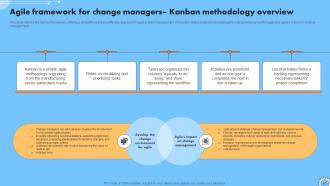
Slide 55: This slide defines the kanban framework, offering a straightforward and effective approach to agile project management.
Slide 56: This slide presents the kanban framework, offering a straightforward and effective approach to agile project management.
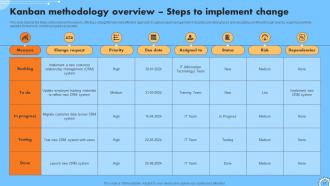
Slide 57: This slide depicts the steps in the kanban framework, offering a straightforward and effective approach to agile project management.
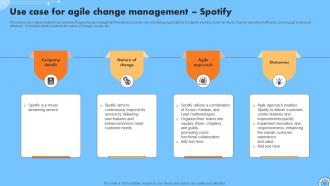
Slide 58: This slide covers details related to an example of agile change management that played a pivotal role in enabling organizations to adapt to evolving customer needs etc.
Slide 59: This slide showcases details related to a case study on agile change management that played a pivotal role in enabling organizations to adapt to evolving customer needs.
Slide 60: This slide shows title for topics that are to be covered next in the template.
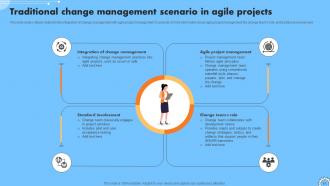
Slide 61: This slide covers details related to the integration of change management with agile project management.
Slide 62: This slide displays details related to the integration of change management with agile project management.
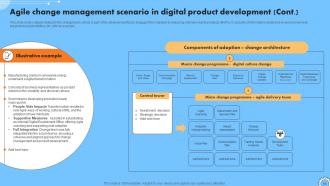
Slide 63: This slide covers details related to the change team, which is part of the development team, engaged from ideation to releasing minimum viable products (MVPs).
Slide 64: This slide presents details related to the change team, which is part of the development team, engaged from ideation to releasing minimum viable products (MVPs).
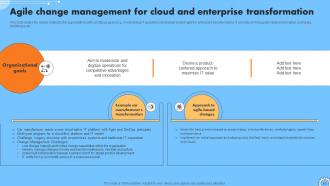
Slide 65: This slide covers the details related to the organizations with ambitious goals (e.g., modernizing IT operations) that adopt scaled Agile for enterprise transformations.
Slide 66: This slide shows title for topics that are to be covered next in the template.
Slide 67: This slide defines the constantly changing world and evolving consumer expectations necessitate organizations to adapt to remain competitive.
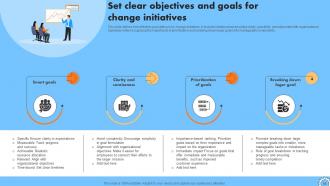
Slide 68: This slide presents how effective goal setting is for change initiatives. It includes details about ensuring clarity, specificity, and alignment with organizational objectives.
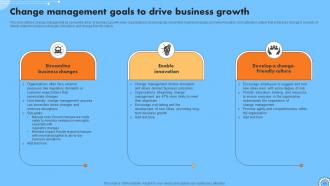
Slide 69: This slide defines change management as a powerful driver of business growth when organizations set clear goals, streamline required changes, promote innovation etc.
Slide 70: This slide shows title for topics that are to be covered next in the template.
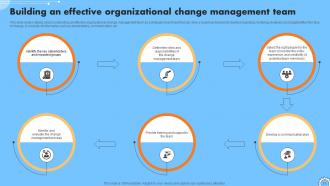
Slide 71: This slide covers details about constructing an effective organizational change management team as a strategic investment.
Slide 72: This slide displays details about Identifying the key stakeholders for the organizational change management team.
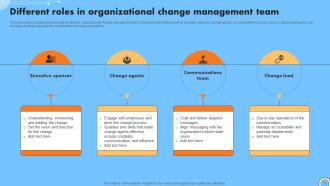
Slide 73: This slide covers creating and nurturing an effective organizational change management team. It includes information about an executive sponsor, change agents etc.
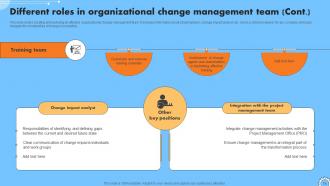
Slide 74: This slide presents creating and nurturing an effective organizational change management team. It includes information about a training team, change impact analyst, etc.
Slide 75: This slide defines that effective change management is crucial for organizations to adapt to evolving circumstances, foster innovation etc.
Slide 76: This slide presents that creating an agile change management plan is essential for organizations looking to succeed in a rapidly changing world.
Slide 77: This slide shows title for topics that are to be covered next in the template.
Slide 78: This slide defines how effectively communicating change to different stakeholders is critical for the success of any organizational change initiative.
Slide 79: This slide presents how agile change management training and education are integral to unlocking the full potential of change.
Slide 80: This slide defines the rapidly changing business environment and best practices for adopting agile change management.
Slide 81: This slide covers details related to monitoring the progress of agile change management practices.
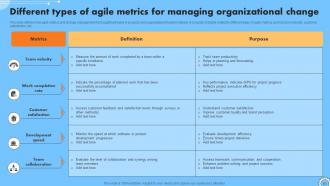
Slide 82: This slide defines how agile metrics and change management hold significant value in projects and organizational transformations.
Slide 83: This slide presents how agile metrics and change management hold significant value in projects and organizational transformations.
Slide 84: This slide shows title for topics that are to be covered next in the template.
Slide 85: This slide defines the approaches to incorporate agile into the organization's culture. It consists of details related to customer value, continuous learning etc.
Slide 86: This slide presents continuous improvement as a dynamic and ongoing process that organizations can leverage to gain a competitive edge.
Slide 87: This slide defines the examples of continuous improvement in action. It consists of details related to fostering a culture of innovation.
Slide 88: This slide shows title for topics that are to be covered next in the template.
Slide 89: This slide defines the best practices to provide a structured and adaptable framework for organizations looking to implement agile management principles.
Slide 90: This slide presents details related to adopting agile change management practices that can create a more resilient and growth-oriented organization.
Slide 91: This slide shows title for topics that are to be covered next in the template.
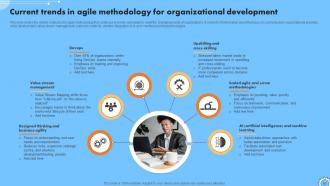
Slide 92: This slide displays the details related to the agile methodology that continues to evolve and adapt to meet the changing needs of organizations.
Slide 93: This slide covers the details related to the need for organizations to embrace change, leverage technology, and create a culture that encourages adaptation.
Slide 94: This slide also covers the details related to the need for organizations to embrace change, leverage technology, and create a culture that encourages adaptation.
Slide 95: This slide shows all the icons included in the presentation.
Slide 96: This slide is titled as Additional Slides for moving forward.
Slide 97: This slide contains Puzzle with related icons and text.
Slide 98: This slide presents Roadmap with additional textboxes. It can be used to present different series of events.
Slide 99: This is Our Target slide. State your targets here.
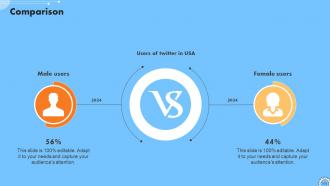
Slide 100: This is a Comparison slide with additional textboxes and related imagery.
Slide 101: This slide shows Post It Notes for reminders and deadlines. Post your important notes here.
Slide 102: This is a Thank You slide with address, contact numbers and email address.
Iterative Change Management Powerpoint Presentation Slides CM CD V with all 110 slides:
Use our Iterative Change Management Powerpoint Presentation Slides CM CD V to effectively help you save your valuable time. They are readymade to fit into any presentation structure.
















































FAQs for Iterative Change Management Powerpoint Presentation Slides
Iterative change management emphasizes continuous adaptation, rapid feedback cycles, incremental implementation, stakeholder collaboration, and flexible planning, contrasting with traditional linear approaches. This methodology enables organizations to adjust strategies in real-time based on employee responses and market conditions, with many companies in technology, healthcare, and retail finding that iterative approaches reduce resistance, accelerate adoption, and ultimately deliver more sustainable transformation outcomes.
Organizations can effectively measure iteration success through key performance indicators, stakeholder feedback surveys, milestone achievement tracking, and real-time analytics dashboards. These measurement approaches enable leaders to assess adoption rates, identify resistance patterns, and quantify operational improvements, with many companies finding that continuous monitoring across departments delivers faster course corrections and ultimately enhances overall transformation outcomes.
Stakeholder engagement evolves from initial awareness and buy-in to deeper collaboration, feedback integration, and ownership throughout iterative cycles. Early iterations focus on communication and resistance management, while later phases emphasize co-creation and refinement, with stakeholders increasingly becoming change advocates rather than recipients, ultimately delivering sustained adoption and organizational transformation.
Feedback serves as the primary mechanism for identifying gaps, measuring adoption rates, and uncovering resistance patterns within each iterative cycle. Through continuous feedback loops from employees, stakeholders, and performance metrics, organizations can adjust communication strategies, modify training approaches, and realign resources, ultimately accelerating change acceptance and minimizing implementation risks across departments.
Technology facilitates iterative change management through real-time analytics platforms, automated feedback systems, cloud-based collaboration tools, and AI-powered predictive modeling. These solutions streamline data collection from multiple touchpoints, enable continuous performance monitoring, and deliver actionable insights faster, with many organizations finding that automated analysis accelerates decision-making cycles and enhances strategic agility.
Organizations implementing iterative change management often face resistance to frequent adjustments, resource allocation difficulties, and communication complexity across multiple change cycles. These challenges can be overcome by establishing clear feedback loops, training teams on adaptive methodologies, and maintaining transparent communication channels, with many companies finding that phased implementation and dedicated change champions ultimately deliver smoother transitions and higher employee engagement.
A culture of continuous improvement naturally aligns with iterative change management by encouraging regular feedback cycles, experimentation, and adaptive learning throughout organizational transformations. This cultural foundation enables teams to embrace incremental adjustments, learn from implementation challenges, and refine processes systematically, with many organizations finding that employees become more receptive to change when improvement becomes an ongoing expectation rather than disruptive events.
Leaders can ensure team alignment through regular cross-functional meetings, standardized communication protocols, shared digital dashboards, and iterative feedback loops that maintain visibility into progress and challenges. These techniques work by establishing consistent touchpoints, creating transparent progress tracking, and enabling real-time adjustments, with many organizations finding that structured communication rhythms ultimately deliver stronger coordination and faster adaptation across multiple teams.
Organizations balance speed with thoroughness by implementing phased validation checkpoints, rapid prototyping cycles, and cross-functional feedback loops throughout iterative processes. This strategic approach enables companies to maintain quality standards while accelerating deployment timelines, with many enterprises finding that structured iteration cycles ultimately deliver faster, more sustainable outcomes than traditional linear approaches.
Common pitfalls include insufficient stakeholder buy-in, lack of clear communication protocols, resistance to feedback loops, inadequate training on iterative methodologies, and attempting to rush implementation timelines. Organizations often struggle with cultural shifts from traditional linear approaches, with many finding that successful transitions require dedicated change champions, regular pulse surveys, and phased rollouts across departments to build momentum and address resistance systematically.
Communication strategies in iterative change management require frequent, transparent updates, multi-directional feedback loops, and flexible messaging that evolves with each iteration cycle. Organizations must establish continuous dialogue channels, real-time progress sharing, and adaptive storytelling approaches, with many companies finding that regular pulse surveys and cross-functional communication hubs ultimately enhance stakeholder engagement and change adoption rates.
Organizations should track employee adoption rates, performance indicators aligned with change objectives, feedback scores, resistance levels, and milestone completion times for each iteration. These metrics enable leaders to assess progress in real-time, identify bottlenecks early, and adjust strategies accordingly, with many companies finding that regular measurement cycles ultimately deliver faster implementation and higher success rates.
Leaders cultivate resilience in iterative change teams by establishing clear communication channels, celebrating incremental progress, providing continuous learning opportunities, and maintaining transparent feedback loops throughout each iteration cycle. Through regular check-ins and adaptive planning sessions, organizations enable teams to view setbacks as learning opportunities rather than failures, ultimately building stronger change capacity and competitive advantage in dynamic business environments.
Training serves as the foundation for successful iterative change management, equipping teams with adaptive thinking skills, continuous feedback techniques, agile methodologies, and rapid adjustment capabilities. Through comprehensive learning programs, organizations enhance team resilience, streamline transition processes, and accelerate adoption cycles, with many companies finding that well-trained teams navigate iterative changes more effectively, ultimately delivering faster implementations and sustained competitive advantage.
Organizations can document lessons learned through structured post-iteration reviews, change impact assessments, knowledge repositories, and stakeholder feedback sessions. These insights enable enhanced change strategies, refined communication approaches, and improved resource allocation, with many companies finding that systematic documentation accelerates future implementations while reducing resistance and costs.
-
I am a big fan of their newsletters because that is how I found my perfect requirement at the time of urgency. Thank God, I kept opening those.
-
Innovative and creative templates with high-quality designs. Helped me with my presentation as the slides were easy to edit.