


Smart Manufacturing Roadmap For It Implementation In The Manufacturing




Try Before you Buy Download Free Sample Product
 Impress Your
 Audience
 100%
100% Editable
 Save Hours
 of Time


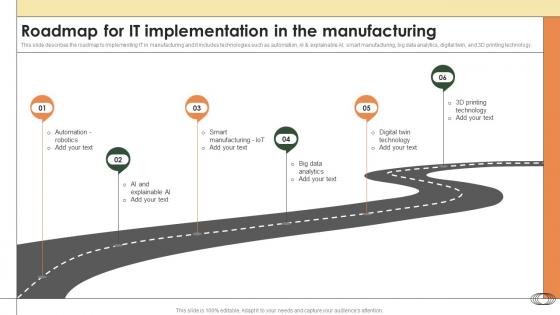
This slide describes the roadmap to implementing IT in manufacturing and it includes technologies such as automation, AI and explainable AI, smart manufacturing, big data analytics, digital twin, and 3D printing technology.
People who downloaded this PowerPoint presentation also viewed the following :
Smart Manufacturing Roadmap For It Implementation In The Manufacturing with all 6 slides:
Use our Smart Manufacturing Roadmap For It Implementation In The Manufacturing to effectively help you save your valuable time. They are readymade to fit into any presentation structure.
-
Smart Manufacturing Roadmap For It Implementation In The Manufacturing
-

Smart Manufacturing Roadmap For It Implementation In The Manufacturing
-

Smart Manufacturing Roadmap For It Implementation In The Manufacturing
-

Smart Manufacturing Roadmap For It Implementation In The Manufacturing
-

Smart Manufacturing Roadmap For It Implementation In The Manufacturing
-

Smart Manufacturing Roadmap For It Implementation In The Manufacturing
FAQs for Smart Manufacturing Roadmap For It Implementation
Key components include IoT sensors and connectivity, data analytics platforms, automation systems, cybersecurity frameworks, and workforce training programs. These technologies streamline operations by enabling real-time monitoring, predictive maintenance, and adaptive production processes, with many manufacturers finding that strategic integration ultimately delivers reduced downtime, improved quality control, and enhanced operational efficiency.
IoT technology enhances operational efficiency in smart manufacturing by enabling real-time monitoring, predictive maintenance, and automated quality control across production lines. Through connected sensors and devices, manufacturers streamline equipment performance, minimize unexpected downtime, and optimize resource allocation, with automotive and electronics companies finding that IoT integration ultimately delivers faster production cycles and significantly reduced operational costs.
Data analytics serves as the foundation for intelligent decision-making in smart manufacturing by transforming raw production data into actionable insights through predictive modeling, real-time monitoring, quality control analysis, and performance optimization algorithms. These analytics enable manufacturers to anticipate equipment failures, optimize supply chains, reduce waste, and enhance product quality, with automotive and electronics companies finding that data-driven decisions ultimately deliver faster response times and significant competitive advantages.
Manufacturers face integration complexities with legacy systems, substantial upfront technology investments, workforce retraining requirements, cybersecurity vulnerabilities, and data management challenges when transitioning to smart manufacturing. While these obstacles present initial hurdles, companies across automotive, electronics, and pharmaceutical sectors find that strategic phased implementations ultimately deliver enhanced operational efficiency, reduced downtime, and significant competitive advantages.
Cybersecurity integration in smart manufacturing involves implementing network segmentation, real-time monitoring systems, encrypted data transmission, multi-factor authentication, and regular security audits across connected devices and production systems. These measures enable manufacturers to protect intellectual property, maintain operational continuity, and ensure data integrity, while delivering enhanced productivity and competitive advantage in increasingly connected industrial environments.
AI in smart manufacturing delivers predictive maintenance, quality control automation, supply chain optimization, energy efficiency improvements, and real-time production adjustments. These technologies streamline operations by reducing downtime, minimizing defects, and accelerating decision-making, with many manufacturers finding that AI integration ultimately enhances competitive advantage while significantly lowering operational costs.
Smart manufacturing revolutionizes supply chain management by enabling real-time visibility, predictive analytics, automated inventory management, and seamless integration across suppliers and distributors. Through IoT sensors and AI-driven platforms, manufacturers streamline demand forecasting, minimize stockouts, and accelerate order fulfillment, with automotive and electronics companies finding significantly improved operational efficiency and reduced logistics costs.
SMEs can adopt smart manufacturing through phased automation, cloud-based IoT platforms, collaborative robotics, data analytics integration, and strategic partnerships with technology providers. These approaches enable smaller manufacturers to streamline production processes, reduce operational costs, and enhance quality control without massive capital investments, with many finding that gradual implementation delivers competitive advantages while maintaining financial flexibility.
Employee training and workforce development are fundamental to smart manufacturing success, enabling seamless technology adoption, enhanced operational efficiency, and reduced implementation resistance. Through comprehensive upskilling programs, manufacturing organizations cultivate digitally proficient teams capable of managing IoT systems, analyzing real-time data, and optimizing automated processes, ultimately delivering improved productivity and competitive advantage in increasingly complex industrial environments.
Manufacturers should track operational efficiency metrics, quality indicators, cost reduction measures, equipment utilization rates, and predictive maintenance effectiveness to measure smart manufacturing success. Through real-time monitoring systems, companies in automotive, electronics, and pharmaceuticals streamline production workflows, minimize downtime, and enhance product quality, ultimately delivering improved profitability and competitive advantage.
Regulatory factors significantly influence smart manufacturing adoption by establishing compliance requirements, data security standards, and operational protocols that guide technology implementation. Industries like pharmaceuticals, automotive, and food production find that regulatory frameworks create both challenges and opportunities, with many organizations discovering that smart technologies actually enhance compliance monitoring, streamline auditing processes, and deliver improved traceability, ultimately providing competitive advantage in regulated markets.
Sustainability drives smart manufacturing through energy optimization, waste reduction, predictive maintenance, and resource efficiency monitoring systems. These technologies enable manufacturers to minimize environmental impact while reducing operational costs, with automotive and electronics companies finding that sustainable smart practices deliver both regulatory compliance and competitive advantage in increasingly environmentally conscious markets.
Manufacturers can ensure interoperability by adopting standardized communication protocols, implementing unified data platforms, conducting thorough compatibility testing, and establishing clear integration frameworks from the outset. Through strategic technology partnerships and middleware solutions, companies streamline operations across diverse systems, ultimately reducing operational costs and enhancing production efficiency in increasingly automated manufacturing environments.
Smart manufacturing investments typically involve substantial upfront costs for IoT sensors, automation systems, data analytics platforms, and workforce training, but deliver significant long-term returns through reduced operational expenses, minimized waste, and enhanced productivity. These technologies streamline production processes, optimize resource allocation, and enable predictive maintenance, with many manufacturers finding that reduced downtime and improved efficiency generate ROI within 2-3 years.
Industry 4.0 drives smart manufacturing innovation by integrating IoT sensors, artificial intelligence, and advanced analytics into production processes, enabling real-time monitoring and predictive maintenance. Manufacturing companies leverage these technologies to optimize equipment performance, reduce downtime, and enhance product quality, with automotive and electronics manufacturers finding that data-driven insights deliver significant operational efficiency and competitive advantage.
-
Informative presentations that are easily editable.
-
I downloaded some of the presentations for work. They were simple to modify and saved me a lot of time and effort.